CEV Orion, 606 update

I know theres like luanch scenarios and landing scenarios, but will there be a ascent scenario? or a re-entry scenarios? Also when you landed on the moon, well when it comes closer to the planning of the LM why dont you do all the expirements there going to take, and you can build your own base on the moon.
Thanks.
Ryan.
 
Nope, same propellant, PBAN. The increase in burn time and thrust comes from the addition of the 5th segment.

Alot of the Ares 1 data comes from hypothetical data analysis of the proposed Five Segment Booster(FSB) upgrade for the Space Shuttle.

One of the claimed benefits of the FSB upgrade was an ATO capability even if they had a single engine failure right at lift-off, but I don't know how true this claim is.

The last information I had on the five segment SRBs was, that they are using HTPB-based fuel, instead of PBAN. But the burn duration should be longer anyway, as the internal pressure would reduce the burn rate.

You can actually reconstruct the approximate fuel composition of the SRBs by the thrust to time plots - the thrust profile for a constant fuel mixture would be a slowly decreasing thrust until it runs out of fuel. Anytime the thrust profile differs from this profile, the fuel mixture changed.

Most pages I can find now say that PBAN is selected, so I must be wrong... :sorry:

BTW, if you want a good laugh: http://www.gaetanomarano.it/articles/011srb5.html
 
I am Trying out the Orion 606, everything looks good to me, One Issue.
The Orion Still tilts to far to the left, now if was real, the Crew would be dead. I am on Retrograde and it, as soon as It hits the Atmosphere, tilts to an angle it shouldnt, at around 78 km.
 
I am Trying out the Orion 606, everything looks good to me, One Issue.
The Orion Still tilts to far to the left, now if was real, the Crew would be dead. I am on Retrograde and it, as soon as It hits the Atmosphere, tilts to an angle it shouldnt, at around 78 km.


Ever thought, that the tilting to the left could be intentional and that your tilting to the left is actually caused by intended aerodynamics and that you maybe should not just use retrograde autopilot?

Is the term "lifting reentry" or "gliding reentry" saying something to you?

Also the crew would very likely not be dead because of it. But when returning from the moon, it would be a good idea to know how to use lift for staying at the right altitude during reentry...
 
Well, why dosent it happen on AMSO Then?

It happens - but you don't notice it as AMSO has a different lift function. I just made some reentries. The capsule does not yaw, it pitches down. And it pitches down until it is stable at about -27°. That is the preset AOA, which the capsule uses during reentry. the RCS of the capsule is only used for keeping AOA and sideslip errors neutralized and banking the capsule for orienting the lift vector.

When you fly heads down and without touching the controls, you fly with maximum positive lift (acceleration is away from earth). heads up means full negative lift.

The thrusters of the capsule are a bit weak or the roll drag seems to be too high. It is really hard to turn the capsule around for aiming for a special landing site using reentry MFD. stopping the rotation is pretty easy so I assume it is more drag than thrust. 10° per second should get achieved for fine targeting a landing site.

EDIT: If the COG of the capsule is placed correctly relative to airfoil definition and thrusters, the roll thrusters should also not produce any other rotation, only tiny translations.
 
Quick comments:

As far I remember (need to check) PBAN seems to be current baseline, at least for eventual ISS missions. Burn time should be ~126s to ~129s or so. Later on, for Exploration missions, there are some 'talks' about upgrading specific SRB design aspects (nozzle design, grain type + geometry, etc) and perhaps also operational assumptions in order to gain extra performance and in order to keep more commonality with SRB used in eventual future AresV, if ever built.

Franz, related with AresI data available on 113007.ISTIM.pdf: if you look closer it seems that someone messed up conversion to SI, when preparing that pdf. Focusing in the SRB data, fuel: 1381043 lbm is not 525431Kg (it is 626430.5674 Kg).

Will try to email you the performance data that have implemented here, in a later occasion.

António
 
Antonio, thanks for pointing me to the typo in the ISTIM.pdf!

I changed the value to 626 ton of fuel. This gives now a burn time of approx. 130 sec
and a staging velocity of a little under 1600 m/s.

I reduced the sea-level ISP slightly to 0.8 * ISP (vac), but this does not make much of a change. The thrust-over-time profile (modelled after a shuttle SRB) seems to be more or less ok, as the total burn time is within the expectations.

Edited also the CM mass center (it was offset to bring the reentry flame closer to the heatshield). Thrusters are now aligned with the z-plane of the mass center. Increased also the roll thruster type to R4D, which is the same as the SM auxillary engines (with a small minus for a shortened nozzle). This gives now a good responsive roll steering during reentry. (I did not use the reentry MFD yet, so I was not aware of the importance of the roll steering.)
 
Last edited:
Antonio, thanks for pointing me to the typo in the ISTIM.pdf!

I changed the value to 626 ton of fuel. This gives now a burn time of approx. 130 sec
and a staging velocity of a little under 1600 m/s.

I reduced the sea-level ISP slightly to 0.8 * ISP (vac), but this does not make much of a change. The thrust-over-time profile (modelled after a shuttle SRB) seems to be more or less ok, as the total burn time is within the expectations.

My pleasure Franz.

Meanwhile will leave two extra comments about 5 segment SRB implementation.


1) Due to the nature of the first seconds / minute of the ascent, we kind of quickly leave behind the denser parts of the atmosphere. What I will write next is not of course correct but, under a very clumsy first order approximation for cases like this, we could kind of use the thrust / ISP vac. values and then slightly 'compensate' for that with a little of tweaking on burnout mass / burn duration / adapted thrust curve / jettison command (note: this is just what I do to workaround a few multistage2.dll constraints: with a custom dll things can be better simulated, even by including a variable to affect performance accordingly with expected temperature for a given time of the year :lol:).


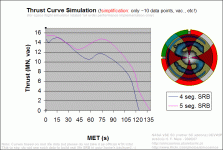
2) Comparing theoric vacuum thrust curve of 5 seg. SRB vs 4 seg. SRB: both curves are roughly 'equivalent' before something like the MET associated with maxQ (note: this MET depending of specific stage application / grain tweaking, etc).

The 5 segment SRB has however higher liftoff thrust and an higher relative second maximum (that is the reason for the mentioned expected improvements, for example, in STS abort options, if making the STS upgrade from 4 seg. to 5 seg. SRB).

To further illustrate this, will share next an older, simplified custom excel graphic that have adapted for some of my ongoing addon work with NASA VSE SC addon and where compare a *specific* 5 segment SRB design configuration with 4 segment SRB.

Having in mind what wrote above, please do not pay much attention to precise Thrust vs MET values neither directly extrapolate to official ongoing Constellations's 5 segment SRB design work (in NASA VSE SC addon alternative reality, STS would have gained 5 seg. SRB between Challenger and Columbia disasters and that SRB design would then become the booster that would power alternative AresI-V configurations, something very different than what happened / will happen in real life): moving on, the most important in this graphic is then to compare rough generic shapes of something like a 5 segment SRB vs 4 seg. SRB (although there is some loss of curve resolution because I have configured these specific curves with only ten data points, for easier Vinka's multistage2.dll [booster] feature compatibility).

These kind of curves shapes can be tweaked by making specific assumptions for thrust output / ISP / grain geometries (overall SRB design assumptions) which could then be related with the specific application of the 5 segment SRB. Related with this, the initial NASA VSE plans were to use the same thrust curve for both AresI and V but not sure if that is or will still be the expected course of action because, among other 'things', of the different role that the 5 segment SRB performs in those two configurations (lonely first stage in AresI vs thrust augmentation / side boosters for big core in AresV).

As a last note and still related with all this, I believe that have downloaded (from NTRS) one or two pdf about thrust curve tweaking strategies for AresI (do not remember the precise reference, should have that pdf somewhere in simcosmos development archives).

António
 

Attachments

  • NASA_VSE_SC_DEVWIP2006-07-08simcosmos_SRB4vs5segCurves.gif
    NASA_VSE_SC_DEVWIP2006-07-08simcosmos_SRB4vs5segCurves.gif
    32.8 KB · Views: 37
Last edited:
I tried a simple VC by registering a rect mesh for showing an MFD on it, but it did not work. I used the original Atlantis-code for reference, and here it looks quite simple.
Could someone please point me to a place (tutorial, code snippet, ...) where this is explained?

P.S: How can correct the meshgroup (number) be identified?
 
You can use meshc (if your mesh has labels). It is a really really really really useful tool. I currently work on a small improved version, which also extracts texture indices.
 
I've flown the CEV launch scenario in the new beta-0f several times now. The fuel remaining in the 2nd stage at cutoff has ranged from 3.5% to 4.2%. The launch profile I got through trial and error was about as follows:

As soon as the vehicle clears the tower, pitch over to a pitch angle of 83 degrees. Hold a zero angle of attack until staging. Then use PEG autopilot MFD in calculation-only mode with the following target orbit parameters:

perigee: 65 km
apogee: 250 km
true anomaly: 60 degrees

I set the pitch over time and PEG start time to zero, so that it immediately goes into closed-loop as soon as I click start after staging. This puts 2nd stage cutoff at an altitude of 110 km with a vertical speed of about 80 m/s.

The exact time and angle I pitch over after liftoff seems to make quite a bit of difference, so I haven't been able to be consistent.
 
Is the file still the same as I have, or did something change over time in 0f?
 
Ok, I have downloaded and installed the free VC++ 2008 compiler and after some headaches compiled the standard ShuttlePB, and after even more headaches compiled the CEV!
I was not aware that so many changes were made to the C-programming language since I learned it ;)
Especially the old string-functions being considered unsafe and generating endless warnings, and variable initializing being checked much more strict.

I have uploaded the result as new version 0g:
http://home.arcor.de/francisdrakex/download/CEV-Orion-0g.zip

The only other mods are the corrected thrust of the first Ares stage (626 MN instead of 525), and a slightly modified thrust-vs-time curve.

Funny error:
The hatch animation crashes when the vessel is in orbit mode, but works in reentry configuration. This is probably due to a programming error, that was forgiven in older C++, but is now lethal. Will look into it.

Please let me know, if this version runs at all, or if there are dll's missing, etc.
 
Especially the old string-functions being considered unsafe and generating endless warnings, and variable initializing being checked much more strict.

You can disable the warnings by specifying the right compiler option. I just redo my code to remove the warnings as the new functions are more robust against buffer overflows.

The variable initializing is actually finally OSI C++ compatible - the earlier VC++ versions had been closer to C in that aspect. Also the support for namespaces is finally really existing - it was a real PITA to work with namespaces in VC6.

I have not yet tried declaring class constants. Did not work in VC6, but are actually standard...
 
Downloaded latest version, but get a CTD everyone, regardless of which scenario is opened. Have gone back to version f.
 
If the addon crashes, it might be due to missing dll's:
"The Microsoft Visual C++ 2005 Redistributable Package (x86) installs runtime components of Visual C++ Libraries required to run applications developed with Visual C++ on a computer that does not have Visual C++ 2005 installed."

These dll's (1.7 MB) can be downloaded from:
// Edit: The old link was to the 2005 runtime package.
// If you downloaded it, and still have problems, please try this package instead:

http://www.microsoft.com/downloads/...34-3E03-4391-8A4D-074B9F2BC1BF&displaylang=en
 
Last edited:
Back
Top