Updates SpaceX Falcon 9 F5 CRS SpX-2 through CRS SpX-12 Updates

Wonder what they'll stencil on the pad next time:

"Look, just RTFM, okay!? It's not hard."
You mean the barge deck? JRTI is the actual name of the barge. Technical designation is Autonomous Spaceport Drone Ship-1 (ASDS-1).
 
CCmA1JoUMAAijtC.jpg:large


:jawdrops:

---------- Post added at 01:22 AM ---------- Previous post was at 01:17 AM ----------

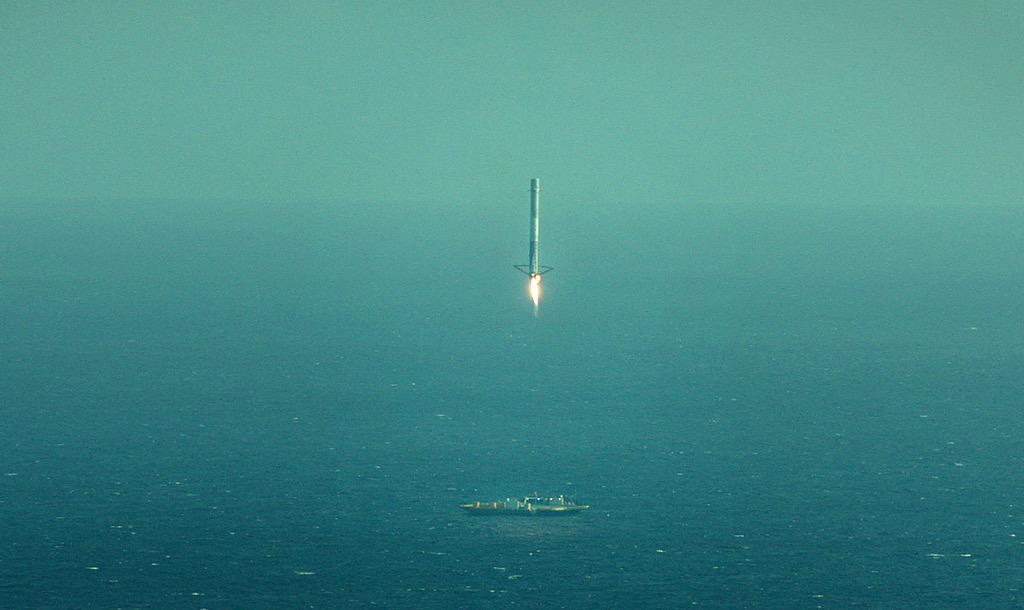
There's a Vine of the landing as seen from the chase plane.
 
Some time in June I think.

Yup, CRS-7 which is tracking June 19.

In other news, looks like the team has already gained progress on the troubleshooting:

Elon Musk @elonmusk
@ID_AA_Carmack Looks like the issue was stiction in the biprop throttle valve, resulting in control system phase lag. Should be easy to fix.

That flight happens to be CRS-7, it's scheduled for the day after my birthday.

I have to wait two entire months until the next one?

The next flight (was before CRS-6 in the queue but delayed) is 9 days away with Turkmensat (thread coming very soon), but no recovery since that one's heading for GTO. Not sure what happens after that but it seems that there won't be any launches in May.
 
Last edited:
They should be doing the pad abort soon. I think they wanted to fit it in right after the Turkmenstat?
 
Wonder what they'll stencil on the pad next time:

"Hit me again"

"As many as it takes"

"1 at sufficient velocity"

or if we're going to stick to the Culture references...

"Death and gravity"
 
Wonder what they'll stencil on the pad next time:

"Look, just RTFM, okay!? It's not hard."

"If you're not willing to shell your own position, you're not willing to win"
"If a manufacturer's warranty covers the damage you do, you didn't do enough damage"
"If you’re leaving scorch-marks, you need a bigger gun"
Or, my personal favorite: ""Mad Science" means never stopping to ask "what's the worst thing that could happen?""
 
Landing video looks to me like the stage was still strongly tumbling until touchdown and not stabilized before landing.

Not just a sluggish reacting throttle... more a too weakly reacting TVC. (to compensate for aerodynamic oscillations and the little bit of slushing in the tanks)
 
Last edited:
Some more ideas about the landing failure...

The sluggish reaction to throttle commands could mean that the stage was much lower than expected by the autopilot. Also the waves suggest some stronger wind, which could mean that the stage could be blown away from the trajectory while the engine was reacting slowly.

Still, there seem to be some more problems in the landing guidance left, if such strong autopilot inputs are required during landing phase. A slow reaction alone can only make this more grave, but is not the only cause.
 
Elon Musk @elonmusk
@ID_AA_Carmack Looks like the issue was stiction in the biprop throttle valve, resulting in control system phase lag. Should be easy to fix.

Does this just mean it was trying to throttle up to cancel the rotation, and the sticky valve prevented this?

(My understanding is the engine is gimballed, so I assume it pointed the engine slightly to one side and was trying to throttle up a little, to make the vehicle stop in the upright attitude while maintaining the vertical descent rate.)
 
Does this just mean it was trying to throttle up to cancel the rotation, and the sticky valve prevented this?

(My understanding is the engine is gimballed, so I assume it pointed the engine slightly to one side and was trying to throttle up a little, to make the vehicle stop in the upright attitude while maintaining the vertical descent rate.)

"control system phase lag" just means, that the control loop for the engine thrust reacted slower than expected.

It has nothing directly to do with the attitude control, which would be a separate control loop.

But it means that the stage is descending way faster than the autopilot expects - You want to be at 150 m/s in the next "tick", but because of the valve, you are at 160 m/s. So the control system requests much more thrust to reach the next goal of 120 m/s. But at the next "tick", you are instead at 140 m/s, ...

Every tick, you are much closer to the surface, than your guidance aims for.

The PID-T1 control loops can compensate for a bit of control system phase lag, but too much phase lag and you are getting an instable control system.
 
I think attitude control is under the same control as vertical thrust, because the engine exhaust does look very much like it's being gimballed. For example there's a video here (probably the same one everyone's seen already):
http://www.engadget.com/2015/04/14/spacex-rocket-launched-successfully-but-didnt-survive-the-land/

(I gather they use pressurised gas thrusters at the top too, but there's no doubt engine gimballing is happening here.)

Just looking at that I would have thought the engine was swinging too far, but he's talking about the throttle valve...

(By the way the camera is in just the right place to see the sideways "waddling" of the rocket, and its exhaust. Just a nice coincidence :) )
 
I think attitude control is under the same control as vertical thrust, because the engine exhaust does look very much like it's being gimballed.

No, you always control one quantity by one loop.

The guidance system may calculate a higher thrust level to compensate pitch, bank or TVC deflections, but the valves are part of the control part, which then tries to achieve the targets of the guidance.

The TVC angle would for example be calculated by multiple control loops. One calculates which deflection angle command is needed for reaching the attitude/attitude rate specified by the guidance. The other control loop is then in the hydraulic actuator and its related electronics and regulates the hydraulic fluid flow to position the nozzle by the hydraulic actuator.

And especially keep the nozzle in the right position, while the engine is thrusting - that needs active input, otherwise the engine would simply turn the hydraulic piston actuator into a hydraulic piston pump.
 
I didn't mention loops :). I was just trying to work out why he's written about the bipropellant valve. If the problem is that valve was sticking (or rather, suffering from stiction or other nonlinear behaviour) why was there an error in attitude? Is there some associated effect the valve has on the hydraulics?

(They are definitely gimballing the engine - therefore it can, or could be, used for vertical and horizontal control. Regardless of how many loops they are running in software.)

My formal control theory education ended decades ago by the way, but at least I can see the basics of why a control loop goes crazy when unexpected lags appear :)
 
If the problem is that valve was sticking (or rather, suffering from stiction or other nonlinear behaviour) why was there an error in attitude?

I did not see him write about attitude.

I believe, IMHO, that the valve could have resulted in the stage descending faster than planned and expected by the guidance system, simply because thrust did not ramp up as fast as planned for such a short burst landing.
 
The video clearly shows a significant oscillation in attitude, and pronounced gimballing. Take a look if you can.

(I guess an incorrect thrust while gimballed caused this - but really I was trying to form an opinion on whether Elon knows the true problem, or was just giving a snappy quote "Stiction in the wotsit" to please people :) )
 
The video clearly shows a significant oscillation in attitude, and pronounced gimballing. Take a look if you can.

I did see it. But I did not see something that can not be not explained by descending faster.

If the deviation from the planned trajectory gets bigger, the steering commands get bigger. For changing attitude, the engine has to gimbal. For changing velocity (and by it, position), the while rocket has to rotate.

If you need stronger steering commands, such a rocket stage with a very uneven mass distribution will have a tendency to overcompensate. Again, nothing unexpected. Such a stage is no LM, you have to handle it with care or you can buckle it like a Proton launcher trying perform a loop.

Especially important for understanding the performance of the autopilot are the velocities of the stage - there you can see that the attitude changes had been conform to necessary position changes.

The strong changes in attitude can indeed be explained then mostly by the lower altitude. Yes, some control system issues have to be noted there. Especially BEFORE the start of the video. But the more I think about it, the more I can really understand attributing the failure to the valve.

But that such a minor valve problem can cause a landing failure is of course a huge technological debt in the Falcon 9 1.1 development. And that is not just fixed by better valves. That just prevents one problem that can make the landing uncontrollable, but there can be much more.

The whole final targeting phase before powered descent has to be more precise. And/or the powered descent has to start earlier to allow compensating problems without exceeding control stability limits.

 
Back
Top