At the frequency you're pushing out airports and cities, I have to wonder... Have you ever thought about doing some large-scale Moon- or Mars bases? Because there's a real lack of those, I feel like a part of the community would greatly appreciate something like that.
Oh, I definitively did. A few months ago, I marked spots on the Moon in Google Earth (since it can do the Earth, the Moon and Mars) for future Orbiter bases. I even gave each of them a bit of lore!
Take in mind that all of these bases were created in the mindset that this is the 2200s or something like that. Far future!
Russell:
(26°30'48.32"N 75°24'18.92"W)
Russell is the second largest colony on the Moon. It was built by the United-States as a direct answer to the Russians' Moscoviense.
Verne:
(24°53'51.70"N 25°16'16.91"W)
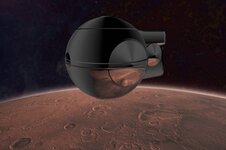
Verne is the third biggest colony on the Moon, and built by Europe. It is famous for being hosted in one gigantic sphere. Verne has become known as the Capital of the Moon, and is the place where colony leaders go to discuss diplomacy.
Dechen:
(46° 6'39.46"N 68°31'46.62"W)
An European colony, Dechen was built next to a crater, which host one of the biggest mining enterprises on the Moon.
Jackson:
(22°11'42.51"N 163°33'16.37"W)
Located not far away from Moscoviense, Jackson is a small American outpost first built to study the geology of the Hidden Face of the Moon.
Moscoviense:
(27°50'57.02"N 148°41'1.77"E)
One of the biggest Moon colonies, Moscoviense was built by Russia. It is the closest thing to a city the Moon has, though it is still rather small in comparison to a city on Earth.
Taurus-Littrow:
(20°12'48.49"N 30°31'33.27"E)
Starting out as a research center, the Apollo 17 landing site soon turned into a popular tourist spot, and attracted many colonists. It is well known for being the place where the Bridge of the Moon was constructed.
Plaskett:
(82° 5'36.51"N 174°32'0.14"E)
Plaskett is a small outpost built to study the geology of the North Pole of the Moon. Originally built by Russia, it has since been abandoned, sold to the Americans and renovated. The only traces of its Russian origins are the name and a handful of buildings.
Tranquility:
(0°40'53.52"N 23°27'36.17"E)
Tranquility is the site where mankind first walked on the Moon. It is a site of pilgrimage for Moon colonists and spaceflight enthusiasts alike, and the most popular tourist attraction on the celestial body.
So popular is it in fact that the International community implemented laws to protect the site. Colonization is forbidden in the Sea of Tranquility, and the only buildings for miles around are basic facilities to accommodate tourist spaceships, and a gift shop.
Tycho:
(43°36'6.12"S 11°20'41.73"W)
Officially a mining outpost, Tycho has been long known for being a place where secretive things happen. There is a conspiracy theory circulating that says Tycho is in fact a vault built to store deadly viruses and bacteria for further study, the Moon's deadly environment ensuring their experiments cannot escape and contaminate others in case of a breach...
Lunar Telescope:
(1° 4'45.70"S 162° 2'59.87"W)
It has long been believed that the next step in the observation of the sky was to built a giant space telescope inside of a crater on the Far Side of the Moon. With the colonization of the Moon, the creation of the telescope became a possibility.
Brighton Beach:
(41° 7'30.00"N 33°26'15.00"W)
One of the first modern Moon bases, Brighton Beach began as a research outpost. A few decades after the founding of the colony, Brighton Beach became the first ever space resort on the Moon.
Yueguang:
(75° 2'12.60"S 132°44'25.47"E)
Located near the South Pole, Yueguang is one of the youngest large-scale colonies on the Moon. Built by China, the colony has expended rapidly and is quickly on its way to surpass Russel and Moscoviense in size and population.
Lowell:
(12°55'3.07"S 103° 3'23.40"W)
Lowell is a small, Canadian outpost on the Moon. Paid for by Canada, the small colony was built and assembled by the United-States. Lowell is one of the smallest and youngest colonies on the Moon, having first opened its doors a mere ten years ago.
Bruno:
(32°14'5.20"S 30°15'2.61"W)
Bruno is a former Italian outpost. The outpost was first built by Europe a long time ago. Soon after the first crew arrived, Europe gave the then unnamed base to Italy to oversee. Italy named the outpost after Italian astronomer Giordano Bruno.
It took two decades before Europe wrestled back control of Bruno, by which point the outpost had fallen into disrepair and earned a reputation for its poor and dangerous living conditions. Italy was sanctioned by Europe for its poor management of Bruno.
After getting back control of the outpost, Europe began a five-year long rebuilding effort to bring back Bruno to its former glory.
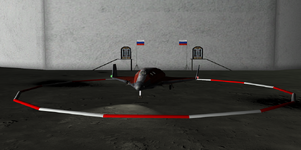
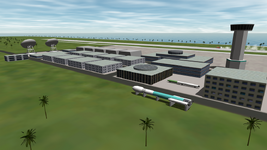
The only base I made so far is Moscoviense, because its design is the simplest (Just a bunch of spheres connected by tunnels. Very utilitarian). But, I'm not quite sure of the final layout. I think its... too many buildings.
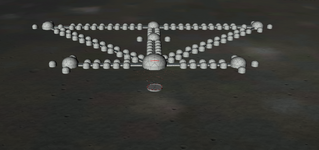
I quite like the landing zone, though!