Orbiter Screenshot Thread

This look amazing! Though looking at the first screen it look like the ship may be a bit too high on the water? Like the waterline should be a bit higher. Then again, maybe its just fine and the position of the ship is what give the illusion it's floating a bit too well.
I basically just looked online for typical displacements and vessel lengths and picked something that looked right. It does bob around a lot like it is riding high. I can add some more weight and see if I can get something more agreeable. It's easy to adjust.
Btw, I can edit the mesh if you need some sort of modification for animations and such. So don't hesitate to ask ;) (I was thinking myself of adding some kind of lamps so some light sources could be added to see the ship in the dark. At bit like in Assassin's Creed, so I may wind up modifying the mesh anyway.
View attachment 42661
When I started tinkering with sailing vessels I was thinking of something like the Black Pearl. Something with some bling and character. This is very much in line with that.

What I can do is run meshc.exe and that gives me a connectivity listing between the meshgroup names and their number order in the mesh file. I can parse that in Orbiter so adjusting to mesh changes shouldn't be too bad. If you can give the groups sensible group labels that are human-readable that would help.
Also I think I'll make a few tiny bases in the Caribbean to sail to and from. Nothing fancy, just for the sake of having destinations for the ship.
I have only ever sailed my skiff. It will be interesting to see how this brig handles.
 
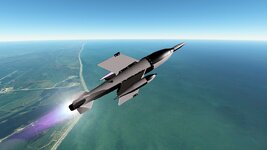
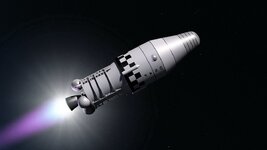
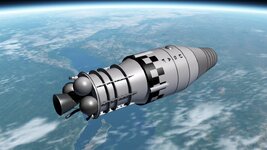
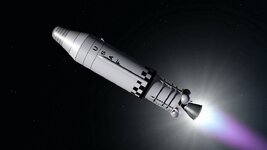
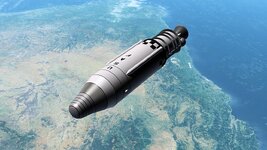
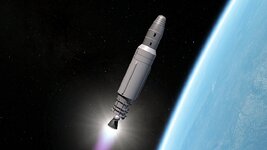
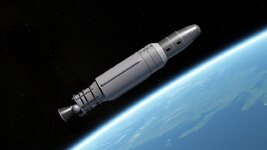
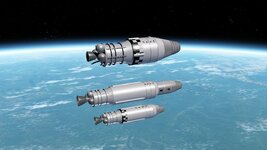
Another Russian research rocket derived from a missile precursor. Tracing its heritage back to the V-2, the V-1-Ye belonged to a group of Soviet geophysical rockets that were active up until 1956. In addition to two FIAR (Physical Investigation of the Atmosphere by means of Rockets) instrument canister pods mounted on the sides, a separate payload section up front could accommodate dog passengers along with their parachute recovery system. I've taken the liberty of launching my model into low Earth orbit; prototypical flights were suborbital in nature.

V-1-Ye 01.jpg

V-1-Ye 02.jpg

V-1-Ye 03.jpg

V-1-Ye 04.jpg

Hi-Ho,

cs
 
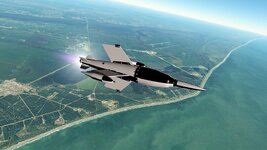
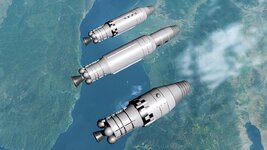
Ruhrstahl X-4: Not exactly 'orbital' in nature, the X-4 was an air-to-air wire-guided missile developed by Germany during WWII - but was never deployed during wartime. Another example of a missile precursor that inspired further work and later developments in the field of rocketry science.

SCREENSHOT 06.jpg

SCREENSHOT 07.jpg

I cheated a bit here; these images were captured after launching from the ground at Cape Canaveral (LC14). And, maybe I could use better exhaust textures. Anyway.

cs
 
Last edited:
Yeah, for Surface to Air use, there was the radio guided Wasserfall missile. :D
 
Great shots. I imagine all of those variables (metal textures, nomals, spec maps) are tricky on their own, and the possible combinations are endless. The ones you have here are very convincing.
 
The ones you have here are very convincing.
Thanks! Yes, it is tricky to find a good combination. The very basic material parameters like color and reflective color are always a bit different in the 3D-modelling program compared to Orbiter's rendering. My very first tries looked more like granite stone, not like metal.

I found a site online that creates normal maps from the textures, which is very helpful! The rest is trial and error. :giggle:
 
🧼

maxresdefault.jpg
 
Default Orbiter 2024 sun does not look good at all in most screenshots. "My" sun is better, I managed to change high frequency spikes (more blurred, so it's better).
 
Could you maybe post your sun texture? It may be interesting to compare the visuals. ☀️:cool:
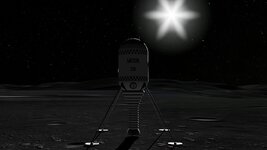
I edited part of glare.hlsl, (backup the file though) and replace these parts (file is in Modules\D3D9client folder):
I think I edited mostly rows with " // High frequency spikes "

// ====================================================================
// Creation of "glare" textures
// ====================================================================


// ======================================================================
// Render sun "Glare" (seen in space)
//
float4 CreateSunGlarePS(float u : TEXCOORD0, float v : TEXCOORD1) : COLOR
{
u = u * 2.0 - 1.0; v = v * 2.0 - 1.0;

float a = atan2(u, v);
float r = sqrt(u * u + v * v);

float q = 0.5f + 0.3f * pow(sin(3.0f * a), 4.0f);
float w = 0.5f + 0.2f * pow(sin(30.0f * a), 2.0f) * pow(sin(41.0f * a), 2.0f);

//float I = pow(max(0, 2.0f * (1 - r / q)), 12.0f);
//float K = pow(max(0, 2.0f * (1 - r / w)), 12.0f);
//float I = exp(max(0, 10.0f * (1 - r / q))) - 1.0f;
//float K = exp(max(0, 10.0f * (1 - r / w))) - 1.0f;

float L = pow(max(0, (1 - r / q)), 2.0f) * 3.0f; // Low frequency spikes
float H = pow(max(0, (1 - r / w)), 8.0f) * 5.0f; // High frequency spikes
float C = ilerp(0.03, 0.01, r) * 7.0f; // Core
float S = ilerp(1.7f, 0.35f, r); // Skirt

C *= C;
C += S * S * 0.40f;

return float4(max(L + C, H + C), 0, 0, 1);
}


// ======================================================================
// Render sun "Glare" (seen in atmosphere)
//
float4 CreateSunGlareAtmPS(float u : TEXCOORD0, float v : TEXCOORD1) : COLOR
{
u = u * 2.0 - 1.0; v = v * 2.0 - 1.0;

float a = atan2(u, v);
float r = sqrt(u * u + v * v);

float q = 0.5f + 1.0f * pow(sin(3.0f * a), 4.0f);
float w = 0.5f + 0.8f * pow(sin(10.0f * a), 2.0f) * pow(sin(6.0f * a), 2.0f);

float I = pow(max(0, (1 - r / q)), 3.0f) * 4;
float K = pow(max(0, (1 - r / w)), 8.0f) * 8;

float L = ilerp(0.05, 0.01, r) * 16.0f;
float T = max(0, max(I + L, K + L)) * 2.0f;

return float4(T, 0, 0, 1);
}
 
0164.jpg
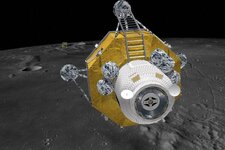
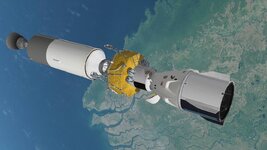
High over the Sundarbans a Dragon capsule is delivering the crew to the Lunar excursion vehicle (LEV). The three-day flight to the Moon will be a bit cramped in the small cabin of the LEV. Note the FalconHeavy upper stage has a grey stripe to prevent the fuel from freezing while it was waiting for the crew to arrive.
 
View attachment 42879
High over the Sundarbans a Dragon capsule is delivering the crew to the Lunar excursion vehicle (LEV). The three-day flight to the Moon will be a bit cramped in the small cabin of the LEV. Note the FalconHeavy upper stage has a grey stripe to prevent the fuel from freezing while it was waiting for the crew to arrive.
Question. How do they get home ?
 
Back
Top