Flight Question getting into orbit?

Status
Not open for further replies.
Urwumpe thats funny. and umm how many flying hours you have? you give me a really good laugh. you know that?

Exactly 15 seconds and about 60 meters. But I am not the one who pretends to be pilot. :lol:

I work now for ten years in the aerospace business, most of the time at the local research airport. I don't claim to be pilot. But my work is the difference between a living and a dead pilot (and crew, passengers and people, who failed being at a place without crashing aircraft).
 
i don't pretend to be any thing im not.

Then prove it. Stop talking bovine excrement like what a pilot you are...we are happy if you simply act like one.
 
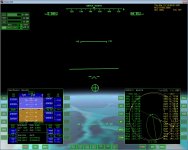
ok heres a screen shot of what i was able to get so far.
 

Attachments

  • IN SPACE SORT OF.jpg
    IN SPACE SORT OF.jpg
    302.4 KB · Views: 95
Last edited by a moderator:
ok heres a screen shot of what i was able to get so far.

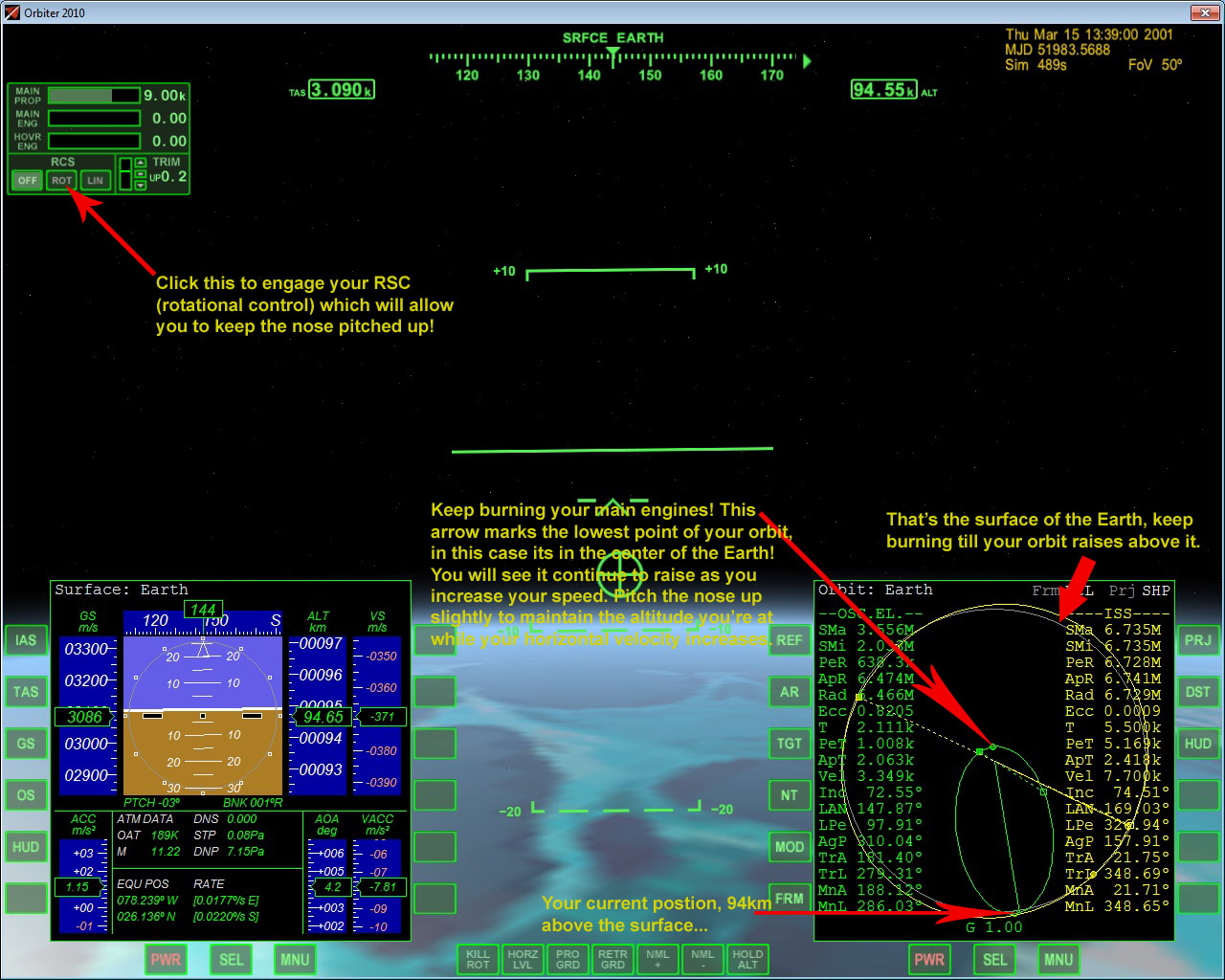
What do you expect to keep you up there at 90km? You're getting no aerodynamic lift at that altitude - look at your DNP. You are going to fall out of the sky, and you're not traveling nearly fast enough to get the Earth to obligingly retreat from under you. So back down you go. You gotta wrap your head around it: this isn't an airplane. Look at your DNP again: no air.

Seriously: say the words "orbital mechanics" out loud, and ask yourself when you've ever needed those words to plan a flight before.
 
ok heres a screen shot of what i was able to get so far.

This explains your screen shot and what you need to do:
rocketdued.jpg
 
If you can get the 2010 Multiplayer addon I can spend a few minutes tutoring you on orbital launches. Once again, watching a launch on autopilot (one of the historical rockets or shuttle missions maybe) will help greatly your understanding of an ascent profile.
 
well ok then. there are real flightsimulator 2004 pilots to. and yes i know that there are pepole that know more then me about aviation. and thats greagt. i like to learn. if somebody shares some good information with me about flying thats good. so now that we have established that. when you look at the attitude indicator in orbiter and a cessna for example. because it's blue on top and brown on the bottom correct? whats the differrrence? NONE!!! now when you look at the heading tape on the top of oribters display and one in a fighter jet whats the differrence? NONE!!! so no maybe i don't know all there is to know about space flight. if any one tells ya they do is full of it.

Ironically I find that the Surface MFD is the least useful MFD. My order of importance for MFDs are: Orbit, Align Planes, Sync Orbit, TransX, Docking, IMFD, and BaseSync.

I would have something like AeroBrake in there if I did more atmospheric re-entries, but I don't. :)


EDIT: And to add to Tex's picture I would point out that you should realize something is wrong when your vertical velocity is -371 m/s. If you had a stable orbit it would say 0 m/s.
 
Last edited:
Now, I'm going to throw in something new. As it appears, the OP knows how to fly aircraft...and as Urwumpe pointed out, incorrectly assumes things about space flight. I did too when I was starting out, as the learning curve for Orbiter is incredibly steep.

It seems there's some principles specific to space flight which you don't understand. So, one thing that I think might help you is this:
It draws the orbits right where you're flying.
videnie-101003-1.jpg

If you, a newbie, launch straight up, the trajectory drawn should give you a clue you're doing it wrong:
videnie-101003-3.jpg
If someone thinks I'm teaching it wrong, you can stop me. But I think if I had Videnie when I started, the principles of orbital mechanics would have been much more intuitive for me to learn, so I make this suggestion now.

Just remember...there is NO replacement for reading the manual. :)
 
Ironically I find that the Surface MFD is the least useful MFD.

You only say that until you have to get the bird down again... :lol:
But I agree, for launch the HUD has totally sufficient information to coordinate your ascent. Plane alignement and Orbit MFD is what I usually have open for launch.

Interestingly enough I didn't have much flight-sim expierience before getting to orbiter (haven't played a serious flight simulator since the "fleet defender"-days) and didn't have much trouble getting a hang of the basic maneuvers. Maybe playing I-War too much helped a bit too... :shifty:
 
Ironically I find that the Surface MFD is the least useful MFD. My order of importance for MFDs are: Orbit, Align Planes, Sync Orbit, TransX, Docking, IMFD, and BaseSync.

I would have something like AeroBrake in there if I did more atmospheric re-entries, but I don't. :)


EDIT: And to add to Tex's picture I would point out that you should realize something is wrong when your vertical velocity is -371 m/s. If you had a stable orbit it would say 0 m/s.

Just get a 1km/s or something vertical acceleration then level out and burn 'horizontal' to build enough velocity to stay in orbit.

In the wise words of Jeremy Clarkson, how hard can it be?
 
900 m/s vertical velocity in 25 km altitude is enough for bringing you out of the atmosphere in theory, practically, some piloting is better if you don't want to loose it all to drag ;)

A smooth trajectory is ALWAYS better than a complex one, but what smooth is, is in the eyes of the observer... the roller-coaster ride of a shuttle or Ariane 5 in the ascent trajectory might not look smooth, but actually it is the trajectory that fights gravity less.
 
Ironically I find that the Surface MFD is the least useful MFD.

I wouldn't say it's the least useful. During the launch, it is important to see your vertical speed and vertical acceleration. For my launches I generally have the surface MFD up on one side and the plane MFD up on the other, see my video here. Once I hit about 6500m/s velocity, I'm at near level flight close to 70km, so the surface MFD is no longer needed. That is when I switch to the Orbit MFD.

Rathelm said:
If you had a stable orbit it would say 0 m/s.
Not necessarily, because your altitude is going to be slightly different on one side of your orbit than the other, even with a perfect Ecc. The eccentricity on the orbit MFD is the important value to look at for a stable orbit.
 
ok heres a screen shot of what i was able to get so far.

This clearly shows that you have NOT listened to the advice we have given so far. You are stuck on the idea that you know far more about this than you actually do.

I will repeat what Urwumpe has tried repeatedly to tell you - EVERYTHING YOU KNOW ABOUT FLYING DOES NOT APPLY HERE.

You have SurfaceMFD set to show true airspeed. This shows that you are still stuck thinking "aircraft" when you need to think "spacecraft". Orbital speed (OS) is the value that you need to be paying attention to.

You are traveling at less than half the speed you need to be if you want to be in orbit. You need around 7.5km/s - not 3k/ms.

You are quite high up for the low speed you are at. You do realize that 90k is about 55 miles and that you are on the edge of space? I usually reach 3km/s velocity before I'm even halfway as high as you - and have reached 7.5km/s velocity (and cut the engines) by the time I'm up to 70 km/s.

The problems you are experiencing with poor handling are the result of you traveling too high at too low a speed - and from trying to use aerodynamic control surfaces when there isn't enough air for them to work.

When we say "read the manual" we don't mean "skim through the manual". We mean read it and understand the concepts it is trying to teach you. Read it like you will be tested on it - because you will. When you attempt to launch into orbit that IS a test of how well you understood the lesson.

This IS rocket science, and it IS hard. If you want to be able to use Orbiter you will need to get over your "I already know all I need to know about flying" attitude. You have been extremely disrespectful to those of us who have tried to help you, and I'm stunned that no one has called you out on that before this.

When you don't see the same things the tutorial tell you that you should see it means you haven't followed the tutorial closely enough. Every ascent tutorial I've ever seen tells you to turn on the RCS long before you reach 90k altitude - but you haven't. You are skipping steps - perhaps because you just don't think they are important (because you don't understand enough to realize they ARE important).

The cause of your problems isn't that Orbiter is bad or because the tutorials are bad or because your airplane flying skills are bad. The problem is that your attitude is bad - and until you correct that there is no more help that I could give you - even if I were willing to try.
 
Rocketdued, I won't claim that you have not read the manuals, as I have no proof of it, but this whole thread is undeniably proof that you do not understand the manuals, and that is what's most important. Now, I can understand that it may be confusing at first, since spaceflight, as pointed out, is completely different that flying an aircraft. If you don't understand, it is perfectly acceptable to come here and ask questions to help you understand, which is again what you did. Plaudits to you. However, instead of following the advice given, you've flat out rejected the information given to you, justifying you're actions by saying that you know how to fly, such as here:

i don't pretend to be any thing im not.

Yes, you do. Perhaps not knowingly, but you have pretended to be much, much more knowledgeable about space flight than you actually are. As you have been told, spaceflight is far different than atmospheric flight, but you don't understand this. Your justification that there must be something wrong with the Delta-Glider because it's nose tilts down again proves that you have not taken the advice given. Claiming that a space craft, which spends 95% of it's time outside of the realm of aircraft, should function the same as an aircraft is akin to saying that a car should be able to drive on the water like a boat, just because the car periodically drives through puddles. It's ridiculous.

well ok then. there are real flightsimulator 2004 pilots to. and yes i know that there are pepole that know more then me about aviation. and thats greagt. i like to learn. if somebody shares some good information with me about flying thats good. so now that we have established that. when you look at the attitude indicator in orbiter and a cessna for example. because it's blue on top and brown on the bottom correct? whats the differrrence? NONE!!! now when you look at the heading tape on the top of oribters display and one in a fighter jet whats the differrence? NONE!!! so no maybe i don't know all there is to know about space flight. if any one tells ya they do is full of it.

You're right. Those things are very, very similar. Why? Because they are meant to be used when you are flying in the atmosphere, which is not what you are doing. Very rarely is the Surface MFD or Surface HUD used while in orbit, so those are not really a good comparison. In fact, there is no good comparison. Spacecraft are different. While you are also right that no one here know's everything there is to know about spaceflight, many do know a lot. Even I know somethings, and I learn more every day. I can guarantee you that you will also begin to learn more if you read and try to understand the manuals- and most importantly- ask the right questions...

Urwumpe im going to pretend i didn't hear you say that. first of all i use flightsimulators to keep my skills as a pilot in the real world sharp!!! you remind me of one of those that say no inhstructor sir i don't need a flightsim i can fly any thing. well those kind of pepole scare me they really do. if you think a flightsimulators a waste of time well then the jokes on you my freind!!! if you know orbiter like you say you do lets see you go to nasa and try the REAL space flightsimulators they have:lol:

Urwumpe thats funny. and umm how many flying hours you have? you give me a really good laugh. you know that?

... but not like that.

I can assure you that Urwumpe's advice, along with that of the other 90% of people on these forums, is good advice. I would ask how many hours of flight you have, but there is no way to verify that information, so it'd be pointless. In fact, there is no way to verify that you have ever flown a flight simulator before; it's up to you to prove that to us. And from how you've acted in this thread, you're not really proving it. Until you do, most of us will assume you have very little understanding of flight, and therefore will most likely direct you to do things like read the manual.

As for advice, I recommend doing every tutorial in Go Play in Space. I can assure you that, if you follow those instructions, you will be able to achieve a stable orbit. Heck, you might even understand how you did it. Aside from Go Play In Space, there are multitudes of tutorials in the Tutorial Page here on Orbiter Forum. Those too will help you out. The learning curve is steep, but it's manageable with some help. Also, don't forget to ask the right questions, but don't expect us to just tell you what, when, and how you need to do things. You'll need to know the why part too, and that can easily be found in the posts and tutorials already in this thread. If you want to get anywhere with Orbiter, you have to understand what you are doing, not just know it.

 
Last edited:
I wouldn't say it's the least useful. During the launch, it is important to see your vertical speed and vertical acceleration. For my launches I generally have the surface MFD up on one side and the plane MFD up on the other, see my video here. Once I hit about 6500m/s velocity, I'm at near level flight close to 70km, so the surface MFD is no longer needed. That is when I switch to the Orbit MFD.

I guess I should have preface it with that the Surface HUD is sufficient enough to give all pertinent information. The extra info the MFD shows I don't find particularly useful during ascent.

Not necessarily, because your altitude is going to be slightly different on one side of your orbit than the other, even with a perfect Ecc. The eccentricity on the orbit MFD is the important value to look at for a stable orbit.

Sure especially if you use non-spherical gravity sources. I suppose I should have said approximately zero m/s. My point was that the fact that he was falling at over Mach 1 was not ideal.
 
i don't think my not being able to get into orbit is NOT!! because of my quote poor piloting skills at all. i was infact able to get into orbit and stay there. i think what im having trouble with is the orbit mfd. and getting a set orbit. like for the international space station for example. cause i bet you 5 dollars that every one of you on this forum was new to orbiter at one time just like me. so piloting skill has nothing to do with it. it's just a matter of understanding what orbiter is trying to tell the pilot. and how the pilot can interpret that information to make it work the way he needs it to.
 
Getting into orbit is one thing, getting into a specific orbit to rendezvous with the ISS is something else entirely.

To use an aircraft analogy - an aircraft can fly from London to New York whenever it chooses to. Space vehicles cannot fly from Earth to the ISS whenever they wish to. They need to launch during the in-plane window which for a shuttle to ISS flight is just 10 minutes wide. So you can see that this adds extra complications to a spaceflight.

Once in orbit you then need to catch up to the ISS and sync orbits. Finally you need to dock.

It's easier to focus on one aspect at a time, get good at that aspect then move on to the next.
 
i don't think my not being able to get into orbit is NOT!! because of my quote poor piloting skills at all. i was infact able to get into orbit and stay there. i think what im having trouble with is the orbit mfd. and getting a set orbit. like for the international space station for example. cause i bet you 5 dollars that every one of you on this forum was new to orbiter at one time just like me. so piloting skill has nothing to do with it. it's just a matter of understanding what orbiter is trying to tell the pilot. and how the pilot can interpret that information to make it work the way he needs it to.
Once again proving that you haven't listened to everyone, If you had read all the help they were giving you, read the manuals et cetera, et cetera, you would know how to get to orbit, what all the information on Orbit MFD means and none of this would be a problem any longer, TAKE ADVICE FROM PEOPLE AND STOP BEING SO ARROGANT TO THINK THAT YOU KNOW EVERYTHING!

Edit: Sorry to sound rude, but I'm sure all of us are getting rather annoyed with you now.
 
i have listend to the pepole here and read the orbiter help on the orbit mfd.
 
Status
Not open for further replies.
Back
Top