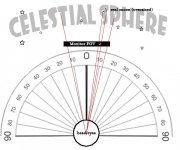
hey i was just wondering i was looking at pictures from the real apollo missions and the moon and earth size from eachother are so much bigger than in orbiter some times the moon is even star like in orbiter is this correct?



 to Orbiter-Forum! It's nice to see another Canadian.


In Orbiter, the Moon appears smaller from Earth's surface because it does not model the optical illusion that makes the Moon seem larger in real life than it really is.
Not quite. The illusion is a result of the moon/sun being low to the horizon and "near" to objects which you recognize. Your mind automatically wants to compare it to those objects, so it appears to be larger. If you were to measure the visual size of the moon when it's at the horizon, and re-measure it when it's higher up, you would find that they're the same.Exactly. Along side with the FOV and monitor size.
The illusion he's referring to is that as light enters the atmosphere, it slows down somewhat and because the atmosphere is curved, it acts like a lens. The effect is even more apparent when the object rises and sets, that's why the Sun looks huge when setting above the sea.
Another little trick is that as the light travels through the atmoshere's different layers, it bends. When you're seeing the Sun set, it is actually already about half way under the horizon, but because light bends when it travels through the atmosphere, it allows you to kind of "peek around the cordner".

Not quite. The illusion is a result of the moon/sun being low to the horizon and "near" to objects which you recognize. Your mind automatically wants to compare it to those objects, so it appears to be larger. If you were to measure the visual size of the moon when it's at the horizon, and re-measure it when it's higher up, you would find that they're the same.
Yeah, something like that. There's also a few more possible explanations of the effect at [ame="http://en.wikipedia.org/wiki/Moon_illusion"]Moon illusion - Wikipedia, the free encyclopedia[/ame]Hmmm, seems you're right.
Is this what you're referring to?
Ebbinghaus illusion - Wikipedia, the free encyclopedia
The problem with using a very low FOV that emulates the real FOV that your monitor is to your eye is that you're heavily limiting yourself. Imagine trying to drive a car when you can only see out a 22" hole. Using a larger FoV is very standard for games, and unless you have several monitors set up to get you a realistic viewport size, using a smaller FoV is just going to make things difficult for you.whether you know it or not, you've got a pretty good instinct about what size of moon "looks" real to you. nothing real complicated here, just sit in your chair, like you always do, looking at your screen like you always do, then get to someplace in orbiter where you can see the moon from the earth surface or easier, earth orbit. the simplest way is to rotate the camera so that the moon is behind your ship. then zoom into your ship, might as well try 10 degrees to start with. then use the mouse wheel zoom to get some distance so your ship is tiny, and you can see the moon clearly. then just judge for yourself, is it too big? press x. still too big? press x again. my screen is just about as wide as a keyboard, and somewhere between 20 and 30 FOV looks good to me.
Then you need trigonometry.


 !!
!!