Updates STS-134 Updates

The funny thing is the programme is picking up a lot more of these issues because of the focus on safety. If they go back to the old ways the shuttle would probably have launched on time and would probably have performed fine but with a failed APU.

On the other hand, lives could have been lost.

So yes, there are more scrubs but these very scrubs are SAVING lives not wasting them.

The really sad thing is that NASA is just getting good at this, just starting to understand the issues, understand how to deal with these issues and turn them around and the programme is being pulled from under them.

When the new system goes live these lessons will need to be learnt all over again.

I'm also a member of NASASpaceflight's L2 area. Engineers post there and watching the posts the dedication to the fleet, to this final flight of Endeavour and to doing it right is remarkable to watch.

I just wish the company I worked for as my day job had such due dillegence.

Edit to add:

I just came across this Pete Conrad quote:

"If you don't know what to do, don't do anything." — Conrad's advice for working in space

Today, engineers didn't know what to do with regard to the APU heaters. So they followed Conrads advice and scrubbed the launch to get more data. That's how you stay safe in space.
 
Last edited:
by letting nasa make a new spaceplane that has more modern equipment and alot safer to say the least
People don't seem to get this. Space travel is inherently dangerous and expensive. Stop whining on about how X is dangerous and YSA should develop launchers that are cheaper and safer.

Please
 
by letting nasa make a new spaceplane that has more modern equipment and alot safer to say the least

That's a falsehood. New doesn't equal safe. Actually new = unknown until it fails then you learn about it.

Classic example - During STS-133 the Soyuz flyabout was cancelled. The reason being the Soyuz TMA-01M was using a digital computer. The first time one had ever flown on a Soyuz. This computer is modern, state of the art and has a few bugs. In other words it has caused the Russians a few problems and they were nervous about doing the undocking, flyabout and redocking in case the computer sulked and they would then have to do an emergency deorbit.

The shuttles aren't perfect but at 134 flights the issues and problems are starting to be understood.
 
STs-134 Post launch scrub news conference:


Well worth watching for those who believe that the scrub was premature or think the shuttle fleet is unreliable. From this video you'll find the following key points:


  • The APU heater problem was known about when the astronaunts were suiting up. Rather than call a scrub then they kept on evaulating the situation. As soon as they were certain it was a serious problem that they needed to do more investigation on a scrub was called.

  • DeTanking was delayed as it keeps the aft area cold. This is a nice 'space like environment' for the engineers to do some more investigation in.

  • Detanking took 24 hours. During this time the flight history of the APU heaters was investigated as were the history of the APU heaters on all shuttles. This would tell the engineers if they were looking at something that had been seen before.

  • When detanking was complete the engineers had a firm test plan to see if it was either a thermostat issue or an LCA (Load controller assembly issue). The potentially faulty LCA was located and engineers went out today to start the tests.

  • Endeavour could have flown as is. Worst case scenario would have been a leaking hydrazine line. Whilst bad (hydrazine ignites in air) it would have meant running the APU until fuel for that APU had been depleted. This would have left two working APU's. Not a flight rule violation.

  • Launching with a faulting heater IS a flight rule violation.

  • The team felt more comfortable with investigating the issue and launching with good APU's, good APU heaters and not being forced to have to use one APU until fuel depeltion.
 
For those who still doesn't understand it:

[ame="http://www.youtube.com/watch?v=mZQHs-g3whk&feature=channel_video_title"]YouTube - Why Endeavour scrubbed - SpacePod 2011.04.30[/ame]
 
Thermostats fail to respond in initial low-temperature tests

Latest from Bill Harwood

CBS News said:
-- Posted at 03:24 PM EDT, 04/30/11: Engineers troubleshoot electrical glitch
-- Updated at 06:20 PM EDT, 04/30/11: Thermostats fail to respond in initial low-temperature tests; more troubleshooting planned

By WILLIAM HARWOOD
CBS News

KENNEDY SPACE CENTER, FL--Engineers troubleshooting an electrical glitch that grounded the shuttle Endeavour Friday have verified that a cockpit fuse panel is working normally, officials said Saturday, indicating the problem likely is either an open circuit in a hydraulic system fuel line heater thermostat or trouble inside an avionics box in the shuttle's aft engine compartment.

Initial thermostat tests were consistent with a problem in the avionics box, but engineers could not immediately rule out a connector problem or some other wiring issue elsewhere in the system.

If the problem can be isolated to an open circuit in a suspect thermostat, a replacement possibly could be installed in time to support a second launch attempt Monday, at 2:34:00 p.m. EDT (GMT-4). But if the problem is traced to the aft load control assembly -- ALCA-2 -- avionics box that routes power to the heaters, launch likely would be delayed until at least May 8, after the planned May 6 launch of an Atlas rocket carrying an Air Force missile early warning satellite.

And that assumes the problem can be traced to a fault in ALC-2.

The problem cropped up Friday during the final hours of Endeavour's countdown to launch on its 25th and final mission. Telemetry showed that multiple fuel line heaters used by auxiliary power unit No. 1 were not activating normally. The heaters are needed to keep the lines from freezing and possibly rupturing in flight.

The shuttle is equipped with three APUs, providing the hydraulic muscle to move the ship's engine nozzles, wing elevons, rudder, tail fin speed brake, body flap, landing gear brakes and nose wheel steering system. The shuttle can safely fly with a single APU, but flight rules require full redundancy for a countdown to proceed. Likewise, each of the shuttle's three APUs is equipped with redundant heater "strings" and only one channel is required for normal operation. But again, the flight rules require redundancy to protect against a subsequent failure that could knock the system out of action.

To find out if a faulty thermostat was to blame, engineers working in Endeavour's cramped engine compartment Saturday afternoon sprayed compressed air on APU No. 1's B-channel heater thermostats to lower their temperature enough to find out whether they would cycle on or not. The initially tested thermostats did not respond, but that could be the result of a wiring problem or a bad connector. Additional tests were planned overnight.

If no obvious culprits are found -- and engineers were not optimistic -- the problem likely is the result of a fault in ALCA-2, a box that contains multiple electronic switches for a variety of subsystems. Replacing ALCA-2 is a complex job requiring extensive retest.

NASA managers and engineers plan to review the troubleshooting Sunday morning to determine a course of action. But without an obvious "smoking gun," the chances of a launching Monday appear slim.

Endeavour's countdown currently is holding at the T-minus 11-hour mark. If a Monday launch is possible, the countdown would resume at 10:07 p.m. Sunday. Fueling would begin at 5:09 a.m. Monday and the crew would begin strapping in at 11:14 a.m. to await launch at 2:34:00 p.m.

The Spaceflight Meteorology Group at the Johnson Space Center is predicting scattered clouds at 3,000 feet and winds out of 100 degrees at 14 knots with gusts to 20, violating NASA's crosswind limits for an emergency landing.

The forecast for Tuesday calls for acceptable weather while the outlook for Wednesday calls for high crosswinds and a chance of showers within 20 nautical miles of the runway.
 
I guess I am the only one in the world who wants it to be delayed even further. This is for the very selfish reason that if it gets pushed back just one more week I will be able to make it to the launch. *hoping*

Though I do feel bad for those who made the trip down to the Cape,and now have to return home unfulfilled.
 
I guess I am the only one in the world who wants it to be delayed even further. This is for the very selfish reason that if it gets pushed back just one more week I will be able to make it to the launch. *hoping*

Though I do feel bad for those who made the trip down to the Cape,and now have to return home unfulfilled.

I understand the feeling... Same happened to me for STS-133, Discovery's last... I was hoping madly for a delay of 1 week so I could catch the launch... Instead I got to see it land. Still a wonderful experience.

As for your wish, it may have been "granted" :P http://www.spaceflightnow.com/shuttle/sts134/110501delay/
 
I'm personally hoping they delay it ever further, such that it affects the launch date of STS-135 enough to push it into July so I can make it down for that one. Wishful thinking and highly unlikely it would slip enough to affect 135, but I can still hope...
 

Additionally, what he did not mention that well, but what is mentioned in the flight rules for the Shuttle: The heaters are not for preventing that the APUs turn into a block of ice. They are for preventing that hydrazine freezes AND thaws again. When Hydrazine freezes, its density increases and it needs less volume. When it thaws, it expands and creates a huge pressure inside the lines, up to 6000 psia. Ground tests had shown that the large propellant lines can already burst after three thawing cycles, which would result in the worse case in an APU fire, like on STS-9.

Such heaters are also not redundant in the usual sense. When one fails, the others can possibly still radiate enough heat into the location to prevent freezing, but generally, every failed heater is a risk of freezing.

Also, he did not mention that the APU heaters lack proper instrumentation to monitor their operation. You have only very limited data about their performance. A hydrazine line could be frozen without you knowing it.
 
I didn't know Mike Ditka worked on the space shuttle!

ditka1.png
ditka2.png
 
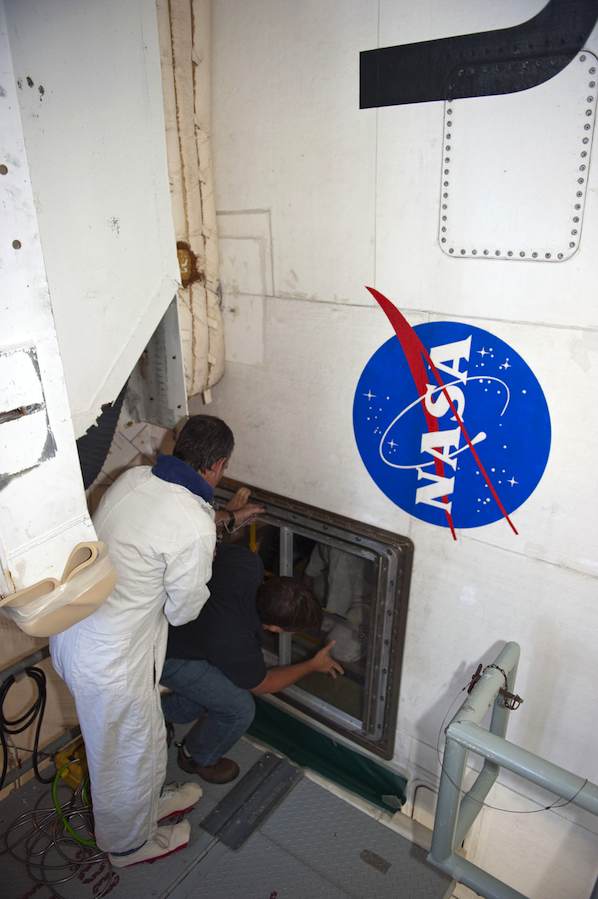
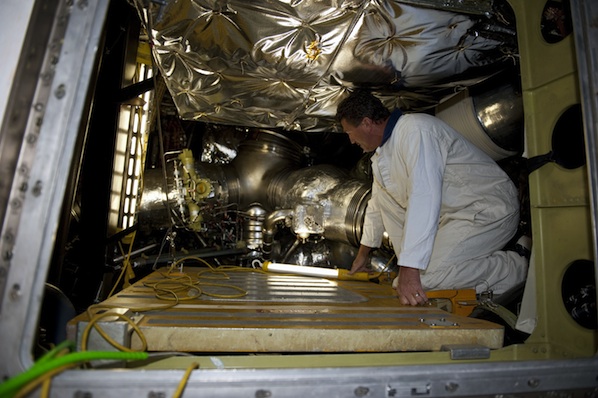
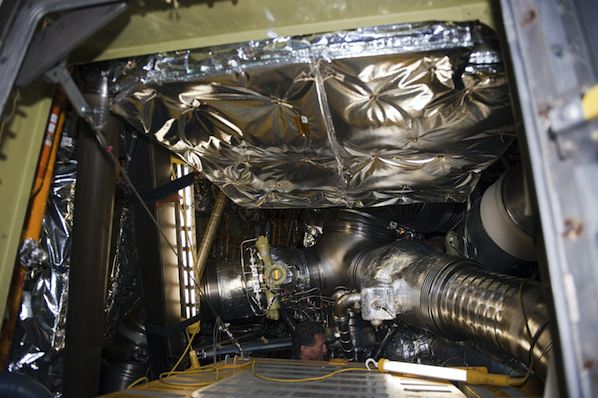
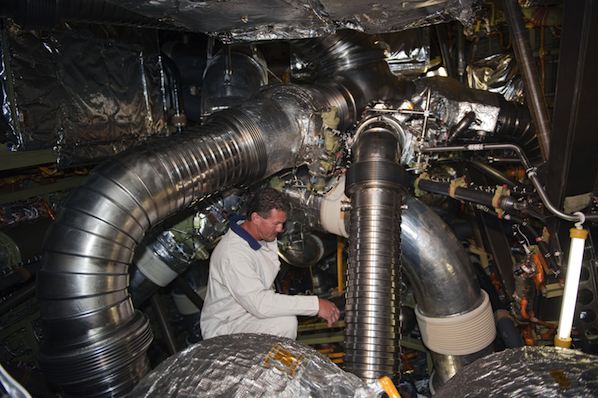
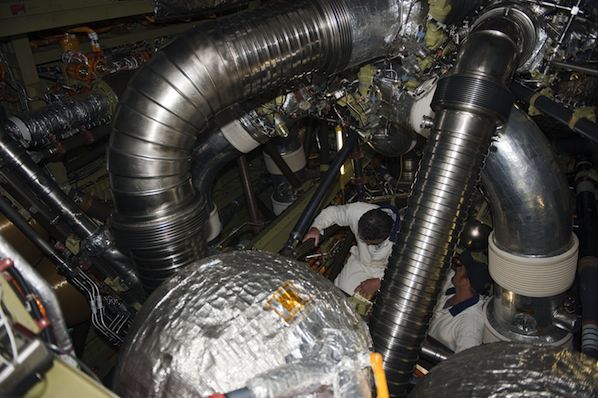
A few pics found on Spaceflight Now :

01.jpg


02.jpg


03.jpg


04.jpg


05.jpg


That looks more complex that my car's engine, for sure ! :lol:
 
Back
Top