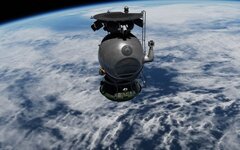
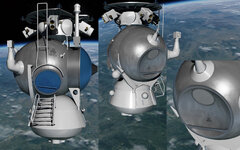
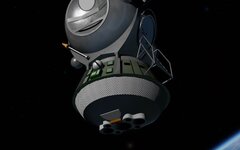
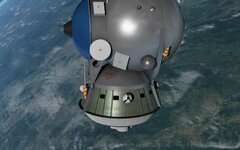
Buck Rogers
Major Spacecadet
- Joined
- Feb 26, 2013
- Messages
- 1,194
- Reaction score
- 1,570
- Points
- 128
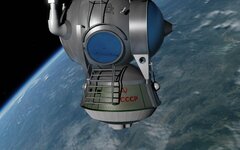
That got me wondering if you could actually make a working periscope using D3D9 reflective surfaces.I modeled the docking periscope
You can with custom cameras.That got me wondering if you could actually make a working periscope using D3D9 reflective surfaces.
It probably wouldn't work but its a nice thought![]()
That would be cool! The reflections are very low quality and lenses would be very difficult though.hat got me wondering if you could actually make a working periscope using D3D9 reflective surfaces.
It probably wouldn't work but its a nice thought![]()
I think this would be the best way to do it.You can with custom cameras.
That was probably just something taken out of the Soyuz for testing inside, no way that would fly. Also, it would look towards the thruster or in the same direction as the (front) window (or sideways), none seem of use.I modeled the docking periscope off the only image I found but I don't think it'll work, it blocks the RCS, and bad angle. I'll remodel shorter and at 90°.
Thanks, nice to see it in action. I think that's the way I modelled it?Don't know if this helps much or is known, mostly for the ladder one, but some LK stuff landed in my timeline:

I'm not as tuned into the lunar stuff as I'd like, but am I understanding correctly the attitude for the lander would be the four slanted down pods at the top? For pitch and yaw that's two nozzles each, roll would be four each. My guess for roll would be each system is a pair of pods 180º apart. This could be off, but if Soyuz commonality applies, I'd say one system operates independently by default, on one combined set of nozzles, and on failure the active system could be switched to the backup (probably irreversible through pyro-valves). Might be possible to get into the weeds if enough info of the crew interfaces exists. As for which set is the main, I'd imagine the one with the greatest torque, so top.The RCS is supposed to have 2 independant reduntant systems, does this mean both are active and by failure the opposite engine is shutdown, or is one system only activated in case of a failure?
I think there were smaller thrusters on the sides of those pods.My guess for roll would be each system is a pair of pods 180º apart.
Two on each, facing opposite ways. So in theory only need two pods to roll either way, and the backup system could use the other two.I think there were smaller thrusters on the sides of those pods.
OK so one system at a time, top first.My guess for roll would be each system is a pair of pods 180º apart. This could be off, but if Soyuz commonality applies, I'd say one system operates independently by default, on one combined set of nozzles, and on failure the active system could be switched to the backup (probably irreversible through pyro-valves). Might be possible to get into the weeds if enough info of the crew interfaces exists. As for which set is the main, I'd imagine the one with the greatest torque, so top.
Astronautix also states the ISP as 245 kgf/s. I was expecting (from my experience so far) a better performance from the RCS? One needs to be very careful with the RCS then!On the ISP differences, the RCS would have been pressure-fed, the engines I'm not sure but might have been pump-fed? I suppose that would lead to a significant difference (though even if they're both pressure-fed, they're still different designs and purposes). Quick look through astronautix has 40 kgf for RCS, and seems to agree with hypergolics for everything, the level of detail there leads me to believe that's accurate.
This is what I presumed too. Due to the low thrust I've decided to have all 8 small thrusters active (also due to setup?), and the top 4 big ones (I'll add the others if damage modelling is added).Two on each, facing opposite ways. So in theory only need two pods to roll either way, and the backup system could use the other two.
One of the ref. pics I usedHere is the image, showing what seem to be the roll thrusters:


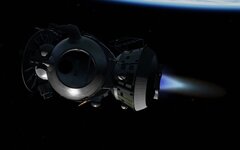
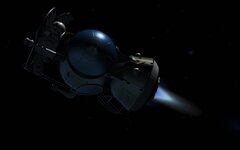
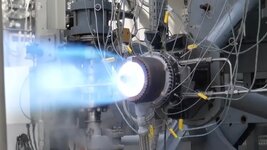
Hypergolic exhaust texture, not sure how it should look like in a vaccum.
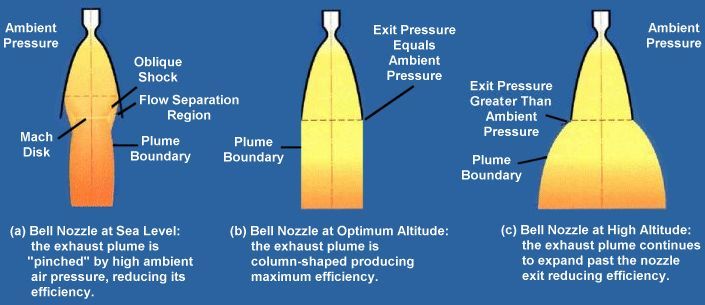
Remember there's no pressure at all in vacuum. It means that the exhaust plume is expanding in a quite spectacular fashion. Your plume is pretty but looks more like the one on the left (sea level) on the diagram below. What you want is something like the diagram on the right. About the color, transparent white is probably the safest bet.
![]()
On the list: https://github.com/orbitersim/orbiter/issues/381Thats also a point that could be improved in OpenOrbiter - realistic exhaust plumes.
I modelled it off an LV launch photo, I think the orange is only seen in the atmosphere? Wide plumes are difficult to do, the exhaust texture uses only a narrow band on the left (most of the .dds is not used).Remember there's no pressure at all in vacuum. It means that the exhaust plume is expanding in a quite spectacular fashion. Your plume is pretty but looks more like the one on the left (sea level) on the diagram below. What you want is something like the diagram on the right. About the color, transparent white is probably the safest bet.

Would also be interested what the suggestions for improvement are?Can you maybe summarize the request in the github ticket?
Nice to see the image uncropped and hi-res!Here is the image, showing what seem to be the roll thrusters:
I modelled it off an LV launch photo, I think the orange is only seen in the atmosphere? Wide plumes are difficult to do, the exhaust texture uses only a narrow band on the left (most of the .dds is not used).