Updates Mars Science Laboratory (Curiosity)

Well as I cant find a thread for Opportunity and it still trudging on.

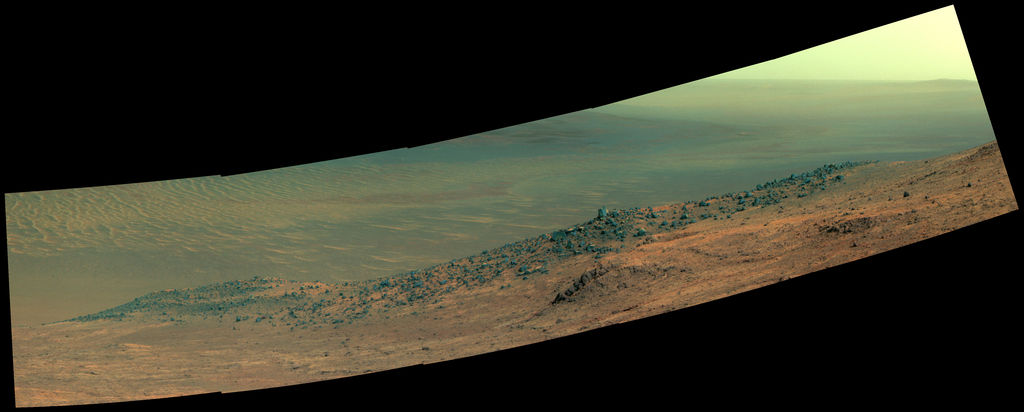
NASA's Opportunity Rover to Explore Mars Gully

opportunity-panorama-warton-ridge-enhanced-pia20850-br2.jpg


NASA's Opportunity Mars rover will drive down a gully carved long ago by a fluid that might have been water, according to the latest plans for the 12-year-old mission. No Mars rover has done that before.

The longest-active rover on Mars also will, for the first time, visit the interior of the crater it has worked beside for the last five years. These activities are part of a two-year extended mission that began Oct. 1, the newest in a series of extensions going back to the end of Opportunity's prime mission in April 2004.

The rover team will face challenges keeping Opportunity active for another two years. Most mechanisms onboard still function well, but motors and other components have far exceeded their life expectancy. Opportunity's twin, Spirit, lost use of two of its six wheels before succumbing to the cold of its fourth Martian winter in 2010. Opportunity will face its eighth Martian winter in 2017. Use of Opportunity's non-volatile "flash" memory for holding data overnight was discontinued last year, so results of each day's observations and measurements must be transmitted that day or lost.
 
NASA: Breaks Observed in Rover Wheel Treads

pia21486.jpg


Two of the raised treads, called grousers, on the left middle wheel of NASA's Curiosity Mars rover broke during the first quarter of 2017, including the one seen partially detached at the top of the wheel in this image from the Mars Hand Lens Imager (MAHLI) camera on the rover's arm.
Credits: NASA/JPL-Caltech/MSSS

A routine check of the aluminum wheels on NASA’s Curiosity Mars rover has found two small breaks on the rover’s left middle wheel—the latest sign of wear and tear as the rover continues its journey, now approaching the 10-mile (16 kilometer) mark.

The mission's first and second breaks in raised treads, called grousers, appeared in a March 19 image check of the wheels, documenting that these breaks occurred after the last check, on Jan. 27.

The monitoring of wheel damage on Curiosity, plus a program of wheel-longevity testing on Earth, was initiated after dents and holes in the wheels were seen to be accumulating faster than anticipated in 2013. Testing showed that at the point when three grousers on a wheel have broken, that wheel has reached about 60 percent of its useful life. Curiosity already has driven well over that fraction of the total distance needed for reaching the key regions of scientific interest on Mars' Mount Sharp.
 
"grousers"

Learned a new word today. Thanks NASA.

Reminds me of the day I learned what "mullions" are.

I certainly hope the wheels hold out long enough. Kind of embarrassing if the lowest tech item on your rover is the part that ends the mission prematurely.
 
Maybe a chance for some space-crazed entrepreneur to fly to Mars and swap tires...
 
Well, they knew in advance that the Mount was...Sharp! They should've provided Curiosity with thickest wheels.
Nomen omen.
 
Maybe a chance for some space-crazed entrepreneur to fly to Mars and swap tires...

:lol:
Now I have an image of a SpaceX tow truck stuck in my mind. :cheers:
 
While Opportunity still thrives, It reminds me of nagging doubts regarding
Curiosity's cost/benefit. It was a very expensive mission, and
we could have used UPGRADED Mer-1 Class rovers to do similar things.
we could have launched two of those, to more Interesting places.

Many of it's Curiosity's scientific accomplishments were confirmation of Earlier Rover missions findings.

IMO, the most impressive things about Curiosity was it's Landing and Design
It may turn out that its landing system and engineering design implementation testing on Mars may be its signature achievements

BUT, such sophistication has a price. and that price is so high as to make
the target area of exploration benign as possible, but also of modest interest.

If we keep Uprated Mer-1 class rovers weight within "normal" balloon sphere type landing, Not only does it have less risk, it opens up more interesting target landing areas. And if we get good at building them (maybe make them lighter as well with more advanced structures) , With spaceX heavy launch vehicles and Delta IV heavy you maybe able to send
2 of them in one go, for the price of 1 Curiosity type rover. The one danger
with the smaller rovers is the dust storms may "kill them" due to lack of
power/heat. There should be an engineering solution to this, and even
to the problem of cleaning the out the panels on occasion.

Curiosity type rovers have their place, probably in carefully scouting out
landing "zone" for manned flights. But the $$ cost means that they cannot become a workhorse for Mars exploration. As of this writing the price of the next Curiosity class rover is over 2.5 billion and once again the risk will dictate a "safe" target zone. But NASA is being penny wise and pound foolish. if you land 180 days from the actual area they wish to investigate
There is no guarantee that through some glitch, it will breakdown before it gets there. So in sum, LETS HEDGE AND GO FOR RISK SPREAD.
 
Weird that this thread is so dead of late...

Had to share this, a panorama shot from Curiosity. The winter weather on this part of Mars was very calm and so the air was very clear when this was shot, and it's stunning.

What amazes me is the blue sky! I had read before that the sky on Mars would be blue if it weren't for all the dust particle blowing around, and it seems that on a clear day it really is, indeed, a pale blue. It's uncanny how much this looks like it could be Utah or someplace familiar.

I wonder what the sunset looked like that evening.

 
As it says in the end of the video, the colors were white-balanced to appear as if it was on Earth, to help geologists identify stuff.

So, nope. Not true color.

I can, however, make a prediction that this or similar image would end up on conspiracy theorists's sites with claims of coverup of... something... on Mars. :(
 
An Interesting Picture From Mars
Keith's Note: NASA recently posted an image taken by the Mars Hand Lens Imager (MAHLI) aboard NASA's Mars rover Curiosity. A reader from Australia contacted me to point out some curious structures within the rock featured in that image.
oomarspic.l.jpg

http://astrobiology.com/2018/02/an-interesting-picture-from-mars.html

This might spur-up the thread...:shifty:

---------- Post added at 10:27 AM ---------- Previous post was at 02:19 AM ----------

The markings appear to be caused by the laser in Curiosity... :uhh:
 
As it says in the end of the video, the colors were white-balanced to appear as if it was on Earth, to help geologists identify stuff.

So, nope. Not true color.

I can, however, make a prediction that this or similar image would end up on conspiracy theorists's sites with claims of coverup of... something... on Mars. :(

For reference, here's an earlier photo from Curiosity with the different color balances applied:

https://en.wikipedia.org/wiki/Color...osityRover-MtSharp-ColorVersions-20120823.jpg

I believe all the color processing is done on Earth, so it should be possible to build a version of that panorama with "as seen by the human eye" white balance instead of "assume that the ambient light is white" white balance.
 
Back
Top