Updates Mars Science Laboratory (Curiosity)

From slate.com
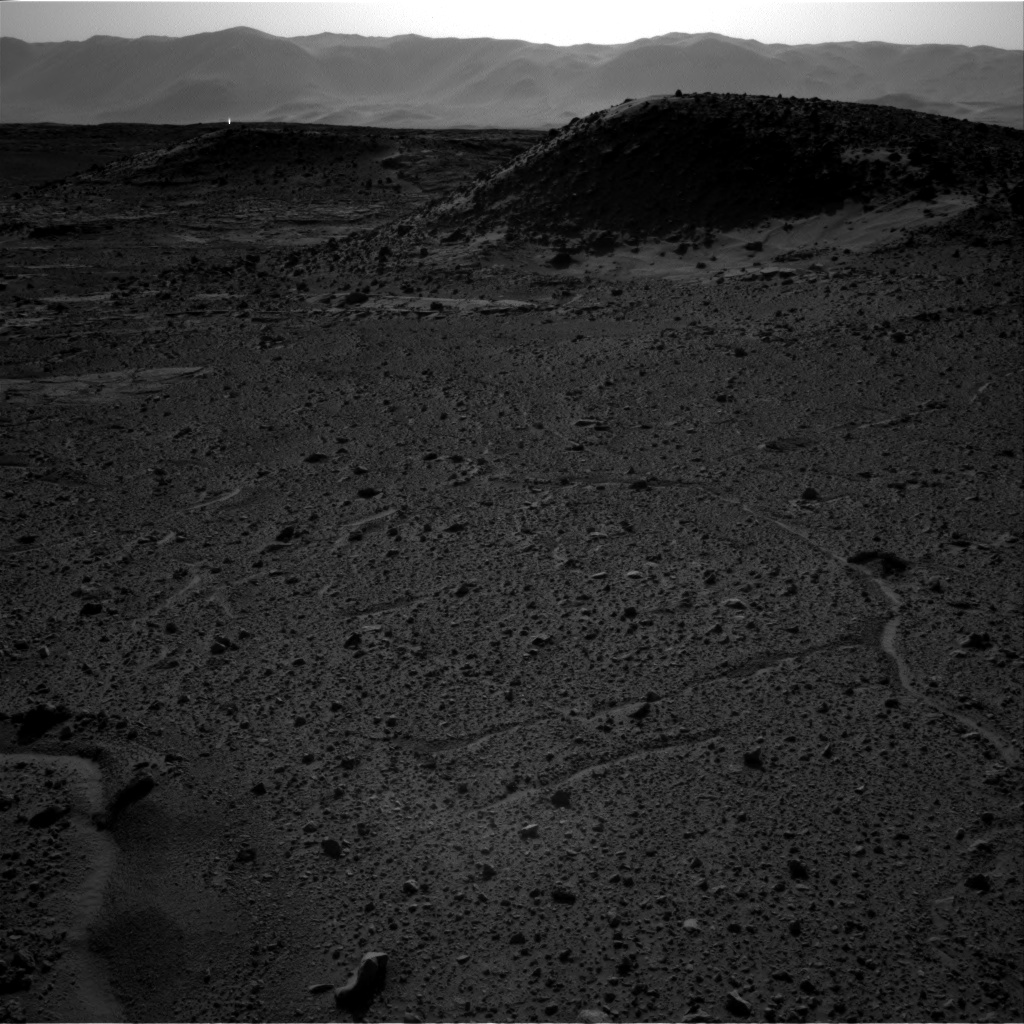
...When I saw the picture, I knew right away it wasn’t from some artificial source. It wasn’t even really a light source on Mars! I’ve worked with astronomical cameras for many, many years, and we see little blips like this all the time. To make sure though, I asked my friend Emily Lakdawalla, who is also a planetary scientist and journalist. Her immediate response: cosmic ray.
 
My money's on weather balloon, but the planetary scientists are probably more correct than me.
 
The skycrane became self-aware and now observes Curiosity at night, duh.
 
Wreckage from the sky crane?

Unlikely. The sky crane traveled away from the rover, and when it crashed, the debris was confined to a fan-shaped field going in the direction of travel that the crane was at during the moment of impact. Thus, any possible debris is directed away from the landing site.

This image displays that clearly...
684928main_pia16143-full_full.jpeg


Also, I don't think Curiosity drove in the direction of the sky crane...
 
Wreckage from the sky crane?
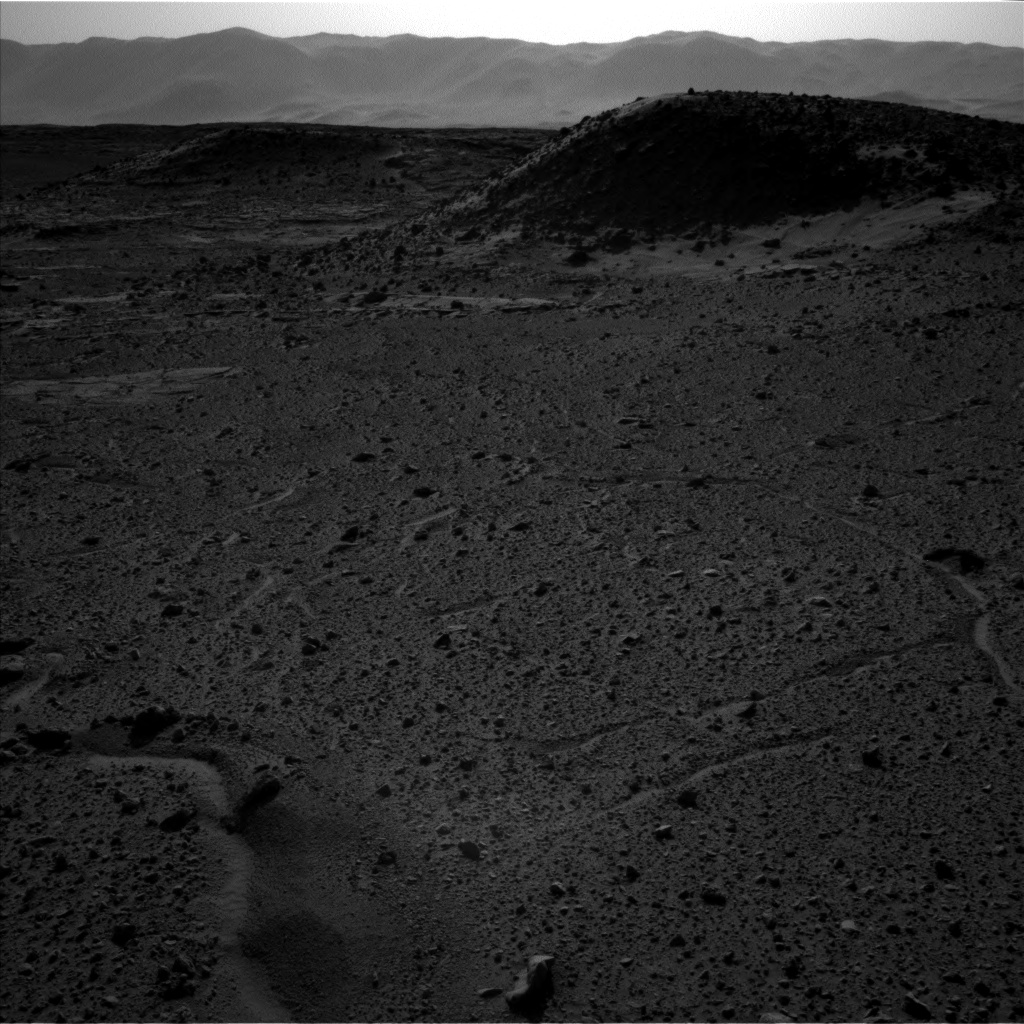
It's probably a cosmic ray that hit Curiosity's right Navcam sensor, an event that happens occasionally. The left Navcam image taken at the same time shows no white dot. If the artifact is anything else, it's a glint from a rock, but that seems less likely and finding its source very complicated. Also, the rover is a few kilometers from the landing site and not getting any closer to where the sky crane crashed.

Left Navcam:
NLB_449790582EDR_F0310000NCAM00262M_.JPG

Right Navcam:
NRB_449790582EDR_F0310000NCAM00262M_.JPG


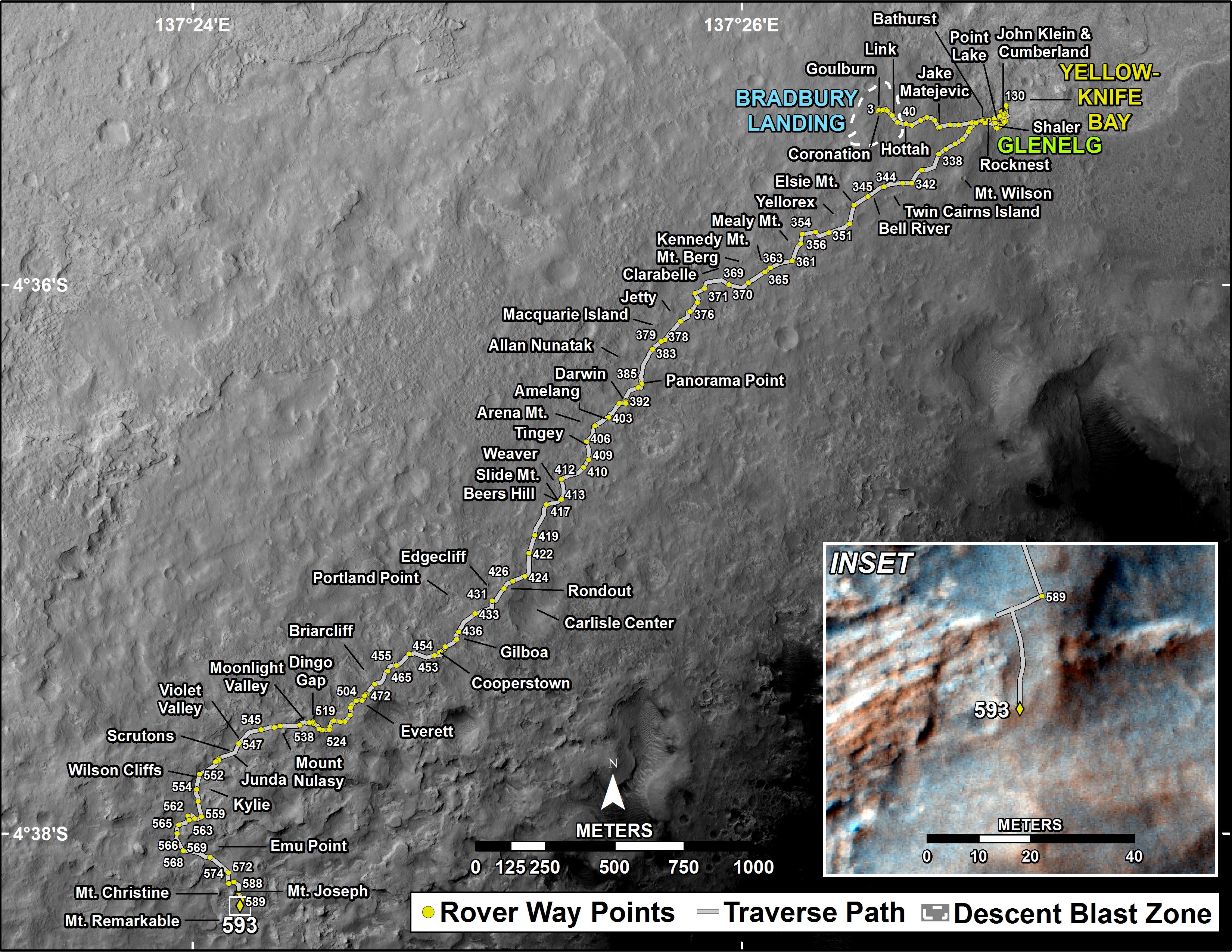
Recent progress:
MSL_TraverseMap_Sol0593-full.jpg


Phil Plait describes it the best (and his article was already posted in this thread):
So that’s what we have here. It’s not some alien rave, or a stranded bug-eyed monster signaling for help, or other fanciful fiction. No, it’s far more mundane, merely the quantized energy deposited by a subatomic particle that was accelerated in the magnetic fields of an exploded star and traveled thousands of light years across the galaxy at nearly the speed of light to finally slam into an electronic camera mounted on a mobile nuclear-powered laser-eyed chemical laboratory humans sent to another planet.
 
Last edited:
Ok, soI'm confused, was there a new image? I thought Peonix was saying there was a new photo with a glint in the same location
 
Curiosity has recently arrived at Kimberley and completed drilling its third sample.

PIA18090.jpg

JPL: NASA's Curiosity Rover Drills Sandstone Slab on Mars
Portions of rock powder collected by the hammering drill on NASA's Curiosity Mars rover from a slab of Martian sandstone will be delivered to the rover's internal instruments.

Rover team members at NASA's Jet Propulsion Laboratory, Pasadena, Calif., received confirmation early today (Tuesday) of Curiosity's third successful acquisition of a drilled rock sample, following the drilling Monday evening (PDT). The fresh hole in the rock target "Windjana," visible in images from the rover, is 0.63 inch (1.6 centimeters) in diameter and about 2.6 inches (6.5 centimeters) deep.

The full-depth hole for sample collection is close to a shallower test hole drilled last week in the same rock, which gave researchers a preview of the interior material as tailings around the hole.

"The drill tailings from this rock are darker-toned and less red than we saw at the two previous drill sites," said Jim Bell of Arizona State University, Tempe, deputy principal investigator for Curiosity's Mast Camera (Mastcam). "This suggests that the detailed chemical and mineral analysis that will be coming from Curiosity's other instruments could reveal different materials than we've seen before. We can't wait to find out!"

[...]
 
PIA18389_mercury_transit-640.gif

JPL: Mercury Passes in Front of the Sun, as Seen From Mars

NASA's Curiosity Mars rover has imaged the planet Mercury passing in front of the sun, visible as a faint darkening that moves across the face of the sun.

This is the first transit of the sun by a planet observed from any planet other than Earth, and also the first imaging of Mercury from Mars. Mercury fills only about one-sixth of one pixel as seen from such great distance, so the darkening does not have a distinct shape, but its position follows Mercury's expected path based on orbital calculations.

The observation by the telephoto camera of Curiosity's two-eyed Mast Camera instrument is available online at:

http://www.jpl.nasa.gov/video/?id=1309
 
Happy 2nd anniversary of roving on Mars Curiosity! :hotcool::banana:

I haven't been tracking on its tracks recently, so what has it been doing lately? Check out here!
 
Flagship Mars Curiosity Rover Doing Too Little with Too Much, Senior Scientists Say
By Dan Leone | Sep. 3, 2014
http://www.spacenews.com/article/ci...y-rover-doing-too-little-with-too-much-senior

Scientific Review Evaluates 7 Planetary Missions, Curiosity Rover Comes in Last Place.
http://www.astrowatch.net/2014/09/scientific-review-evaluates-7-planetary.html


While I am a big supporter of Mars exploration I'd much prefer the Mars 2020 mission to be changed to a lander mission to Europa:

A generational opportunity for Europa.
by Casey Dreier
Monday, July 21, 2014
http://www.thespacereview.com/article/2561/1


Bob Clark
 
Last edited:
Mars Curiosity Rover Has A Broken Arm

NASA's Mars rover is undergoing several days of testing after a short circuit caused one arm to stop responding.
The electrical problem was discovered at the weekend when Curiosity tried to transfer powder from a drilled rock to its on-board analysis tools.
NASA is now running tests on the rover before attempting to move the arm again or drive further across the red planet.
Testing is expected to take several days.
NASA said in a statement: "Telemetry received from the rover indicated that a transient short circuit occurred and the vehicle followed its programmed response, stopping the arm activity under way at the time of the irregularity in the electric current.
"A transient short in some systems on the rover would have little effect on rover operations. In others, it can prompt the rover team to restrict use of a mechanism."
Project manager Jim Erickson added: "We are running tests on the vehicle in its present configuration before we move the arm or drive."
Curiosity landed on Mars in 2012 and since then it has uncovered evidence of an environment that could have supported life early in the planet's history.
The rover will be in operation on the planet indefinitely.

Source
http://news.sky.com/story/1438233/mars-curiosity-rover-has-a-broken-arm
http://rt.com/news/237541-nasa-mars-curiosity-arm/
http://www.sciencerecorder.com/news/curiosity-rover-has-a-broken-arm-nasa-reports/
 
Curiosity Rover Enters Precautionary Safe Mode:
{...}

The team operating NASA's Curiosity Mars rover is taking steps to return the rover to full activity following a precautionary stand-down over the Fourth of July weekend.

Curiosity is now communicating with ground controllers and is stable. The rover put itself into safe mode on July 2, ceasing most activities other than keeping itself healthy and following a prescribed sequence for resuming communications.

Engineers are working to determine the cause of safe-mode entry. Preliminary information indicates an unexpected mismatch between camera software and data-processing software in the main computer. The near-term steps toward resuming full activities begin with requesting more diagnostic information from Curiosity.

{...}
Also, the mission has been extended by 2 years:
NASA last week approved an additional two-year extension, beginning Oct. 1, 2016, for the Mars Science Laboratory Project, which developed and operates Curiosity.
 
Curiosity Mars Rover Resumes Full Operations
Mars Science Laboratory Mission Status Report

UPDATED JULY 11, 2016 AT 1:15 P.M. PDT

NASA's Curiosity Mars rover is resuming full operations today, following work by engineers to investigate why the rover put itself into a safe standby mode on July 2. The rover team brought Curiosity out of safe mode on July 9.

The most likely cause of entry into safe mode has been determined to be a software mismatch in one mode of how image data are transferred on board. Science activity planning for the rover is avoiding use of that mode, which involves writing images from some cameras’ memories into files on the rover’s main computer. Alternate means are available for handling and transmitting all image data.

{...}
 
The first video thumbnail - "What an anniversary gift I got! More worked being forced to do! Yay!"
 
Back
Top