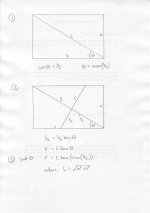
I got that result last night, but was to tired to post the final solution. Here is mine, all the way through. I apologize for any pictures that may be unclear, but I am not used to the program I am using.
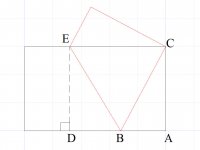
First we fold the notecard, getting line EF, as seen below.
Lets fill in a few values, shall we? I will just list them here, but if you are confused, be sure to ask. For clarity's sake, the smaller segments of BE and FD will be named x.
[math] BE=x[/math]
[math]FD=x[/math]
[math]AF=5-x[/math]
[math]EC=5-x[/math]
[math]BA=3[/math]
[math]CD=3[/math]
[math]EC=FC [/math]
Now, you may be confused as to how I came to that final conclusion, so let me edit our diagram.
You can now see that both EC and FC are radii of the circle C, and are therefore the same lenght. But there is more we can determine about FC!
FC is the hypotenuse of triangle FCD, and therefore it's length can be determined through the Pythagorean theorem.
[math]FD^2+CD^2=FC^2[/math]
plugging in the values we determined earlier;
[math]x^2+3^2=FC^2[/math]
[math]x^2+9=FC^2[/math]
[math]sqrt(x^2+9)=FC[/math]
We can now create an equation to find x, from what we have deduced thus far.
[math] EC=FC[/math]
[math]5-x=sqrt(x^2+9)[/math] (this is where I got stuck yesterday)
[math]5-x (5-x)=x^2+9[/math]
[math]25-10x+x^2=x^2+9[/math]
[math]25-10x=9[/math]
[math]-10x=-16[/math]
[math]x=8/5[/math]
Now that we have x (which is 1.6, as C3P0 got), we must form an equation to plug it into. Let me add to our diagram again, to better explain my process.
(note that I took the circle out, just so it didn't get too cluttered.
As you can see, I dropped in a line through point F, perpendicular to line BC. Let us fill in values again.
[math]FG=3[/math]
[math]GC=x[/math]
[math]EG=5-2x[/math]
We know that GC is x, since it forms rectangle FDCG. The opposite side of FD is also x, so there fore GC must also be, too. Doing this, we have formed triangle FGE, where the hypotenuse, EF, is also the crease. We can find it through the Pythagorean theorem. First, let's plug in for x in line segment EG.
[math]5-2x=EG[/math]
[math]5-2(8/5)=EG[/math]
[math]5-(16/5)=EG[/math]
[math]9/5=EG[/math]
So now, to find the hypotenuse, we must simply do the following equation.
[math]EG^2+FG^2=EF^2[/math]
[math](9/5)^2+3^2=EF^2[/math]
[math](81/25)+9=EF^2[/math]
[math](306/25)=EF^2[/math]
[math](3sqrt34)/5=EF[/math]
So, for our final solution, we have;
[math](3sqrt34)/5=EF[/math]
Now that I have that solved, I'm off to generalize! :thumbup:
Thanks for the help all, it was an interesting one.
Also, C3P0 (if you read this far :lol

, what program were you using in your pictures? It looks pretty nice :thumbup: