Em drives

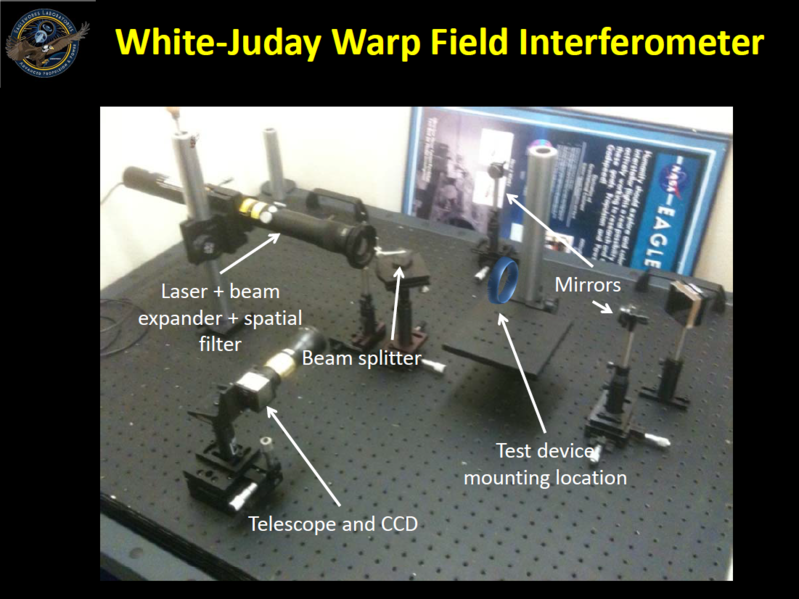
Explanation of the interferometer concept:

756px-White-Juday_Warp_Field_Interferometer.png


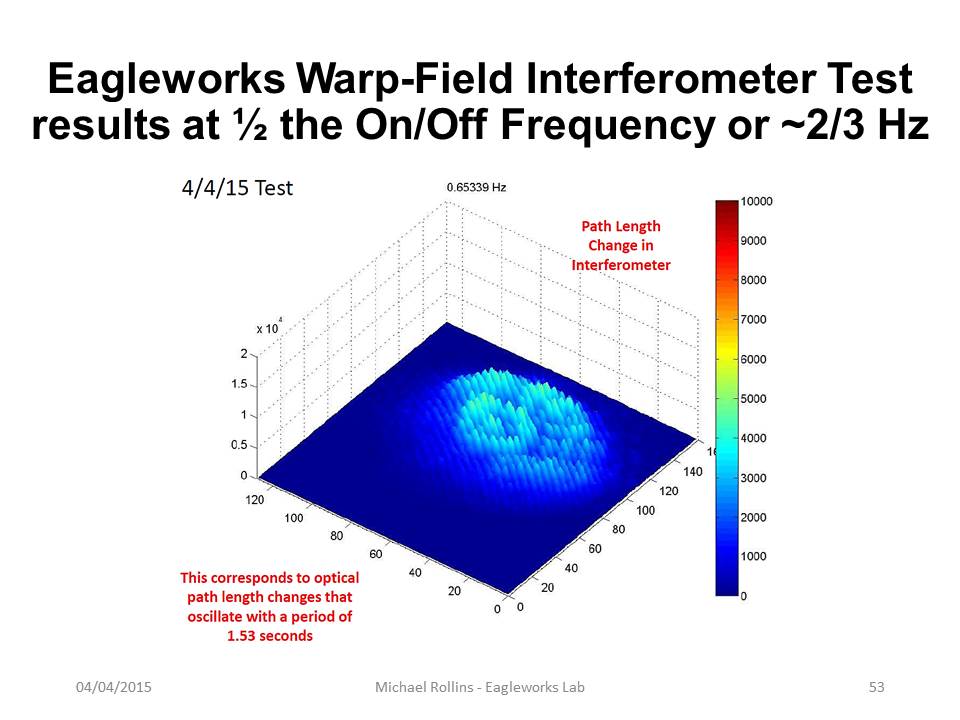
Essentially, the device measures difference in length of the two arms of the interferometers (up/down and left/right) by measuring flight time of photons. The gizmo is mounted on the left/right path. What White is seeing, is that the if the gizmo is powered on, the interferometer shows that the path length on the left/right arm increases by some ~250nm. This is simply not supposed to be happening.

But it gets worse: it appears that the difference in flight time depends on the location inside the cavity, i.e. since the beam has non-zero radius, different parts of the beam experience different change in time of flight (path length). This is even more difficult to explain.

The upside is that the setup looks easy to duplicate for any competent optics lab, so we should have independent confirmation or lack thereof in less than one year.

---------- Post added at 11:05 AM ---------- Previous post was at 11:03 AM ----------

So let me repeat it again: if what the drive produces is rotational momentum, it is close to useless for applications in space. This - and only this - is what my statement was about.

That statement is true.

However, please note that we are dealing with a gizmo that should not be producing any forces, rotational or otherwise!

Not to mention that it should not be affecting light.

---------- Post added at 11:22 AM ---------- Previous post was at 11:05 AM ----------

DIY version of the gizmo: http://www.reddit.com/r/EmDrive/comments/34226k/yes_you_really_can_build_an_emdrive_test_article/

(Usual warnings about working with high power RF apply)

 
However, please note that we are dealing with a gizmo that should not be producing any forces, rotational or otherwise!

I agree that it might demonstrate a electromagnetic principle in a new and creative way, but I am still not convinced that it will result in linear momentum without former linear acceleration due to an equal and opposite force.

If it produces only rotational momentum - by whatever new and exciting way that might be - it is still not a "drive" that can be used for space applications.

If I see it raising the orbit of a space vehicle without pushing stuff out on the other end, though... that would be cool and a reason to party :cheers:.
 
The interferometer shown there is a Michelson interferometer.

[ame="http://en.wikipedia.org/wiki/Michelson_interferometer"]Michelson interferometer - Wikipedia, the free encyclopedia[/ame]

Yes, it is easy to create. I've worked with it several times...


It can measure movements extremely precisely. The idea is that you split the initial beam, then have the two beams travel different paths, then you join them together again so they interfere with each other.

The device doesn't measure the travel time of the beams, it measures the difference of time the two beams take.


What I can't see is what's supposed to be producing any effect in the first place. The only mention I can really find is some "toroidal capacitor ring" or something. I can't find the arrangement of capacitors, the voltage applied to them (YES, VERY VERY IMPORTANT!), any theory of operation that would translate an electric field into space warping...

I can't even find a decent resolution picture worth a damn.

The wiki page itself is a circle jerk of warp field papers and YouTube videos, but none of them explain the setup being tested.
 
We will probably have to wait until White releases an official test report of some kind. So far all we have are some slides which someone from the team has dumped on NSF (I've linked to that post upthread). Everyone else at this point is just speculating based on what gets posted on NSF.

The story as far as I understand this was that NASA already had the setup to investigate space warping by Alcubierre drive (think Interstellar: a ring of capacitors around a spacecraft). Someone on NSF theorized that EmDrive works by space warping, and suggested testing it by putting the gizmo in place of the capacitor ring, and shining the beam through it...

The fun part here is that Shawyer claims that EmDrive is not a warp drive and (according to him) can be explained entirely by SR and EM.
 
Another factor for confusion here is the use of capacitors.

If they're highly charged, then air will get partially ionized. Ions and electrons will be accelerated in the electric field, producing their own emissions of light as well as interacting with the laser. This could produce the effect of slowing light down and "smudging" the interference pattern in a way that you described was shown.

This would also produce heating of air, because the ionized particles eventually smack into another molecule - ionizing it and heating it.

The way I did that experiment, I got the voltage high enough to produce x-rays, even.

Even in a vacuum this would happen because a perfect vacuum is not achievable, but it would happen a lot less. The interference pattern would be sharper, but I also suspect that the path difference will go away.

That said... producing that kind of thrust from emission of radiation alone is impossible. It'd be quicker to suspect that the device is again ionizing air and transferring energy to ions, which then produce thrust. Either way, nothing that'll work in vacuum.
 
I've thought about the rotational thing a bit. If a torsion balance is used to test the small forces, it should be easy to inverse the rotation direction by mounting the device the other way around and test again. If just the direction of rotation changes with all other things being equally observed, internal rotational momentum generation is less likely (but of course not impossible). If it does not, it is almost certain that no linear momentum is observed.

I'm not familiar with the standard scientific approach to these things, so does anybody know if those tests included this reversal procedure already?
 
producing that kind of thrust from emission of radiation alone is impossible.

Not impossible, if you punch enough radiation into it. But the claimed effectivity is high for a pure radiation thruster, and weak for an electric motor.

Any induced current and any induced magnetic field (which are often coupled, surprise surprise) can create more or less strong forces. That the principle behind many electromechanic devices. But its no radiation thruster.

And EM waves can induce very powerful currents in any conductor - an antenna is just a conductor that does not cancel out most of the AC currents that EM waves induce. If you don't trust me, ask your favorite radio/radar technician.
 
Not impossible, if you punch enough radiation into it. But the claimed effectivity is high for a pure radiation thruster, and weak for an electric motor.

Impossible given the kind of power is being pumped into the system - not nearly enough.
 
Impossible given the kind of power is being pumped into the system - not nearly enough.

In relation to the thrust that is reported. It is not violating thermodynamics yet though. Radiation pressure is no violation of known physics.

But "harnessed directed vacuum energy" and other voodoo claims that can not be verified by experimental setups should belong out of a NASA study.

Vacuum energy in the sense of "How modern physics define it" is a lot different to the claims that appear in such papers - the casimir effect for example is pretty interesting there.
 
Last edited:
There are no capacitors. The capacitor ring has been replaced with the EmDrive test article.

---------- Post added at 05:47 PM ---------- Previous post was at 04:47 PM ----------

I'm not familiar with the standard scientific approach to these things, so does anybody know if those tests included this reversal procedure already?

Yes, it was done during the previous test campaign (in air).

http://orbiter-forum.com/showthread.php?p=477009&postcount=80
 
Evaluating NASA’s Futuristic EM Drive

Looks like NASA has now reproduced successful results in a hard vacuum: http://www.nasaspaceflight.com/2015/04/evaluating-nasas-futuristic-em-drive/

However, Paul March, an engineer at NASA Eagleworks, recently reported in NASASpaceFlight.com’s forum (on a thread now over 500,000 views) that NASA has successfully tested their EM Drive in a hard vacuum – the first time any organization has reported such a successful test.

To this end, NASA Eagleworks has now nullified the prevailing hypothesis that thrust measurements were due to thermal convection.

EDIT:
Oops, just saw that TL8 already posted that link 2 pages back. :P
 
Last edited:
Popular Mechanics gets the basic facts wrong:

http://www.popularmechanics.com/science/a15323/temdrive-controversy/

For starters the inventor never claimed that it is a warp drive, the warp drive conjecture originated at NASA.
That's a minor flaw that doesn't negate the point of the article. Does it really matter who came up with the warp drive idea?
Maybe, one day, the emDrive eventually works and we all eat our hats. In space. But the initial results will have to hold up against the forces of peer reviews and repeated tests (which it hasn't so far). Until then, it remains a far-out idea waiting for its day in the sun, or its timely death.
 
The statement that there has been no replication is simply false. The work by NASA/Eagleworks is, in fact, an independent replication of Shawyer's gizmo. Further, it is the second replication of the gizmo, the first having been done by Yang in China in 2010.

The claim of lack of peer-review is also false, because Yang's paper describing his version of the thruster has been published in a peer-reviewed journal.

Further, please let me observe that if we had consistently applied the standard of proof described above, then we would have to reject the discovery of the Higgs boson because it has never been replicated outside of CERN.

Then there is a the whole Extraordinary claims require extraordinary proof adage, which will probably go down in history as one of the most damaging ideas in science ever. Yes, indeed, the claim of space warping is an extraordinary one, but what can be the required extraordinary proof? (*) By definition, it cannot be the proof from Michelson's interferometer, simply because Michelson's interferometer is an ordinary device. There's absolutely no question that White should redo that in vacuum, and someone else should replicate, but beyond that point? Launch the experiment to Earth-Sun L1 to eliminate all outside influence? That's going to be around $1B, kid, and no, we won't give you that $1B because you're making some extraordinary claims, and extraordinary claims require extraordinary proof first, you know.

If you think about it, Carl Sagan's adage allows you to artificially raise the standard of proof for ideas you do not like, thus ensuring that the proof challenging your beliefs will never be delivered. In the old times, to disprove an idea, one had to get up from their desk, run the experiment themselves, and obtain a null result. Now people just contend themselves by saying Gimme moar proof!

(*) Actually, it is less extraordinary then Shawyer's original theory of operation. If the device is warping space it does not violate known physics, it uses currently undiscovered physics.
 
Last edited:
Then there is a the whole Extraordinary claims require extraordinary proof adage, which will probably go down in history as one of the most damaging ideas in science ever.

:rofl::facepalm:

Let me guess: Fairies and unicorns should also become scientific?

Lowering the bar does not make science. Science is a process not a result!
 
:rofl::facepalm:

Let me guess: Fairies and unicorns should also become scientific?

Lowering the bar does not make science. Science is a process not a result!
So Hero of Alexandria shouldn't have built the [ame="http://en.wikipedia.org/wiki/Aeolipile"]Aeolipile[/ame] because he couldn't mathematically describe how it worked?
 
So Hero of Alexandria shouldn't have built the Aeolipile because he couldn't mathematically describe how it worked?

No. But was somebody else capable of reproducing his work in the following 1800 years?

Science is not producing something - hell, most old houses here had been build without even static analysis beyond trial and error.

Would Hero worked scientifically, others would have been able to understand his work and reproduce it. He would have been able to teach his stuff to others. But he didn't. His work was pretty much forgotten, because he kept his knowledge for himself. He likely did not even understand much of it. Just enough to produce devices that other artisans of his time did not have.


So, again: Do you really think that somebody has produced a spacecraft thruster, but we should not expect scientific accuracy there? Then, to put it into the Hero analogy, there should be spacecraft. In Space. Flying.

Otherwise, there should be solid evidence that this device is a spacecraft thruster, that can convince others, even if they are not having much faith in it. But this solid evidence does still not exist.
 
So Hero of Alexandria shouldn't have built the Aeolipile because he couldn't mathematically describe how it worked?

Hero didn't need millions of dollars from taxpayers to support his crazy idea. What he did is something anyone can do in their own kitchen for a few bucks, then and now.

You are free to experiment with whatever wacky ideas you want. You should not expect people to simply hand you money to do them, unless you've got a good reason.

---------- Post added at 06:19 PM ---------- Previous post was at 06:15 PM ----------

Then there is a the whole Extraordinary claims require extraordinary proof adage, which will probably go down in history as one of the most damaging ideas in science ever.

On the contrary; it is one of the filters that separate real science from the wackerdoodles with the perpetual motion machines and the faeries Urwumpe referred to.


Yes, indeed, the claim of space warping is an extraordinary one, but what can be the required extraordinary proof?

Well, you need to identify an observable, and then demonstrate it.

If there is no observable, then you are describing faith, not science.
 
Let me guess: Fairies and unicorns should also become scientific?

Good example, thanks. Let's work it. I make two claims:

(1) I have a horse
(2) I have a unicorn

Please describe to me what evidence will you require to verify my claims. If the evidence needed in case (2) is different than in case (1), then please explain why.
 
Good example, thanks. Let's work it. I make two claims:

(1) I have a horse
(2) I have a unicorn

Please describe to me what evidence will you require to verify my claims. If the evidence needed in case (2) is different than in case (1), then please explain why.

Sorry, but thats not how it works. First of all, how do you want to define what a unicorn is (Thats the most important question behind any scientific discovery)? After all, what a horse is, is globally pretty well defined. So, there should be a difference between the two.
Next, assuming that unicorn is a biological species, breeding two unicorns should result in more unicorns. Or there is a reproducable way to produce unicorns? If this way is glueing a horn on a horse, we would have different definitions of unicorns.
Next, your ownership of a horse can be established by known methods, so there is no need for scientific research to prove this statement.
 
Back
Top