Em drives

So, another possible error source has been eliminated. That's progress. A few more tests changing some of the variables might be a good next step. See if you can make predictions about the things actual performance behavior. Ultimately, I hope they'll stick it to a small satelite and see if they can measurably influence its orbit. If that works, all bets are off. We still might not get how the thing actually works, but we'd know that it works... Which would still surprise me, but I think the concept deserves the opportunity after a few more vacuum tests.
 
I am still skeptical, since even the inventor does not know how it works.

What ever the effect is - it is not as planned and not controlled. Thus, it could really be useless in space. Or useful for something completely different than spacecraft propulsion.
 
http://www.dailymail.co.uk/sciencet...ossible-engine-travel-faster-speed-light.html

282D515000000578-3063082-image-m-45_1430422004612.jpg
 
Last edited:
I am still skeptical, since even the inventor does not know how it works.

Nobody understands how paracetamol works either, but billions of people can attest that it does. Not understanding the mechanism of action has never prevented humans from harnessing an effect.

Your complaint is typical of modern academia, who, for the last 50 years, have been putting theory ahead of experiment. This is however a recent phenomenon; for the most of human history the experiment came first and the theoretical explanations followed.

What ever the effect is - it is not as planned and not controlled.

If you can switch thrust on/off by switching the RF source on/off, then it's obviously controlled.

The original inventor's theory of operation was wrong, that's all, but he has accidentally stumbled on a working gadget.
 
Nobody understands how paracetamol works either, but billions of people can attest that it does. Not understanding the mechanism of action has never prevented humans from harnessing an effect.

Thats not quite the same kind of not-knowledge. This thruster produces an effect - but this effect is not what the inventor predicted. Its not about being able to turn it on or off - its about telling how much input results in which force. Or under which conditions the force is produced.
 
Which are all questions that may possibly be answered by a wide array of experimentation. It's arguable that we don't know how gravity or anything for that matter REALLY works. Not knowing why/how something works doesnt stop it from working.

My main reason for skepticism is not wanting to get my hopes up for seeing a cool/huge/mysterious advance of technology in my lifetime.
 
Which are all questions that may possibly be answered by a wide array of experimentation. It's arguable that we don't know how gravity or anything for that matter REALLY works. Not knowing why/how something works doesnt stop it from working.

My main reason for skepticism is not wanting to get my hopes up for seeing a cool/huge/mysterious advance of technology in my lifetime.

My main problem is the suspicion, that the experiments turn out to be just another "laboratory-only miracle". For really making sure, that the phenomena work, we need to understand them better. We must not know every mu instantly... but good enough to ensure that the effect is not cause by the experiment setup.
 
Well, well, well... it looks like the gizmo is affecting laser interferometers...

http://forum.nasaspaceflight.com/index.php?topic=36313.msg1361931#msg1361931

I browsed that thread and have two (seemingly obvious) questions that seem to have gone unanswered...

How likely is it that "the drive" is confounding the sensors rather than generating actual "thrust"?

and...

Can we conclusively rule out the possibility that this is a "repulsor" effect of some sort where the em field generated by the drive is simply reacting with or "pushing against" an ambient field?
 
This is from Shawyer's lab (not NASA), but an effect of this magnitude is not exactly what I would call "confounding the sensors"...


The basic fact is that the gadget moves. The other basic facts is that there are three groups who claim to have independently gotten the gadget to move (Shawyer, Yang, EagleWorks/NASA), and it's unlikely that all three (or four if we include Fetta/Cannae) groups would have made the same experimental error. The controvesy is down to why exactly it moves: is it pushing against the space itself as the inventors claim, or against the walls of the room/chamber? (We can rule out that it is pushing against air since it has been determined to work in vacuum).

The real killer is the interferometry result though: no "classical" theory of operation can explain that one! Here's a write-up: http://en.wikipedia.org/w/index.php?title=White–Juday_warp-field_interferometer&oldid=660286918
 
Last edited:
Maybe you should go to YouTube and look for "Free energy device". Because a lot of those gadgets move.

Exactly. The point still is if it moves in space. All other inertial thruster designs won't.

Also that Shawyer video shows a rotation, if I'm not mistaken. You can create rotation without fuel by means of reaction wheels even today.

I'll stick to my previous statement: I believe it if it flies.
 
If this setup is supposed to be a torsion balance, its no surprise if it rotates. Properly setup torsion balances are used for many experiments to measure extremely small forces. Like radiation pressure or gravity between two spheres.

Still, if you look at the experiment setup, the most trivial source of a small force has never been excluded: The Lorentz force.

(Which would be pretty boring - we already had satellites using the Lorentz force in space for orbital maneuvers)
 
Also that Shawyer video shows a rotation, if I'm not mistaken. You can create rotation without fuel by means of reaction wheels even today.

Moving the goalposts. You are now alleging an intentional fraud, not a measurement error. The setup is not supposed to have any moving parts.

Except if it was a fraud, then people would be unable to reproduce the effect. Again, there are 3 groups working with this currently.
 
Moving the goalposts. You are now alleging an intentional fraud, not a measurement error. The setup is not supposed to have any moving parts.

Except if it was a fraud, then people would be unable to reproduce the effect. Again, there are 3 groups working with this currently.

Cool your jets down. I'm not alleging anything, I'm simply stating that the movement in the video you posted looks like rotation. You could easily mistake a rotation for linear movement if the displacement is small enough. And if the device produces rotation, this is close to useless for actual applications.

That's what my statement was about. Interesting that you bring up words like "fraud", though. Is it some kind of deep fear that it might eventually reveal as such? If so, don't worry, it won't be that hefty.
 
Still, if you look at the experiment setup, the most trivial source of a small force has never been excluded: The Lorentz force.

How do you get net Lorentz force with AC fields?

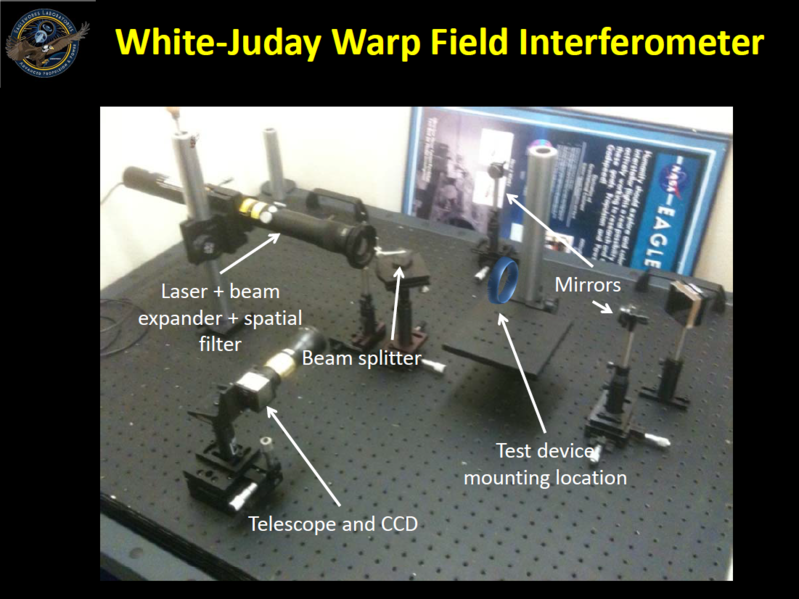
But, ignore whether the gizmo moves or not. This is the newest development, which came around because someone on NSF floated a crazy idea to explain why it moves. This is the test setup:

799px-White-Juday_Warp_Field_Interferometer_Experiment.png


2015_NASA-JSC_Eagleworks_Warp-field_Interferometer_Test_Set_Up.jpg


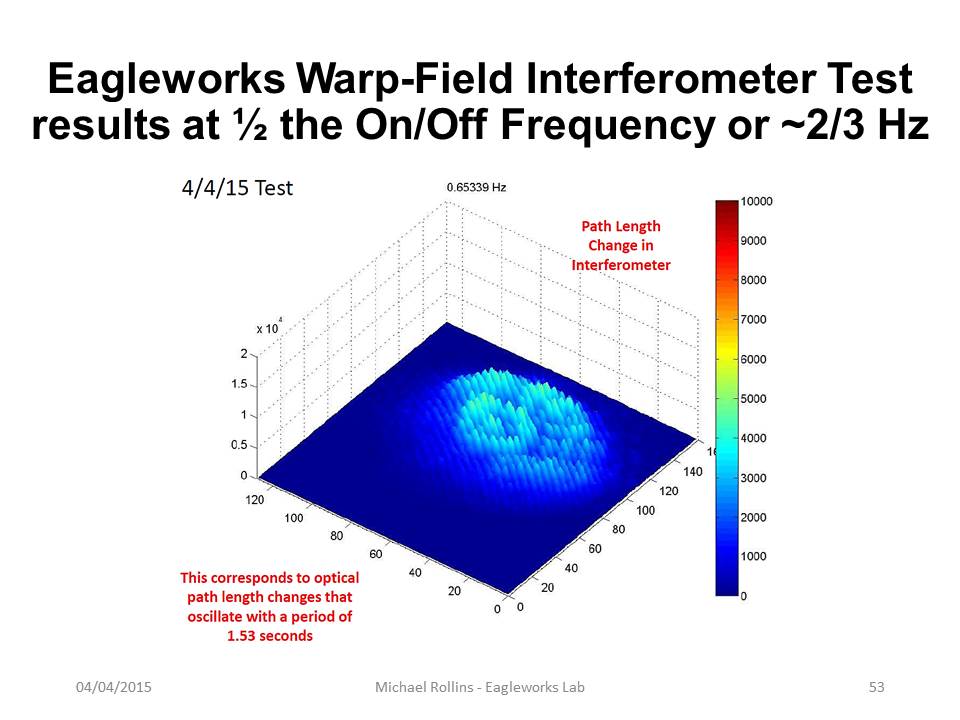
Note that the gizmo is fixed, and all they are doing is running laser rays through the cavity... and:

Eagleworks_Warp-Field_Interferometer_CCD_Camera_Test_Results_04-04-2015.jpg


This is simply not supposed to be happening.

White calculated that it cannot be due to air heating, but wants to redo that in vacuum anyway. If he gets intereference patterns in vacuum, then it will become really interesting...

---------- Post added at 10:34 AM ---------- Previous post was at 10:24 AM ----------

Cool your jets down. I'm not alleging anything, I'm simply stating that the movement in the video you posted looks like rotation. You could easily mistake a rotation for linear movement if the displacement is small enough. And if the device produces rotation, this is close to useless for actual applications.

In the video, the gizmo is mounted on the edge of the platform, with the supposed direction of thrust parallel to the edge, so you have this:

vtord.gif


Thus, either the device produces force which results in torque rotating the platform (by whatever mechanism), or he has an electric motor on the axis which produces the torque (fraud). Tertium non datur.
 
Last edited:
Thus, either the device produces force which results in torque rotating the platform (by whatever mechanism), or he has an electric motor on the axis which produces the torque (fraud). Tertium non datur.

And only because you can't imagine interaction of electromagnetic forces with the environment that result in a rotational momentum, you automatically assume that it is either this or that and consequentially I am alleging fraud?!? What a weird logic.

There are so many possible reasons for a rotational momentum besides an intentional fraud commited by an electric motor, that your "tertium non datur" is a very weak argument for laying words in my mouth.

So let me repeat it again: if what the drive produces is rotational momentum, it is close to useless for applications in space. This - and only this - is what my statement was about.
 
Back
Top