
- Joined
- Oct 30, 2009
- Messages
- 14,019
- Reaction score
- 4
- Points
- 0

... Chang'e 2 does not seem to be a radically different spacecraft from its sister, Chang'e 1, which was launched to the Moon in 2007. In theory, China could still have launched this bird to the Moon with the same Long March 3A launch vehicle used for Chang'e 1.
However, the upgrade to the more powerful Long March 3C rocket does produce its advantages. It leaves Chang'e 2 well stocked with fuel. The mission hadn't reached the final stages of countdown when China's state media began to discuss this, suggesting a great deal of confidence in the fuel surfeit. The confidence was so high that the media was openly speculating that the spacecraft would leave lunar orbit at the end of its primary mission.
...
Chinese media have spoken of different options for a post-primary mission for Chang'e 2. Evidently, controllers are keeping their options open. Exactly what happens to Chang'e in another six months will probably depend on the exact amount of fuel left, the state of the spacecraft, and the outcome of some conscientious debate that's probably already underway.
The easiest plan would be to remain in lunar orbit for an extended mission. This could be useful if China wants to closely reconnoiter more areas at close range. The orbit could be shifted to dip downwards at several key areas, enabling high-resolution photos to be taken.
...


A 15 kilometers above the surface orbit, that's something I would be afraid to do in Orbiter, because of the tidal effects of the Earth and Sun ! That should give great pics, another probe on the way ! :hail:

That isn't funny. Then the cape would end up in Fallout! (or is it Fallout 2?)
Darren
Several months after departing from the moon, a Chinese spacecraft has arrived at a new destination about 930,000 miles (1.5 million kilometers) from Earth, according to news reports in China.
The Chang'e 2 moon probe arrived at Lagrange Point 2 (L2) — a place where the gravity of Earth and the sun roughly balance out — on Aug. 25, the Xinhua news service reported Tuesday (Aug. 30). Chang'e 2 had left lunar orbit in early June to head for deeper space.
China is now the world's third nation or agency to put a probe in L2, one of five spots in near-Earth space that serve as a sort of parking lot for spacecraft to hover without being pulled toward any planetary body. NASA and the European Space Agency have also accomplished the feat.
{...}
{...}
Deep space exploration
China's State Administration for Science, Technology and Industry for National Defense has heralded the repurposed probe, which has made China's space agency the third ever to visit a Lagrangian point. Missions launched by the European Space Agency and NASA also visited Lagrangian points.
Liu Tongjie, the deputy director for the second-phase project of the China Lunar Exploration Program, said Chang'e 2 new position allows it to tackle two scientific tasks: observing the Earth's magnetic field and charting solar storms, according to a China Daily report.
Yet another assignment for October is for Chang'e 2 to help assess the capability of two large deep space communications antennas in China, Liu said.
One antenna, 115 feet (35 meters) in diameter, is being built at Kashgar in the northwest. The second antenna is nearly twice the size, with a diameter of nearly 210 feet (64 meters), and is being built at Jiamusi in the northeast.
These antennas will be part of China's deep space network, reportedly to take shape in 2016 and built to handle possible future exploration of Jupiter and the poles of the sun.
{...}
Chinese scientists have assembled the highest resolution map ever created of the entire Moon and unveiled a series of global Moon images on Monday, Feb. 6.
The composite Lunar maps were created from over 700 individual images captured by China’s Chang’e-2 spacecraft and released by the country’s State Administration of Science, Technology and Industry for National Defence (SASTIND), according to reports from the state run Xinhua and CCTV new agencies.
“The map and images are the highest-resolution photos of the entirety of the moon’s surface to be published thus far,” said Liu Dongkui, deputy chief commander of China’s lunar probe project, reports Xinhua.
Of course there are much higher resolution photos of numerous individual locations on the moon taken from orbit by the spacecraft of other countries and from the surface by NASA’s Apollo lunar landing astronauts as well as unmanned Russian & American lunar landers and rovers.
{...}
The images were snapped between October 2010 and May 2011 using a charge-coupled device (CCD) stereo camera as the spacecraft flew overhead in a highly elliptical orbit ranging from 15 km to 100 km altitude.
The Chang’e-2 maps have a resolution of 7 meters, which is 17 times greater than from China’s first lunar orbiter; Chang’e-1, launched in 2007.
In fact the maps are detailed enough that Chinese scientists were able to detect traces of the Apollo landers, said Yan Jun, chief application scientist for China’s lunar exploration project.
Chang’e-2 also captured high resolution photos of the “Sinus Iridum”area , or Bay of Rainbows, where China may land their next moon mission. The camera had the ability to resolve features as small as 1 meter across at the lowest altitude.
The satellite left lunar orbit in June 2011 and is currently orbiting the moon’s second Lagrange Point (L2), located more than 1.5 million km away from Earth.
{...}

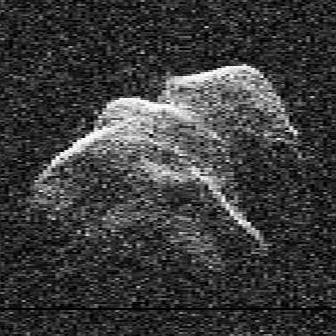

{...} Second, user "Galactic Penguin" at the NASASpaceflight forum (who was the original person to post this news in the first place, evidently) {...}


