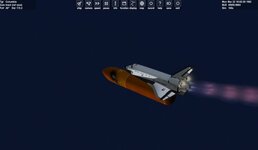
Project Space Shuttle Vessel

Yes saved. It might be easier to just add that wires into my dfi. Now it makes me what to redo my dfi with the spartan attachments. Just need to see better images,.
.
 
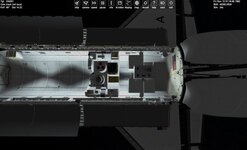
Not sure why not seeing the wire tray? My DFI has a texture of the wires,... in the center
 

Attachments

  • sts2dfi.jpg
    sts2dfi.jpg
    41.7 KB · Views: 9
  • sts3dfi.jpg
    sts3dfi.jpg
    61.5 KB · Views: 9
Not sure why not seeing the wire tray? My DFI has a texture of the wires,... in the center
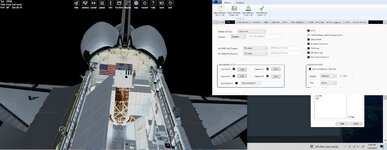
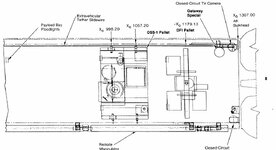
The DFI wire tray are the 2 white panels (convering the wires) in the bottom aft of the PLB, they are not part of the pallet.
 
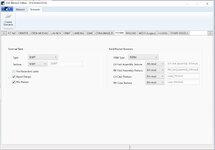
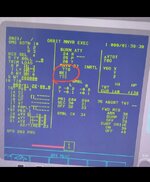
Hi, I have done three burns successfully. The 1st was to circularized my orbit and the another two burns rising my apogee to 140 and perigee 138

I noticed after the burns, that the TTA and TTP is not there anymore but

TTG
REI
TTC

I take it that the TT in the TTC, TTG is also 'Time To'
done some reseach but have no idea what the C and G or REI stands for. And how to get the TTA and TTP to be displayed again? In order to calculate the next burn.

Screenshot_20250131_233841_WhatsApp.jpg
 
Hi, I have done three burns successfully. The 1st was to circularized my orbit and the another two burns rising my apogee to 140 and perigee 138

I noticed after the burns, that the TTA and TTP is not there anymore but

TTG
REI
TTC

I take it that the TT in the TTC, TTG is also 'Time To'
done some reseach but have no idea what the C and G or REI stands for. And how to get the TTA and TTP to be displayed again? In order to calculate the next burn.

View attachment 42010


Data Processing System Dictionary said:
Orbiter range in nautical miles from 400k feet to the landing site is shown next to REI in OPS 3. Time-to-next-apsis (for OPS 1 and 2) or Time-to-400k feet for OPS 3 is provided, in minutes and seconds, next to TXX. In OPS 1 and 2, time to apogee (TTA) or time to perigee (TTP), whichever is closer, is displayed unless apogee and perigee differ by less than 5 nm. In this case, the title becomes TTC (Time- to-Circularize) and the time field is blanked. During OPS 3, TXX becomes TFF (Time-to-400k feet).
 
Hi, I have done three burns successfully. The 1st was to circularized my orbit and the another two burns rising my apogee to 140 and perigee 138

I noticed after the burns, that the TTA and TTP is not there anymore but

TTG
REI
TTC

I take it that the TT in the TTC, TTG is also 'Time To'
done some reseach but have no idea what the C and G or REI stands for. And how to get the TTA and TTP to be displayed again? In order to calculate the next burn.

  1. Fetch yourself a copy of the DPS Dictionary for such help, most parameters are well explained there.
  2. Some common parameters:
    1. REI = Range from entry interface to landing site
    2. TTG = Time to go
    3. TTC = Time to circularization
    4. TTF = Time to 400 kft.
    5. TTA = Time to apogee
    6. TTP = Time to perigee
 
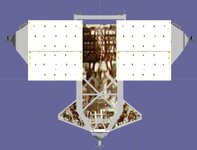
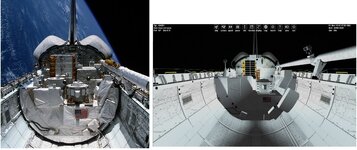
STS-3 This is what I get as far as payloads. The dates, orbits,... are wrong. I wonder if the best way is to set up a launch scn?
 

Attachments

  • STS3SSV3.jpg
    STS3SSV3.jpg
    68.1 KB · Views: 12
  • OSS1PALLETLOCATION.jpg
    OSS1PALLETLOCATION.jpg
    33.3 KB · Views: 12
  • STS3CBLOCATION.jpg
    STS3CBLOCATION.jpg
    81.6 KB · Views: 10
  • STS3SSV4.jpg
    STS3SSV4.jpg
    64.4 KB · Views: 12
  • sts3compare.jpg
    sts3compare.jpg
    101.5 KB · Views: 14
The dates, orbits,... are wrong. I wonder if the best way is to set up a launch scn?
Yes... there's no way I can figure out where the vehicle was at some point during the mission. 🤷‍♂️

For detail accuracy, select the old-type CCTV cameras ("-506/-508", on the Orbiter tab, and the Payload tab for the RMS cameras)


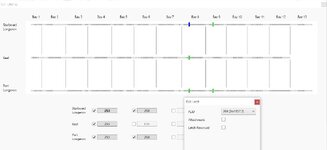
BTW: on the PLB preview feature... it started as something quick and simple, but then it snowballed into more work... :cautious:
I'll should have something pretty to show maybe in a week.
 
I meant that, for a mission the user creates (I don't know if it is real or fictional), I can't* figure out the vehicle state at some random point during the mission. That is why the Mission Editor only has pre-launch scenarios.


*) maybe with 1001 more parameters, but there are better things to do.

Well, even that is a solvable problem. Or is it impossible to save and restore a state during a mission?
 
Well, even that is a solvable problem. Or is it impossible to save and restore a state during a mission?
Let's say that I create a fictional mission to launch a new fictional module to my fictional space station. What information is needed so Mission Editor can create a scenario in orbit?
Where is the vehicle? Somewhere in the rendezvous profile, docked, or on the way home? Need data on all the planned orbit maneuvers and loads of math to propagate the vehicle position.
Same for vehicle attitude.
What consumables does the vehicle still have? Need data on planned prop usage.
If docked, what is the vehicle doing? Is the RMS holding the module? Where is the module? What state is the station?

And this is just for a nominal flight... one might expect a T+2h scenario to be in orbit, but could very well be on the ground, with the vehicle being towed off the runway after an abort landing.

So yes it is is a solvable problem, NASA solved it (I'd say) hundreds of times, but the required information and detail is too large for 99% of users to care, and they'll end up going with the T-31s scenario option. 🤷‍♂️


There are easier, and more useful features on which to invest time.
 
I will go here, all I care is standard situations (T-31, or -9 min), plus open bay for viewing mode. I am quite satisfied with these options.
P.S. About those other things (maybe) to do. I noticed SRB deflection smoke cloud is noticably smaller that SSME' s, maybe values from SSME's deflection smoke can be transferred to SRB's, to make them similar?
Because SSME's defelection smoke cloud parameters and size are OK.
 
Actually I just meant: Give me a launch scenario and let the computing power of my PC handle it. If I don't have a flight plan, I can at least reconstruct the maneuvers by taking the TLE and find the fitting intersections between the orbits. Maybe I get a wrong TIG by one or two orbits then, but it should be accurate enough if I don't have a flight plan.

Of course: With Orbiter 2024, it would be very GREAT! if the switches could be flipped from Lua. If you still have most of the SSU code base there, it might be straight forward, maybe I can make a PR for that then, if you permit.
 
plus open bay for viewing mode
You should get that before the Spring.


I noticed SRB deflection smoke cloud is noticably smaller that SSME' s, maybe values from SSME's deflection smoke can be transferred to SRB's, to make them similar?
Somehow the particles behave differently in different graphic clients, and they where sized more for MOGE than for D3D9. I'll try to balance it a bit more.


Actually I just meant: Give me a launch scenario and let the computing power of my PC handle it. If I don't have a flight plan, I can at least reconstruct the maneuvers by taking the TLE and find the fitting intersections between the orbits. Maybe I get a wrong TIG by one or two orbits then, but it should be accurate enough if I don't have a flight plan.
Where are you getting the TLEs for my fictional space station mission above?
In terms of mission planning, the thing I have at the top of the list (well, second now as it was bumped by the PLB preview thing) is a simple calculator to figure out the propellant offload in the IUS, and later in a PAM. Take payload mass + destination (GEO or escape) = prop offload. It won't cover all cases, but it would still be a big help on most of them.
I see that as a much better investment that trying to skip the launch and go straight to FD2 or something. 🤷‍♂️

Of course: With Orbiter 2024, it would be very GREAT! if the switches could be flipped from Lua. If you still have most of the SSU code base there, it might be straight forward, maybe I can make a PR for that then, if you permit.
Hmm, maybe not in lua, but that might already be possible, by having a pointer to the vessel and then calling the standard mouse event callback with the correct parameters.
But, what would happen if this could be done from lua?
 
Where are you getting the TLEs for my fictional space station mission above?

Wouldn't more be a matter than of WHERE the payload / station should be? And simulate everything around these constraints in Orbiter?

Also, with Lua, it is possible to run a Orbiter 2024 session headless (without graphics) and with fixed timesteps. Some things could be better there, but everything needed is already there. It could even be launched for that from a command line. Which means, it could be possible to script a basic (no failures) launch and save a state after a defined sim time, while not spending as much time. And if you have that for one mission, you could quickly reuse it for the next.... etc.
 
Wouldn't more be a matter than of WHERE the payload / station should be? And simulate everything around these constraints in Orbiter?

Also, with Lua, it is possible to run a Orbiter 2024 session headless (without graphics) and with fixed timesteps. Some things could be better there, but everything needed is already there. It could even be launched for that from a command line. Which means, it could be possible to script a basic (no failures) launch and save a state after a defined sim time, while not spending as much time. And if you have that for one mission, you could quickly reuse it for the next.... etc.
I'm sorry, maybe I'm too overworked and sleep deprived to see better, but that just seems like a lot of work to skip the launch...
 
For actual flown missions, if you wanted saved scenerios by far the easiest solution would be to just fly from launch and save along the way. This is almost certianly less work (and probably more fun) than trying to propagate that with all possible perturbations.
 
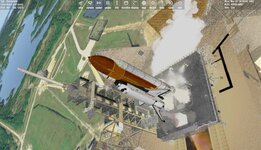
Launched sts3

Not sure on which ET?
 

Attachments

  • sts3ssvet.jpg
    sts3ssvet.jpg
    41 KB · Views: 17
  • ssvsts3launch2.jpg
    ssvsts3launch2.jpg
    26.9 KB · Views: 17
  • ssvsts3launch1.jpg
    ssvsts3launch1.jpg
    137.8 KB · Views: 17
Launched sts3

Not sure on which ET?

STS-3 still used a unique kind of ET, I think. The first orange (unpainted), but with some differences to the first standard weight tank (SWT) ET used on STS-4. Somewhere was an overview of the first tanks used, but I can't find it again.
 
Back
Top