Project VulcanCentaur

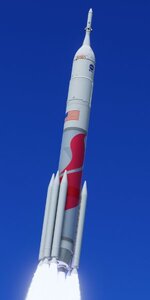
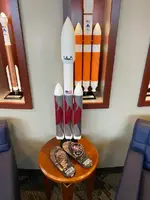
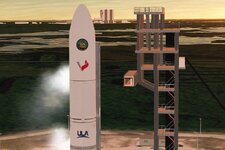
I mean we do have a complete Orion and LES spacecraft already as a mod, in addition to an SLC-41 launch complex with a crew-access tower (for Starliner), the only way to do now is find a way to mount it on the Vulcan Centaur rocket
GWBt1o9XYAAlBaK.jpeg
 
As good as it looks :) I am not sure this is based on any real-world assumptions.
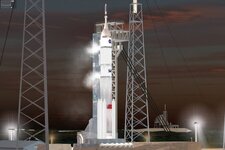
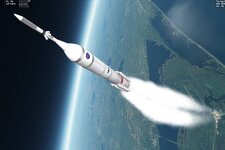
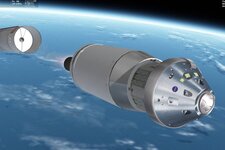
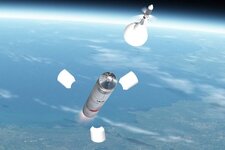
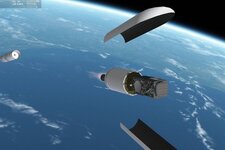
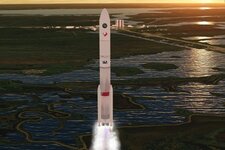
While the Orion fits onto a Vulcan Centaur VC6N, the launch mass of the Orion is too high to achieve orbit.
The Centaur upper stage - while being very fuel effective - lacks the punch of high-thrust engines and falls back into the atmosphere, with the Orion attached.

If you want to play around yourself by modifying a steeper launch trajectory, the Orion-MPCV-15 needs to be installed.
Scenario file 'VC6N Orion' see attached below.

0040a.jpg
0032a.jpg
0039a.jpg
 

Attachments

Huh. That's weird. Iirc the Vulcan Centaur is more powerful than a Delta IV-Heavy, yet the latter managed to lift the first Orion to orbit back in 2014.
 
Googling gave me this:
- Delta IV Heavy can lift 28,370 kg to low Earth orbit.
(Note that the Orion test launch on the Delta IV Heavy did not have a service module attached.)

  • A Vulcan Centaur with six solid rocket boosters can put 27,200 kilograms into low Earth orbit, nearly as much as the Delta IV Heavy.
  • Orion has 33.446 kg (LAS, crew module, service module, upper stage adapter)

The Orion-MPCV-15 seems to be too heavy. The payload reading of the launcher shows around 43.000 kg.
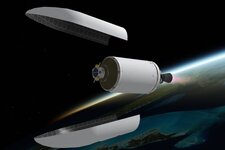
Also the VulcanCentaur addon does not handle mass changes of the payload too well (jettison of LAS and panels).
It only re-checks the payload mass at stage separation, which is a bit later than the LAS jettison.

0051a.jpg
 
I keep forgetting that Orion EFT-1 doesn't have a live service module attached. I guess, if ever Vulcan Centaur is used for Orion, the spacecraft would not be fully fueled (like the Apollo CSM and Saturn 1B combination) to be able to go to LEO. But yeah, I don't think Orion would be ever used for LEO missions (unless a Mars-bound spacecraft happens to be assembled in LEO)

Still a fun concept, regardless though
 
Last edited:
1739094362772.jpeg
Attached is a small maintenance update of the Vulcan Centaur launcher.

- Modified the launch autopilot - key [V] - to reduce the up-and-down pitching (it still wobbles a bit)
Please test it. It seems to behave differently on different frame rates or time compression (1x or 10x).

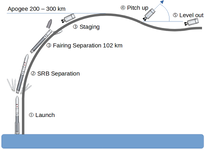
Remember that after first stage MECO the autopilot shuts off and you have to take control. The trajectory overshoots the orbit height to 300 - 400 km, before dropping back to the desired perigee.
1739095250911.png

- Re-did and re-named the scenario files. If you are not using a mod-manager, please empty the folder 'Scenarios\VulcanCentaur' before installing. Added a 9 ton heavy Maxar 1300 satellite (shown in the screenshot above) as payload to GEO.
 

Attachments

Like this idea and might be the way to save Artemis or have a backup for the Dragon. brianj did some DOD sats in 2006 and they might be fun to see launch with this rocket
 
If you make this you might check with gattis about his latest Orion. Might think about using the Orion CM on a centaur 5 with solar panels for Artemis 2
 
you might check with gattis about his latest Orion
Could you maybe give it a try? I am not sure what is the latest Orion, and what are the dependencies.

Meanwhile I corrected the mass of the Orion-MPCV to 33.446 kg, and tried some manual launches.
But flat or steep trajectory, none was successful. I am pretty sure, the launch mass of Orion is beyond Vulcans capability.
 
Just for fun :) :
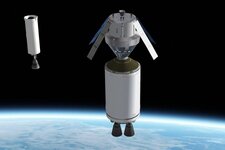
If you are into alternative launch scenarios for the Orion, launch it on a FalconHeavy, then dock in Low Earth Orbit to a fully fueled Centaur upper stage. The FalconHeavy has enough power to lift the Orion into orbit, and a fully fueled Centaur has enough dV to boost it on a Lunar trajectory.

See also here. Scroll down to: "In a totally hypothetical scenario, the "Department of Government Efficiency" (DOGE 🐶) has stopped the production of the SLS-launcher ..."
0054a.jpg
 
the weak link in the Artemis mission is the ESA service module, it can not do what the Apollo SM could do. Along with lots of launches the Artemis program is a dead woman walking. the Alpaca or even the Altair lander would be the only way to reach the Moon any time soon. Project Constellation could have put us there by now, yes you would need new stuff for every mission but what does Gateway cost and 12 flights with an unproven system cost.

Maybe a new look at this Vulcan / Orion and the SLS / Altair might be the better way to go . Maybe a short version of a Centaur 5 with solar panels on it could be used for the Orion SM to get the Orion home and the Altair descent stage to do the LOI burns
 
According to Gunter's page, seems to indicate GSSAP 8 and Sunrise 1-6 is the other cargos

 
Sorry, it looks like USSF-87 is the mission flying GASSP-7 & 8 and Sunrise 1-6

Hypothetical near-term schedule, SLC-41, UTC:

✅️ June 23 - Project Kuiper KA-02 (2 of 8) (x27) - Atlas V 551 (AV-105)

late July - USSF-106: NTS-3 (Timation-5) [Vanguard], USSF payload TBA - Vulcan VC4S (V003)

NET August - USSF-87: GSSAP 7, GSSAP 8 - Vulcan-VC4S (V004)

NET September - ViaSat-3.2 (ViaSat-3 EMEA) - Atlas V 551 (AV-100) - Canaveral SLC-41

NET Q3 - Kuiper KV-01 (x45) - Vulcan-VC6L - Canaveral SLC-41

NET H2 - Project Kuiper KA-03 (3 of 8) (x27) - Atlas V 551 (AV-10x)

later fall - Dream Chaser Cargo System 1st flight [DCC-1] (SNC-1): Tenacity, Shooting Star - Vulcan-VC4L - Canaveral SLC-41
 
I had actually also been playing around with USSF-106 only using Brianj's LCROSS payload mesh and a modified config file lol
I'm a diehard AtlasV fan, was there for the very first launch and many since. I'm so trying to warm up to the Vulcan, but I guess it is like comparing a 1957 Chevy Bel Air to a 1967 Chevy Bel Air, one has beautiful lines, the other is just a boxy power house
 
Last edited:
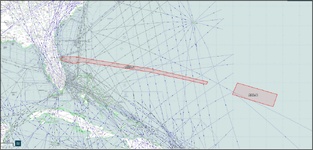
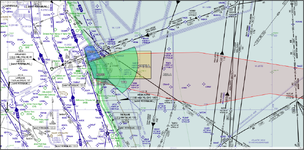
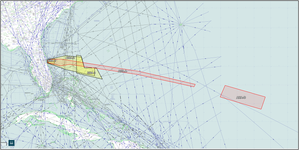
Here is the contents of my warning Area.mkr file in the config\Earth\Marker folder. Go into the map mfd and into mod button, turn on the warning area folder to see where flight is tracking. Using a 090 launch azimuth tracks the northern edge of AHA-A but middle of AHA-B.

; Warning Area

BEGIN_HEADER
InitialState on
ColourIdx 4r
ShapeIdx 1
Size 0.5
END_HEADER

BEGIN_DATA

-80.65 +28.66 : AHA-A 01
-80.21 +28.70 : AHA-A 02
-78.41 +28.51 : AHA-A 03
-76.63 +28.31 : AHA-A 04
-74.26 +28.05 : AHA-A 05
-72.50 +27.85 : AHA-A 06
-70.13 +27.45 : AHA-A 07
-67.90 +27.06 : AHA-A 08
-67.95 +26.83 : AHA-A 09
-69.93 +27.10 : AHA-A 10
-72.00 +27.41 : AHA-A 11
-74.35 +27.75 : AHA-A 12
-77.11 +28.15 : AHA-A 13
-78.75 +28.15 : AHA-A 14
-80.51 +28.35 : AHA-A 15
-60.05 +24.70 : AHA-B 01
-59.46 +25.95 : AHA-B 02
-57.00 +25.31 : AHA-B 03
-54.65 +24.70 : AHA-B 04
-55.15 +23.38 : AHA-B 05
-57.60 +24.03 : AHA-B 06


------------------------------------------------------------------------------------------------------------------------------------------------------------------------------------------
Here is the NGA Release:

070936Z AUG 25
NAVAREA IV 822/25(11,25,26).
NORTH ATLANTIC.
FLORIDA.
1. HAZARDOUS OPERATIONS, ROCKET LAUNCHING
122359Z TO 130204Z AUG
, ALTERNATE
132355Z TO 140200Z, 142351Z TO 150156Z,
152348Z TO 160153Z, 162344Z TO 170149Z,
172340Z TO 180145Z AND
182336Z TO 190141Z AUG IN AREAS BOUND BY:
A. 28-40.35N 080-38.64W, 28-43.00N 080-13.00W,
28-31.00N 078-25.00W, 28-19.00N 076-38.00W,
28-03.00N 074-16.00W, 27-51.00N 072-30.00W,
27-27.00N 070-08.00W, 27-04.00N 067-54.00W,
26-50.00N 067-57.00W, 27-07.00N 069-56.00W,
27-25.00N 072-00.00W, 27-45.00N 074-21.00W,
28-09.00N 077-07.00W, 28-18.00N 078-46.00W,
28-27.00N 080-31.00W.
B. 24-42.00N 060-03.00W, 25-57.00N 059-28.00W,
25-19.00N 057-01.00W, 24-42.00N 054-39.00W,
23-22.00N 055-09.00W, 24-02.00N 057-36.00W.
2. CANCEL THIS MSG 190241Z AUG 25.//
 

Attachments

  • USSF-106_2.png
    USSF-106_2.png
    781.1 KB · Views: 2
  • USSF-106_3.png
    USSF-106_3.png
    823.3 KB · Views: 2
  • USSF-106_1.png
    USSF-106_1.png
    365.2 KB · Views: 2
So many different results depending on what payload weight is used. If I run just the NTS-3 weight of 1250kg (Gunter's NTS-3 page) and nothing else, I wind up throwing the core and fairings past AHA-B by a small amount. GSO is is easily achieved, as well as centaur disposal to hyperbolic trajectory.
The 2023 Vulcan User Guide indicates the VC4S is capable of 4,800kg direct to GSO. So USSF-106 must weigh in around 3,600 or less with fuel mass.


So I subbed in your Flashsat as payload with the 3,700kg plus fuel weight and I'm dropping in the boxes and making GSO and about 500kg of fuel in centaur for disposal burn. Also, a launch azimuth of 094 runs me right down the middle.
 
Last edited:
Back
Top