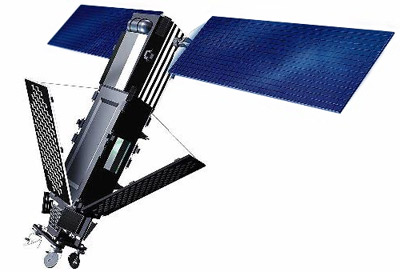
Two Satellites Collide

If that were true, then how are people able to track the debris ("upwards of 600 pieces") from the collision, or other small objects which are even smaller than the satellite was?

They can't really. All we can tell is that there are a lot of fragments up there. We have absolutely no idea about their orbital parameters at the moment as there's just too many to track in too small a portion of sky.
 
Let's see...

Cosmos-2251 (Strela-2M series military comm sat, mass 900 kg) launched from Plesetsk on June 16, 1993.

Iridium 33 (commercial comm sat, mass 689 kg) launched from Baikonur on September 14, 1997.

Now they...
2vbk75z.gif


Our kinetic warhead target practice really puts anybody else's to shame! :hotcool:
 
Well they did realise they were going to come close, there was a warning 5 days before that they'd pass within 500m.
I don't know whether the people at Iridium didn't get it (unlikely) or if they just ignored it as teh chance of a hit was so small.
The upside is that it's caused a hell of a mess, so we'll probably get more hits now.
How big a deal for the operators would a collision avoidance manoeuvre have been, "just in case"? Probability*Cost_of_collision < Cost_of_manoeuvre?
 
They can't really. All we can tell is that there are a lot of fragments up there. We have absolutely no idea about their orbital parameters at the moment as there's just too many to track in too small a portion of sky.

But as small addition: One important research field for spaceflight engineers is improving the mathematical models to predict the sizes and numbers of fragments produced in such events.

They can only track larger objects, of around 2 cm diameter with X-Band radar, the small stuff can only be detected by debris detectors on satellites ("In-situ").
 
Don't forget LAN. ;)

You could also have a head-on collision, even at the same inc.
You could only have a head-on collision at the same inclination if both satellites were at 90° inclination (and LANs were 180° apart).

For any given orbit, the orbit of an object that's travelling in the opposite direction will have an inclination of 180°-(inc-of-given-object) with the LAN 180° different.
 
You could only have a head-on collision at the same inclination if both satellites were at 90° inclination (and LANs were 180° apart).

For any given orbit, the orbit of an object that's travelling in the opposite direction will have an inclination of 180°-(inc-of-given-object) with the LAN 180° different.

Depends on what you call heads-on. 0° azimuth angle? <10°? <20°?

Also, most satellites are in fact in almost 90° inclination, and if you look at the plots, you will notice that both satellites had been in a sun-sync orbit with about 100°
 
Rough scenario

Here is a rough scenario using two DeltaGliders; they pass within about 3 km of each other with a pretty good closing rate...

BEGIN_DESC
END_DESC
BEGIN_ENVIRONMENT
System Sol
Date MJD 54872.70488400
END_ENVIRONMENT
BEGIN_FOCUS
Ship Iridium 33
END_FOCUS
BEGIN_CAMERA
TARGET Iridium 33
MODE Extern
POS 6.66 -126.60 -18.42
TRACKMODE TargetRelative
FOV 60.00
END_CAMERA
BEGIN_HUD
TYPE Docking
END_HUD
BEGIN_MFD Left
TYPE Docking
END_MFD
BEGIN_MFD Right
TYPE COM/NAV
END_MFD
BEGIN_PANEL
END_PANEL
BEGIN_SHIPS
Iridium 33:DeltaGlider
STATUS Orbiting Earth
ELEMENTS 7155811.74569582 0.00022530 98.55896219 120.43580197 190.12351025 169.68451025 54872.70488400
AROT 62.90 -0.99 -93.92
VROT 0.00 0.00 13.11
PRPLEVEL 0:0.553 1:0.999
IDS 0:528
NAVFREQ 588 0 0 0
NOSECONE 1 1.0000
GEAR 0 0.0000
AIRLOCK 0 0.0000
END
Cosmos 2551:DeltaGlider
STATUS Orbiting Earth
ELEMENTS 7166090.44771824 0.00160150 51.85305375 21.27688527 108.73136069 107.06676069 54872.70496500
AROT -117.10 0.99 -86.08
VROT 0.00 0.00 -13.11
PRPLEVEL 0:0.409 1:1.000
IDS 0:588
NAVFREQ 528 0 0 0
NOSECONE 1 1.0000
GEAR 0 0.0000
AIRLOCK 0 0.0000
SKIN BLUE
END
END_SHIPS
 
http://news.bbc.co.uk/1/hi/sci/tech/7885750.stm


-----Post Added-----


Objects currently in Earth orbit (data from ESA):
Bee-Hive-4_H1.jpg


-----Post Added-----


With that amount of objects in orbit, frankly I'm surprised that there aren't more collisions.

It seems that quite a lot of things in orbit are just empty boosters.
Shouldn't we really be cutting back on how much stuff we're putting up there?

What is needed is a huge rocket pulling some sort of giant net:P


We'd better start to cut back now, or else in the future, I predict this situation:
:rofl::rofl:
 
It seems that quite a lot of things in orbit are just empty boosters.

Well, why not an automated deorbit system for all boosters? :hmm:
 
Yea, it's not like it costs you a lot of fuel to de-orbit your empty booster or your old satellite. Just let it catch the upper atmosphere and it's done.
 
Or you can ask why not all payloads have engines allowing them to boost up from a suborbital trajectory.

Sure.
It isn't a lot of Dv, just needed to lower the perigee of the booster below 200km, air drag can do the rest.

EDIT:
@Orbinaut Pete: That video is hilarious. :lol:
I've decided to go into environmental activism:
billboard.JPG

Of course, these billboards pose quite a bit of a threat themselves.

EDIT:
It doesn't look too good at this resolution, click on the image to see it full size.
 
I've decided to go into environmental activism:
billboard.JPG

Of course, these billboards pose quite a bit of a threat themselves.

:rofl::rofl::rofl:

I'm sure NASA would perhaps fly it on the Shuttle for you! You could e-mail them & ask:)
 
This sounds very suspicious to me.............
Why didn't they temporarily alter the Iridium's orbit to avoid collision ?
You can't honestly tell me that NORAD didn't see this coming months ago if it truly was a dead Russian sattelite.

If the can track a lost tool-bag, they can sure as s... track a russian sattelite.

Sounds more like a deliberate act to me to take out a sattelite that might have been snooping around in the wrong spot............

Makes you wonder what the Russians are up to !
Furthermore due to the debris field we can also not put a replacment in that spot for quitte some time.
Gives the Russians a nice window of oppertunity...........

Just my two cents.
 
This sounds very suspicious to me.............
Why didn't they temporarily alter the Iridium's orbit to avoid collision ?
You can't honestly tell me that NORAD didn't see this coming months ago if it truly was a dead Russian sattelite.

If the can track a lost tool-bag, they can sure as s... track a russian sattelite.

Sounds more like a deliberate act to me to take out a sattelite that might have been snooping around in the wrong spot............

Makes you wonder what the Russians are up to !
Furthermore due to the debris field we can also not put a replacment in that spot for quitte some time.
Gives the Russians a nice window of oppertunity...........

Just my two cents.

Yeah, that is a real question why NORAD saw it coming and your uniformed guys did nothing to divert the course. Because that poor Strela was indeed dead (Russian satellited designed back in 70's just can't last for 15 years!) and had absolutely no propulsion system on board. Its only means of keeping attitude was a gravity stabilization mast.

It was as able to maneuver as a floating log.
 
This sounds very suspicious to me.............
Why didn't they temporarily alter the Iridium's orbit to avoid collision ?

Risk/Benefit tradeoff. They obviously thought the chance of impact was too small to bother using up valuable fuel.

You can't honestly tell me that NORAD didn't see this coming months ago if it truly was a dead Russian sattelite.

If you'd read the read of the thread you'd notice that I already said NORAD saw it coming. They even informed Iridium.

Sounds more like a deliberate act to me to take out a sattelite that might have been snooping around in the wrong spot............

It was a commercial communication satellite. It wasn't very well designed for snooping.

Makes you wonder what the Russians are up to !
Furthermore due to the debris field we can also not put a replacment in that spot for quitte some time.

The replacement satellite is already being maneuvered into place.


Perhaps you should remember that the cold war is over. The Russians have more important things to do than fool around with a satellite that does nothing more interesting than route phone calls.
 
Back
Top