
STS-119

Because the shuttle's heat shield faces the atmosphere in the direction the complex is travelling, causing drag.

I know that, my question is how doing that the drag is increased with respect with the normal attitude of the station-shuttle complex. Whats the normal attitude? is there any image to show that?
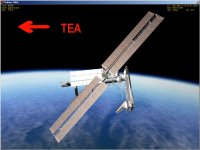
 
Torque Equalibrium Atitude
 

Attachments

  • TEA.jpg
    TEA.jpg
    68.9 KB · Views: 31
Torque Equalibrium Atitude
What's the direction of motion in that picture? Same direction as the arrow?

If that is: then what I want to understand is why puting the shuttle before the station has a grater drag than puttin (like in this image) the shuttle behind the station
I mean the surface area (which is responsible for the drag) is the same....
 
Shuttle docking/un-docking attitude:
attachment.php


While-docked attitude (to minimise drag):
attachment.php
 
Last edited:
In your first picture, you are right that Zvezda's surface is small so the drag is small... but that doesn't mean that the shuttle doesn't add to the drag!
The whole upper section of the shuttle is parallel to zvezda's surface so the shuttle also adds to the drag, thats what I'm trying to explain....
 
Pete: Completely wrong, the docking attitude of the ISS is like the undocking attitude.

The Shuttle always docks from the +V-Bar, as you can see in the checklists. Soyuz and ATV on the other hand dock, from the -V-Bar, because this makes their guidance simpler.

STS-docking.png


Also, you overestimate the effect of drag. More important is the gravity gradient torque, which is a few orders of magnitude higher than drag in 380 km altitude. The ISS assumes an orientation, where the gravity gradient torque is minimal.
 
@ElPelado:
Sure, you're right. I'm not saying it doesn't cause drag in the docking attitude - I'm just saying it causes more drag in the un-dock attitude;)

--------

@Urwumpe:
ISS docking:
manuever.jpg


So then the ISS must switch to the attitude shown in the first picture after docking, to minimise drag?
 
Pete: Yes. The attitude shown is called Torque Equilibrium Attitude(TEA). The shuttle manuevers the entire station/orbiter complex from the normal station LVLH attitude to the TEA post-docking.
 
Right. Thanks guys (I learn something new every day);)

---------- Post added at 09:59 ---------- Previous post was Yesterday at 16:53 ----------

EVA-3 is now complete, the final spacewalk for the STS-119 mission.

During the spacewalk, astronauts moved a CETA cart from the P1 to the S1 Truss, and lubricated snares on the SSRMS's B end LEE*. They were still unable to deploy the UCCAS that was tied in place on the P3 Truss during EVA-2. As the cause of the problem is unknown, Mission Control deicided to scrub the installation of the UCCAS on the S3 Truss also, until more information is known.

* = Latching End Effector - the thing that grapples targets;)

----------
Some new "beauty-shots":

iss018e042094.jpg

Hi-res: http://www.spaceflight.nasa.gov/gallery/images/shuttle/sts-119/hires/iss018e042094.jpg

iss018e042087.jpg

Hi-res: http://www.spaceflight.nasa.gov/gallery/images/shuttle/sts-119/hires/iss018e042087.jpg

iss018e042037.jpg

Hi-res: http://www.spaceflight.nasa.gov/gallery/images/shuttle/sts-119/hires/iss018e042037.jpg

iss018e042080.jpg

Hi-res: http://www.spaceflight.nasa.gov/gallery/images/shuttle/sts-119/hires/iss018e042080.jpg

---------- Post added at 10:16 ---------- Previous post was at 09:59 ----------

P.S: @ElPelado.

Also, the angle at which that the shuttle hits the atmosphere will affect drag. If the shuttle faces 90̊ up, it will cause a large surface area of the shuttle the hit the atmosphere, whereas flying in the while-docked attitude means less of a surface area will hit the atmosphere, as the shuttle is at a different angle;)
 
Last edited:
Discovery/ISS hatch closure will be @ 4.53pm GMT today (Wed 25th)
Discovery/ISS undocking will be @ 7.53pm GMT today
ISS flyaround will begine @ 8.22pm GMT today

Wow, STS-119 really went by quickly and uneventfully.
Maybe that's because I was just too busy to notice.

A nice shot of the new S6 solar arrays deployed:
s119e007129.jpg

Wow, nice. Is that taken from one of Discovery's windows? Which one?
 
Wow, STS-119 really went by quickly and uneventfully.
Maybe that's because I was just too busy to notice.

Don't worry - Truss flights are always boring.;) At least we've got STS-125 to the HST & STS-127 with the EF to look forward to...those will be good missions.

Wow, nice. Is that taken from one of Discovery's windows? Which one?

That would have been taken from Discovery's left-hand-side, zenith (top) window, on the flight-deck.
 
When I watched Discovery's flyaround, I had sort of a deja-vu moment.:lol:

I've been looking forward to the completion of the truss for so long, that I expected to be quite excited by the view.
But thanks to Orbiter, the completed ISS has become so familiar, that when I watched it on NASA TV, it wasn't nearly as impressive as I expected it to be.

I wonder if anyone else got that "familiar" feeling too.:cheers:

[ame="http://www.youtube.com/watch?v=-XLbIwCKPNw"]YouTube - Space station flyaround[/ame]
 
Last edited:
When I watched Discovery's flyaround, I had sort of a deja-vu moment.:lol:

I've been looking forward to the completion of the truss for so long, that I expected to be quite excited by the view.
But thanks to Orbiter, the completed ISS has become so familiar, that when I watched it on NASA TV, it wasn't nearly as impressive as I expected it to be.

I wonder if anyone else got that "familiar" feeling too.:cheers:
http://www.youtube.com/watch?v=-XLbIwCKPNw

It doesn't have the Russian NEM power module we have in Orbiter (the one with 8 smaller solar arrays shaped overall like an umbrella) on top and the core isn't that massive-looking - but yes, looks really familiar this time!
 
Why during the flyaround only two of the 8 panels were traking the sun?
 
Tracking the ISS visually

Hello everyone,

Yesterday one of you (I think it was Orbinaut Pete?) was on the chat relating how he was visually tracking the ISS with binoculars. I would like to do the same thing using my telescope. Where are you getting your orbital location data of the ISS from? Is the orbit and position of the ISS in Orbiter accurate in any of the standard scenarios for this purpose, or have you got a different reference source? Please let me know...

Thanks in advance,

Keith
 
Hello everyone,

Yesterday one of you (I think it was Orbinaut Pete?) was on the chat relating how he was visually tracking the ISS with binoculars. I would like to do the same thing using my telescope. Where are you getting your orbital location data of the ISS from? Is the orbit and position of the ISS in Orbiter accurate in any of the standard scenarios for this purpose, or have you got a different reference source? Please let me know...

Thanks in advance,

Keith

Yes it was me - it was so cool - my first time I ever saw it:)

For tracking sites, any of the following are good:

www.heavens-above.com

www.n2yo.com

http://spaceflight1.nasa.gov/realdata/tracking/index.html


Or, for you specifically:

http://spaceflight1.nasa.gov/realda...ew.cgi?country=Ecuador&region=None&city=Quito

(there are many more good links on this site also)
 
Back
Top