
You are using an out of date browser. It may not display this or other websites correctly.
You should upgrade or use an alternative browser.
You should upgrade or use an alternative browser.
Space Shuttle Ultra development thread
- Thread starter DaveS
- Start date
The RMS camera view needs to be moved so it rotates around the Endeffector with the camera's view, that's how you line up on the target. Also could the clipping be fixed? The target dissappears at 5 feet now. Maybe the view has to be set back 5 feet.

- Joined
- Feb 6, 2008
- Messages
- 38,938
- Reaction score
- 3,937
- Points
- 203
- Location
- Wolfsburg
- Preferred Pronouns
- Sire
Suggestion for a subproject:
- Create a plugin which allows Internet access to the simulation telemetry. Maximum of N connections (I would suggest 8).
- Create a reference telemetry view application, which shows the internet stream and allows sending text messages and or commands to the simulation.
- Create a proxy application, which allows forwarding telemetry from the simulation (or another proxy) to a limited number of spectator computers.
Call this "VSA support". Maybe somebody might like such a feature.
- Create a plugin which allows Internet access to the simulation telemetry. Maximum of N connections (I would suggest 8).
- Create a reference telemetry view application, which shows the internet stream and allows sending text messages and or commands to the simulation.
- Create a proxy application, which allows forwarding telemetry from the simulation (or another proxy) to a limited number of spectator computers.
Call this "VSA support". Maybe somebody might like such a feature.
- Joined
- Feb 4, 2008
- Messages
- 9,762
- Reaction score
- 1,031
- Points
- 203
How about putting this on back-burner until everything is coded and checked out? I'm afraid this kind of sub-project could stall the main project for quite a while for no real reward.Suggestion for a subproject:
- Create a plugin which allows Internet access to the simulation telemetry. Maximum of N connections (I would suggest 8).
- Create a reference telemetry view application, which shows the internet stream and allows sending text messages and or commands to the simulation.
- Create a proxy application, which allows forwarding telemetry from the simulation (or another proxy) to a limited number of spectator computers.
Call this "VSA support". Maybe somebody might like such a feature.
- Joined
- Feb 6, 2008
- Messages
- 38,938
- Reaction score
- 3,937
- Points
- 203
- Location
- Wolfsburg
- Preferred Pronouns
- Sire
How about putting this on back-burner until everything is coded and checked out? I'm afraid this kind of sub-project could stall the main project for quite a while for no real reward.
Well, yes, we also don't have much telemetry yet to show, what other applications can't do. But it's just one thought that crossed my mind. For debugging, a telemetry stream would be a good idea at a point (written to a file), turning this into a internet stream would not be hard later.
- Joined
- Feb 4, 2008
- Messages
- 9,762
- Reaction score
- 1,031
- Points
- 203
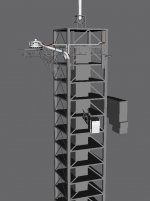
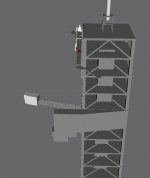
Today's FSS work:
-Addition of the GVA platform and truss structure on the south side
-Addition of the access stairs and platform on the north side of the 225 ft level.
-Relocated the Orbiter Access Arm to a more correct location.
-Addition of the GVA platform and truss structure on the south side
-Addition of the access stairs and platform on the north side of the 225 ft level.
-Relocated the Orbiter Access Arm to a more correct location.
Attachments

See Enjo's suggestion in this thread.Suggestion for a subproject:
- Create a plugin which allows Internet access to the simulation telemetry. Maximum of N connections (I would suggest 8).
- Create a reference telemetry view application, which shows the internet stream and allows sending text messages and or commands to the simulation.
- Create a proxy application, which allows forwarding telemetry from the simulation (or another proxy) to a limited number of spectator computers.
Call this "VSA support". Maybe somebody might like such a feature.
I've updated the CRT MFD code to display the triangle on the PASS TRAJ display.
- Joined
- Feb 4, 2008
- Messages
- 9,762
- Reaction score
- 1,031
- Points
- 203
Nice. How about adding the PDRS screens?I've updated the CRT MFD code to display the triangle on the PASS TRAJ display.
- Joined
- Feb 6, 2008
- Messages
- 38,938
- Reaction score
- 3,937
- Points
- 203
- Location
- Wolfsburg
- Preferred Pronouns
- Sire
Nice. How about adding the PDRS screens?
Let the man catch some breath! :speakcool: As he currently also works on the PDRS panels, making the PDRS screens could use some synergy effects.
- Joined
- Feb 4, 2008
- Messages
- 9,762
- Reaction score
- 1,031
- Points
- 203
OK, wasn't aware that he still was working on the PDRS stuff.Let the man catch some breath! :speakcool: As he currently also works on the PDRS panels, making the PDRS screens could use some synergy effects.
- Joined
- Feb 4, 2008
- Messages
- 9,762
- Reaction score
- 1,031
- Points
- 203
orbiter_fan at hotmail.com. Also managed to get some answers on OBSS control: It's controlled from panel A7U from a series of existing pushbuttons thanks to a GPC software upgrade made prior to Return To Flight in 2005.David,
If you can give me you Email addy, I can give you the updated ET mesh and scorched texture nad see what you think.
Don
I'm trying to locate a document on this upgrade to see exactly what was done.
- Joined
- Feb 6, 2008
- Messages
- 38,938
- Reaction score
- 3,937
- Points
- 203
- Location
- Wolfsburg
- Preferred Pronouns
- Sire
orbiter_fan at hotmail.com. Also managed to get some answers on OBSS control: It's controlled from panel A7U from a series of existing pushbuttons thanks to a GPC software upgrade made prior to Return To Flight in 2005.
I'm trying to locate a document on this upgrade to see exactly what was done.
If you can find, it it would be nice. Does the OBSS have any animations which would be visible?
- Joined
- Feb 4, 2008
- Messages
- 9,762
- Reaction score
- 1,031
- Points
- 203
Other than the LDRI and ITVC movement, no. Both of these are mounted on Pan/Tilt Unit similar to the Payload Bay cameras.If you can find, it it would be nice. Does the OBSS have any animations which would be visible?
- Joined
- Feb 6, 2008
- Messages
- 38,938
- Reaction score
- 3,937
- Points
- 203
- Location
- Wolfsburg
- Preferred Pronouns
- Sire
Other than the LDRI and ITVC movement, no. Both of these are mounted on Pan/Tilt Unit similar to the Payload Bay cameras.
OK, so animating them would only be partially visible right?
Do you know if the MPLM thermal control system (two heat exchanges and a water loop) of the Shuttle has any controls (switches, circuit breakers, etc) inside the Shuttle?
- Joined
- Feb 4, 2008
- Messages
- 9,762
- Reaction score
- 1,031
- Points
- 203
Well, at least as much as the Payload Bay cameras. The flickering view you can see on NASA TV is from the LDRI and the non-flickering view is from the ITVC.OK, so animating them would only be partially visible right?
No I don't, sorry. BUt stuff like this is usually located on payload-specific panels that are removed and replaced during post-mission turnaround in the OPF.Do you know if the MPLM thermal control system (two heat exchanges and a water loop) of the Shuttle has any controls (switches, circuit breakers, etc) inside the Shuttle?
- Joined
- Feb 6, 2008
- Messages
- 38,938
- Reaction score
- 3,937
- Points
- 203
- Location
- Wolfsburg
- Preferred Pronouns
- Sire
Well, at least as much as the Payload Bay cameras. The flickering view you can see on NASA TV is from the LDRI and the non-flickering view is from the ITVC.
But the crew only sees the ITVC view, does it?
Also on the detachable payloads: Do we want to make only three attachments reserved for the three switch positions or do we want to make a general, higher number and make it possible to assign each attachment exclusively to a payload number?
For example, we could make the attachments 0-2 reserved for detachable payloads and move them to the orientation needed.
Or we could make lets say, 7 attachments (0-6) for the centerline (movable along the center line with a single integer number) and some (I am not sure how many had been used) for each side of the payload bay (either fixed position or movable like the centerline) and define inside the scenario how they are affected by the switches inside the Shuttle, if at all?
I think option 2 is better for the flexibility, but option 1 might be better for scenario makers as they only need to specify the position, but not the full behavior.
For option 2, a line could look like:
Code:
ATTACH_PL_CTR0 35 1 31for a payload attachment which is at position 35 along the center line (out of 72 possible I think, need to look it up again), is assigned to payload 1 and requires all 5 latches to be opened for releasing the payload (but only one latch is required for the sake of simplicity for grappling a payload into the payload bay).
Code:
ATTACH_PL_CTR0 35could be used for a static payload attachment (cannot be released)
- Joined
- Feb 4, 2008
- Messages
- 9,762
- Reaction score
- 1,031
- Points
- 203
No. They can see both the LDRI and ITVC views. The LDRI data is usually recorded onboard for downlinking as there could be gaps in the KU coverage real-time and not all of the data might make it down at that time. So once the surveys are complete, they downlink the recorded data during the available KU coverage passes.But the crew only sees the ITVC view, does it?
- Joined
- Feb 6, 2008
- Messages
- 38,938
- Reaction score
- 3,937
- Points
- 203
- Location
- Wolfsburg
- Preferred Pronouns
- Sire
No. They can see both the LDRI and ITVC views. The LDRI data is usually recorded onboard for downlinking as there could be gaps in the KU coverage real-time and not all of the data might make it down at that time. So once the surveys are complete, they downlink the recorded data during the available KU coverage passes.
OK, thats something we should remember for pro versions. Would it be possible to create something like CameraMFD for the SSU alone? Like, render with much lower resolution as CameraMFD and/or in Grayscale for performance reasons?
Similar threads

- Replies
- 157
- Views
- 39K

- Replies
- 21
- Views
- 19K


- Replies
- 7
- Views
- 4K

- Replies
- 156
- Views
- 45K