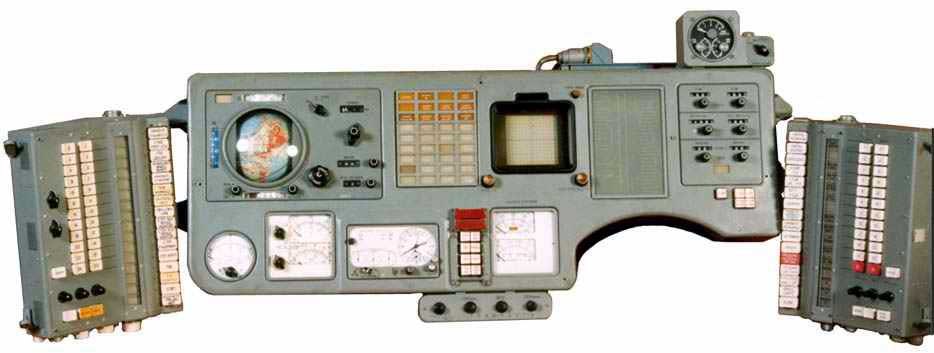
Soyuz 7K-TM

Well, I try to replicate the original Soyuz cockpit, it isn't very sophisticated, which makes it easier.

The KEI screen for example also acts as indicator for RCS pressures (in an oscilloscope like mode).
 
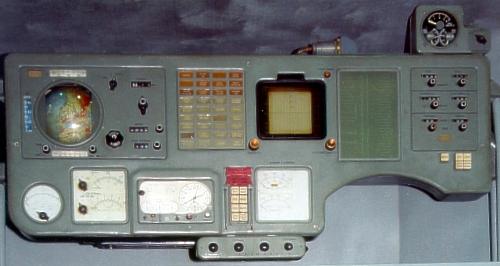
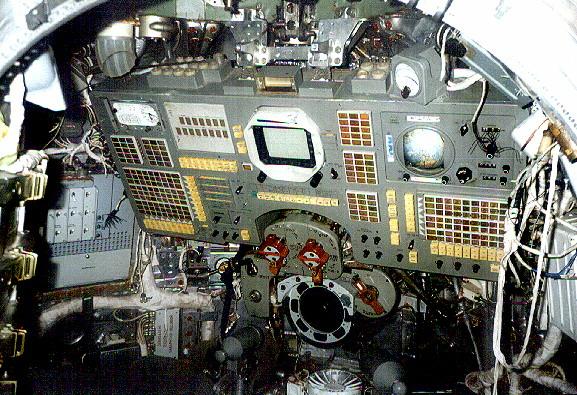
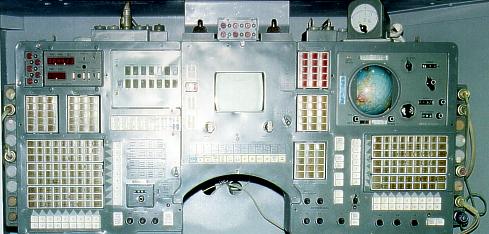
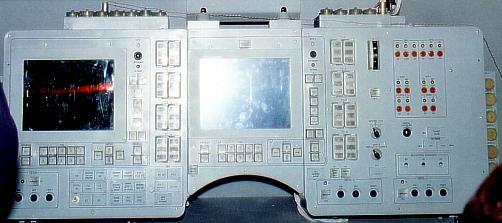
Here's what www.astronautix.com has on the Soyuz panels:

7K-OK, 7KT-OK, 7K-TM, 7K-T
soyokpn1.jpg


T
soytmpnl.jpg


TM
soytmpn1.jpg


TMA
soytmap1.jpg


I had some doubts about all the 7K panels being the same... so I checked http://web.mit.edu/slava/space/essays/essay-tiapchenko1.htm.

The info there is:

Soyuz-7k uses the Sirius-7k panel.
Soyuz-A8 uses Sirius-A8 (modified Sirius-7k)
Soyuz-Apollo uses Sirius-M (modified Sirius-A8)
ess-tiap4-1.jpg


Soyuz-T uses Neptun and Simvol
Soyuz-TM uses Neptun-M and Simvol
Soyuz-TMA uses Neptun-ME

So it checks out. All the early Soyuz had the same Sirius panel wich I'm triying to replicate.
 
Exactly. I have a more detailed description of the Sirius and the Neptune panels by Tiapchenko as Russian PDF files, which are currently my biggest pain, since I am not really capable of the Russian language and pretty much learn it on the fly by using a dictionary with some coarse grammar information. Works still better than Google, mostly because the abbreviations confuse it completely.

I try to work without Orbiter MFDs in the panels, because they would look too strange in them, if you need to cheat, you can use External MFD.

Also I try to put as much stuff as possible on the Wiki, but it would take a while.

---------- Post added at 05:08 PM ---------- Previous post was at 11:24 AM ----------

here is a analysis of the command/signal indicators on Soyuz spacecraft, also explains the Soyuz-OK one.

http://www.cosmoworld.ru/spaceencyclopedia/publications/analiz_1.pdf

Somewhere on this server was the PDF about the Sirius system, I still search it.

---------- Post added at 05:09 PM ---------- Previous post was at 05:08 PM ----------

There it is:

http://www.cosmoworld.ru/spaceencyclopedia/publications/soyuz7.pdf

---------- Post added at 05:12 PM ---------- Previous post was at 05:09 PM ----------

And one more about the Salyut space stations:

http://www.cosmoworld.ru/spaceencyclopedia/publications/salut_tg.pdf

Neptune IDS:

http://www.cosmoworld.ru/spaceencyclopedia/publications/neptun_1.pdf
http://www.cosmoworld.ru/spaceencyclopedia/publications/neptun_2.pdf
 
Last edited:
I want to help you with this project.

I read a blog from a spanish guy that has a lot of information. He wrote a post about the Soyuz space ship. If you read the references at the bottom you can find more detailed information.
http://danielmarin.blogspot.com/2008/12/soyuz-la-nave-de-la-unin-vi.html

Feel welcome. :)

The Blog doesn't really go beyond the information we already have, he actually uses less sources than we already have. Also, my Spanish is maybe only slightly better than my Russian (because I actually had Spanish at school), but it seems like he just wrote translations of the Tiapchenko-Slava summaries. So, it is a bit redundant, with no new information.

I could use some more information about Soyuz-OK subsystems, I currently reconstruct a lot of stuff by using the manuals of the Russian segment of the ISS and the acronyms used there.

For example, what does "ИД разг.тор" mean? Or what is "ВКИП"? I know that it is related to the propellant utilization system, but that is where it ends, since it starts with "B", I guess it is a valve or valve assembly, but not sure. Or what is "БАКИ"?

I started a translation of the Command/Signal Matrix here as reference for development, but there are still many errors.

http://www.orbiterwiki.org/wiki/Sirius-7K_IDS#Command.2FSignal_matrix_.28English_translation.29
 
Great work and links Urwumpe :thumbup:.
My Russian is null so I can't really help there.
One thing that might be useful (although certainly not consensual) would be an English version of the panel itself. Yes, I know its sacrilege :facepalm: but it would make operations much simpler for most of us.

On my side, I've got a launchable Soyuz 7K-T as a spacecraft.dll implementation. Usable but still not ready for a release. The main problem is having the meshes changed so that everything fits inside the fairing (antennas and panels retracted, etc). I can do some of it using animations but there are a lot of groups in the meshes and it's just complicated.

Besides that, I still have to tweak the docking port locations, so that the craft modules "re-dock" immediately after they are "activated" (jetissoned). My setup now requires you to "activate" all 3 Soyuz modules upon reaching orbit. You then end up with 3 docked vessels. This way you have total freedom to separate in whatever order is needed. Also, each module has it's own camera position, so that the reentry module gives you the periscope view, the Orbital module the standard forward view, and the Service module will simulate the external camera used for the Soyuz 4/5 EVA.

It's looking promising and I'll keep at it but it's still has a long way to go.

---------- Post added at 01:58 PM ---------- Previous post was at 01:48 PM ----------

And speaking of Soyuz 4/5:

http://www.britishpathe.com/record.php?id=72304

Nice soviet video with the docking and EVA realtime TV footage, including some inside capsule stuff. Most of it is new for me!
 
Great work and links Urwumpe :thumbup:.
My Russian is null so I can't really help there.
One thing that might be useful (although certainly not consensual) would be an English version of the panel itself. Yes, I know its sacrilege :facepalm: but it would make operations much simpler for most of us.

On my side, I've got a launchable Soyuz 7K-T as a spacecraft.dll implementation. Usable but still not ready for a release. The main problem is having the meshes changed so that everything fits inside the fairing (antennas and panels retracted, etc). I can do some of it using animations but there are a lot of groups in the meshes and it's just complicated.

Besides that, I still have to tweak the docking port locations, so that the craft modules "re-dock" immediately after they are "activated" (jetissoned). My setup now requires you to "activate" all 3 Soyuz modules upon reaching orbit. You then end up with 3 docked vessels. This way you have total freedom to separate in whatever order is needed. Also, each module has it's own camera position, so that the reentry module gives you the periscope view, the Orbital module the standard forward view, and the Service module will simulate the external camera used for the Soyuz 4/5 EVA.

It's looking promising and I'll keep at it but it's still has a long way to go.

this all sounds excellent, 4throck!
as far as the meshes go, in previous work with the OctoberSky project we found that it was easiest to separate out the animated meshes (WIP antennae, IGLA, panels, deflector, etc) rather than doing static versions of the entire mesh-complex in its predeployed state...
so, let me know if you want to go this route and i'll post all the bits and bobs as separate .msh files.

cheers
hc

---------- Post added at 02:27 PM ---------- Previous post was at 02:22 PM ----------

here btw is the current working state of the -TM mesh complex...
obviously still plenty to do (the docking collar's gonna be fun! ...), but 'progress' is being made...

TM_WIP.jpg
 
Great work and links Urwumpe :thumbup:.
My Russian is null so I can't really help there.
One thing that might be useful (although certainly not consensual) would be an English version of the panel itself. Yes, I know its sacrilege :facepalm: but it would make operations much simpler for most of us.

No problem for me, I wouldn't even mind if somebody would make a German, French or Klingon version of it. :lol:

Well, I do my best. I have some plans already how the Panels could be programmed, thanks to martins tutorials, it is now longer a mystery. The only big unsolved questions are launch vehicle (I could use my own meshes, but they would need improvements by somebody who knows how to make meshes)...

Soyuz_wip4.jpg


...and some puzzles about which subsystem in the English literature has which name in the panel.

The best thing so far, the panel could be programmed with only the CEI requiring painting on textures, the rest would be no problem with UV coordinate manipulation. Which would mean 99% of the textures could reside in GPU memory and things could be a lot faster.

I currently work on a small helper class, that produces Panel2D meshes dynamically, so it is easier to program and debug panels. The basic spacecraft DLL is done, most parameters can be modified in the configuration file. Only basic Soyuz structure, animations, panel and set of subsystems will be fixed, for performance reasons.
 
Which parts of Russian user interface do you need translated?
 
Which parts of Russian user interface do you need translated?

Ideally all, because I don't have much trust in my translation. I only have parts of КСУ and КЕИ translated, and a small part of the command signal matrix on Orbiterwiki, but again with little confidence.
 
as far as the meshes go, in previous work with the OctoberSky project we found that it was easiest to separate out the animated meshes (WIP antennae, IGLA, panels, deflector, etc) rather than doing static versions of the entire mesh-complex in its predeployed state...
so, let me know if you want to go this route and i'll post all the bits and bobs as separate .msh files.

I try to keep things simple. The simplest way is to have 2 meshes: one pre-deployed, another deployed. The meshes are changed on "J"etisson.

I know that it is a bad usage of resources (Orbiter loads the meshes 2 times), but it's is much simpler than doing it all using animations.
I tried to do a simple animation to retract the solar panels on the service module and even after identifying dozens of mesh groups, there were still parts that remained on their original positions.

So if you could provide the separate module meshes with all the parts retracted, it would be faster and simpler on my end.
I don't need the separate parts (for my implementation) because I'd have to place each part on their retracted positions anyway.

---------- Post added at 10:39 PM ---------- Previous post was at 10:33 PM ----------

..The only big unsolved questions are launch vehicle ...

I'm using Soyuz FG/U v1.1: [ame="http://www.orbithangar.com/searchid.php?ID=4545"]Soyuz FG/U v1.1[/ame]

It works and is simple to get the launch autopilot configured. It only needs a fairing mesh with soviet texturing (configurable by scenario).
 
I'll work through the wiki.

EDIT: first change done (ДО=RCS), but I may be better off compiling a dictionary and printing it into PDF and sending to you. Tons of abbrevs I don't know, gotta be interesting to learn.
 
Last edited:
So if you could provide the separate module meshes with all the parts retracted, it would be faster and simpler on my end.
I don't need the separate parts (for my implementation) because I'd have to place each part on their retracted positions anyway.


ok, after i finish-up the -TM i'll do some static retracted meshes for the -T for ya...


I'm using Soyuz FG/U v1.1: Soyuz FG/U v1.1

It works and is simple to get the launch autopilot configured. It only needs a fairing mesh with soviet texturing (configurable by scenario).


i like thorton's LV very much as well!

cheers,
hc
 
I'll work through the wiki.

EDIT: first change done (ДО=RCS), but I may be better off compiling a dictionary and printing it into PDF and sending to you. Tons of abbrevs I don't know, gotta be interesting to learn.

I would be more careful with that ДО is not the same as "RCS", it is a special kind of RCS, the 1 kg(f) vernier thrusters. The real primary RCS would be the ДПО, which is made of 10 kg thrusters and also does translation.

I decided to not translate such abbreviations for he sake of making stuff easier understood: ДПО or ДО are different things and even translating them as RCS (ДПО) and VRCS (ДО) would make it a bit harder to work with the information.

I have this article for typical Russian engineering terms, that are not part of my normal dictionary or for quicker translation of more complex terms.

http://www.orbiterwiki.org/wiki/Russian_glossary

---------- Post added at 09:22 AM ---------- Previous post was at 09:20 AM ----------

It works and is simple to get the launch autopilot configured. It only needs a fairing mesh with soviet texturing (configurable by scenario).

Does it also permit launch aborts?
 
Does it also permit launch aborts?
Second bullet point: "- Accurate implementation of Emergency Escape System", so yes.
 
Second bullet point: "- Accurate implementation of Emergency Escape System", so yes.

I mean for custom payloads that are no Soyuz TMA by Thorton.
 
Table translation

Uploading my attempt at translating Table 1.1.
 

Attachments

Looks great :) Can work with this.

One thing: Star attitude is solar attitude, using the 45K sensor.

And "star orientation" in the program category seems to be a orbit change, as far as I can see the sequences on the ИКП.

The simplest "astroorient." program (Fig. 3.7) consists of:
  1. Activate ГБ-А
  2. Activate ДУС (propulsion system)
  3. Activate attitude mode
  4. Activate ГБ-Б
  5. Uncage gyroscopes
 
Last edited:
Still don't know: СОУД, ГБ-А, ГБ-Б, СКД, БУС, ДРК, ДУС... Hope Thorton is reading this thread :) and laughing out loud...
 
Still don't know: СОУД, ГБ-А, ГБ-Б, СКД, БУС, ДРК, ДУС... Hope Thorton is reading this thread :) and laughing out loud...

СОУД - Propulsion and orientation system
ГБ-А - "sealed enclosure"-A on the ISS, Г is also used as symbol for fuel.
ГБ-Б
СКД - Main propulsion system
ДКД - Backup propulsion system
БУС - БУ means control system, possible reentry control system
ДРК
ДУС - Possibly reentry attitude control thruster system.
 
Last edited:
Back
Top