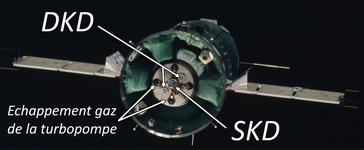
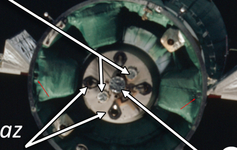
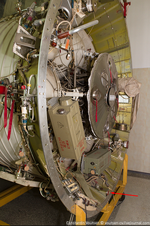
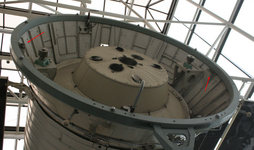
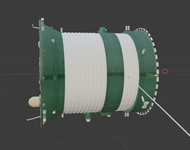
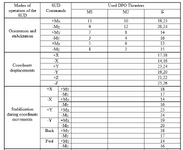
Been looking into the digital unit (БЦИ). For now, its only use in the sim is to monitor the remaining Delta-V and input the desired Delta-V for an SKD burn. This last one was simplified, but I've been looking into just how much. The result is finally seeing a purpose for the "Settings" (Л) column in the KSU, partially shown here for 7k-OK from Tiapchenko's article, and the BTsI illustration:

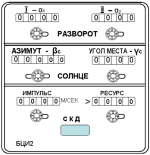
The rough translation of the BTsI's section in that article has this to say:
"The device consists of six electromechanical decimal counters of drum-type sequential pulse counting with electromagnetic stepper drive and electroluminescent indicator with the inscription "Backup SKD". Five counters, designed to control the input settings, have 2 stepper drives each, which allows counting pulses both in the forward and reverse directions. The sixth counter ("SKD resource"), designed to control the remainder of the working fluid in the SKD cylinders, operates only in the reverse counting mode. At the stage of automatic correction of the flight trajectory, the values of the angles of rotation of the astrodome to the azimuth and elevation angle of the Sun - βс and γс, the angles of rotation of the object relative to the associated axes - αх and αу and the values of the setting for the operation of the correction engines (SKD impulse) are received at the input of the setting counters in the number-pulse code.
The counters of the settings in this mode are indicators, by the readings of which the cosmonaut can judge the magnitude and direction of the action of the impulse of the correcting engines, necessary for a given change in the trajectory of the spacecraft.
At the stage of manual correction, the cosmonaut enters the settings manually using special racks. The value of the settings is communicated from Earth. When entering, the counters work in the reverse mode. The input stops upon reaching zero, when a signal about zeroing is received from the corresponding counter. The reading frequency is 16.66 Hz. The gear ratio from the stepper drive to the drum of the least significant digit of the counter is chosen such that the receipt of one pulse changes the counter reading by 0.044 m/sec, which corresponds to the actual increment of speed during the operation of the engines for a time equal to the period of one pulse of the frequency of 16.66 Hz. (...)"
The ASTP doc also makes direct reference to "settings" in the context of these BTsI values, so I think it all firmly establishes the connection between KSU and BTsI.
My takeaway for the overall functioning is, the internal electronics send a certain number of pulses to the unit to rotate stepper motors, which set the right digits in the right counters. This is for when for example a burn is commanded by the ground, it will display the Delta-V it is targetting, and the angles for the burn. Unclear if it will also count down the Impulse counter as the burn happens down to zero, whether in automatic or manual burns. Interesting to note that the 0.044 m/s for each 16.66 Hz <-> 60 ms it mentions doesn't seem to line up with the engine thrust and vessel mass as documented. It works out to ~0.73 m/s^2, which for the stated thrust of 4090 N, would make the vessel mass much lighter than the stated 6800 kg (like 1000 lighter). Or the other way around, for 6800 kg, it would make thrust quite a bit higher. Anyway

.
The manual input is more interesting. It would seem the cosmonaut would set the needed counter, and in reading mode pulses would then be sent to the stepper motor, in the reverse direction. It counts how many pulses it sends until it reaches zero, and that's how it knows what the cosmonaut entered. So at the end of the input stage, we'd end up with the counter at zero. I am then assuming that the process for the Delta-V would then work something like this:
-KSU L-1 press, manual settings on. What this would do internally/logic-wise, not sure, I suppose set the respective systems to expect inputs and stop any automated changing of the counters.
-Use the BTsI knob to set the desired value in the counter.
-KSU L-11 press, SKD impulse. The """computer""" then starts reading it by counting downwards to zero. Makes sense that there would be no off action for this mode (the two squares on the KSU indicator), since it's the equivalent of hitting Enter in a keyboard. This value is then fed into the integrating accelerometer.
-KSU L-2 press, manual settings off.
Something similar would happen for the angles for manoeuvres, I suppose. They seem to be unidirectional with the free gyros at least, so no signs, though I struggle to see then why there would be 4 digits for something that's between 0 and 360. There could be one decimal place, though unlike for the Delta-V's that's not depicted in any illustration nor visible in photos.
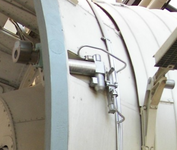
Remaining question is, why do the knobs move, what role does that play. From the look of it and photos showing them in a different position, it seems they move linearly left or right. I can't really reconcile them with the reading process if there's already a key to read data in, so my assumption is it could be a way to select which digit to change in the counter? With several detents in which the knob sits for each digit. The Globus has a similar concept to set the orbital period, but with a concentric knob. It's described above as "the cosmonaut enters the settings manually using special racks", the specific term for racks used in the original being
кремальер. That directs me to rack and pinions type stuff, among other things, so it leads me to believe this motion of the knobs is what racks refers to. It would track, pun intended, with why the solar azimuth seems to have a wider rack(?), having one more digit than the others.