Updates Rebirth of the Immortal Falcon: JAXA Hayabusa 2 updates

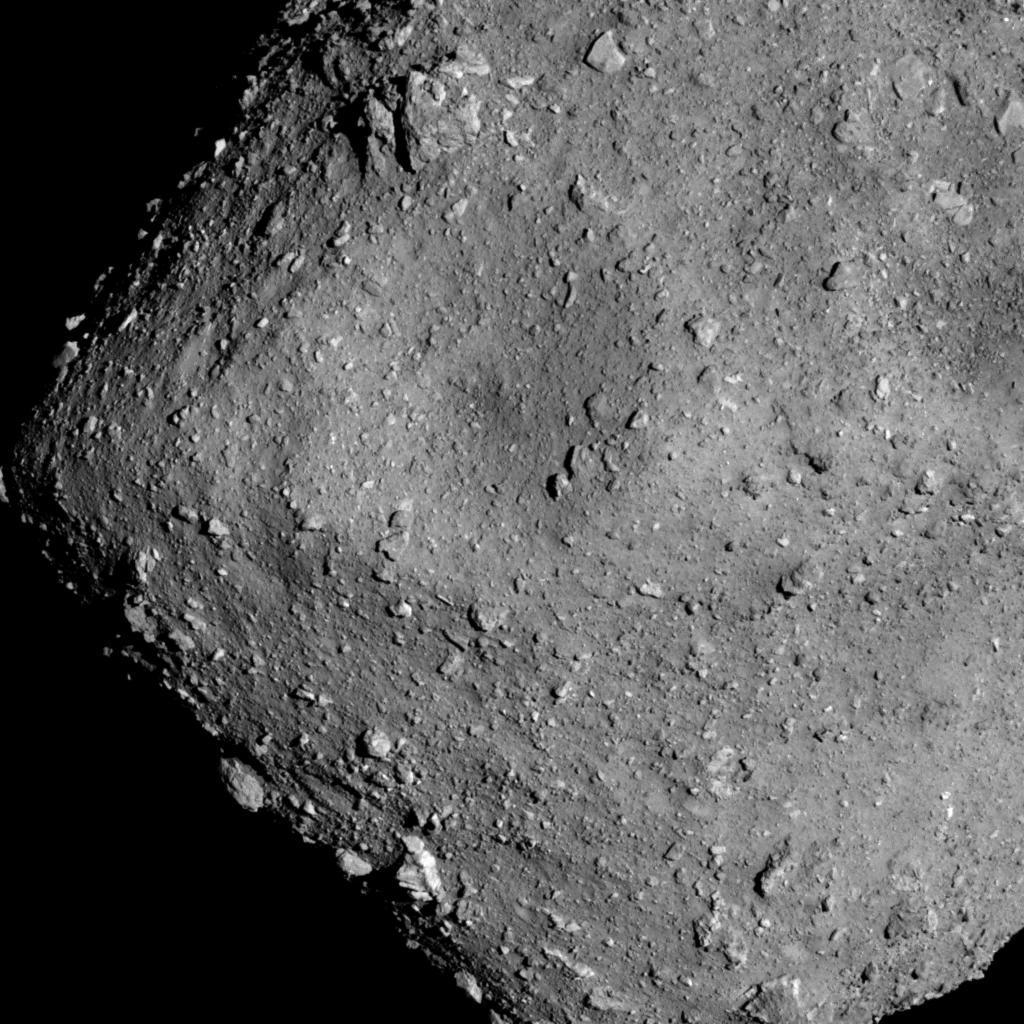
planetary.org : Ryugu from Hayabusa2, 20 July 2018
20180725_ryugu_home_20180720-0700.jpg

JAXA, University of Tokyo, Kochi University, Rikkyo University, Nagoya University, Chiba Institute of Technology, Meiji University, University of Aizu, AIST.​

Hayabusa2 obtained this image from a position less than 6 kilometers away from Ryugu's surface on 20 July 2018 at around 07:00 UTC. Near the center is a bowl-shaped crater, the largest on the asteroid.
 

3D Visualization of Asteroid Ryugu


NEW HORIZONS v2.0
Published on Sep 11, 2018

This simulated flyover was created using data taken by JAXA's Hayabusa2 spacecraft

Status update: Hayabusa-2's first Touchdown Rehearsal yesterday was terminated due to LIDAR issue.

The first operation rehearsal for the first touchdown of Hayabusa2 began on September 10 and during September 11, the spacecraft descended towards Ryugu. Today (September 12), the spacecraft was approaching the planned lowest altitude in the descent when the spacecraft autonomously stopped descending at about 600 m, and started to rise. The cause was that the laser altimeter (LIDAR) became unable to measure the distance between the spacecraft and surface of the asteroid. LIDAR measures distance by reflecting a laser from the asteroid surface. A probable reason for this measurement becoming impossible is the low reflectance of the surface of Ryugu.

The condition of the spacecraft is normal and is today returning to the home position (about 20 km from the asteroid center). From tomorrow, we plan to revise the descent procedure, including a review of the LIDAR settings.

Source
 
https://www.bbc.co.uk/news/science-environment-45578795

Japan's Hayabusa-2 spacecraft despatched a pair of "rovers" to the 1km-wide space rock known as Ryugu.
If all goes well, Hayabusa-2 will be the first spacecraft to successfully place robot rovers on the surface of an asteroid.
Rover 1A and Rover 1B will move around by hopping in Ryugu's low gravity; they will capture images of the surface and measure temperatures.
Hayabusa-2 reached the asteroid Ryugu in June this year after a three-and-a-half-year journey.
The 1km-wide space rock known formally as 162173 Ryugu belongs to a particularly primitive type of asteroid, and is therefore a relic left over from the early days of our Solar System. Studying it could shed light on the origin and evolution of our own planet.
 
They made it!


First soft-landing of space probes on an asteroid!

[ame="https://twitter.com/haya2e_jaxa/status/1043481944179105792"]HAYABUSA2@JAXA on Twitter: "We are sorry we have kept you waiting! MINERVA-II1 consists of two rovers, 1a & 1b. Both rovers are confirmed to have landed on the surface of Ryugu. They are in good condition and have transmitted photos & data. We also confirmed they are moving on the surface. #asteroidlanding"[/ame]

index.php

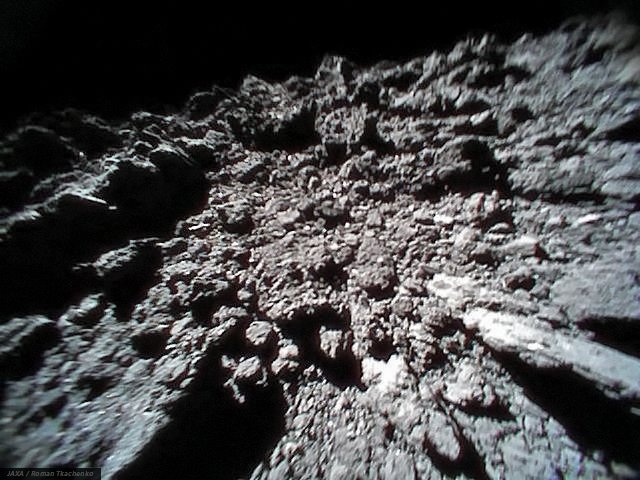
This is a picture from MINERVA-II1. The color photo was captured by Rover-1A on September 21 around 13:08 JST, immediately after separation from the spacecraft. Hayabusa2 is top and Ryugu's surface is below. The image is blurred because the rover is spinning.

index.php

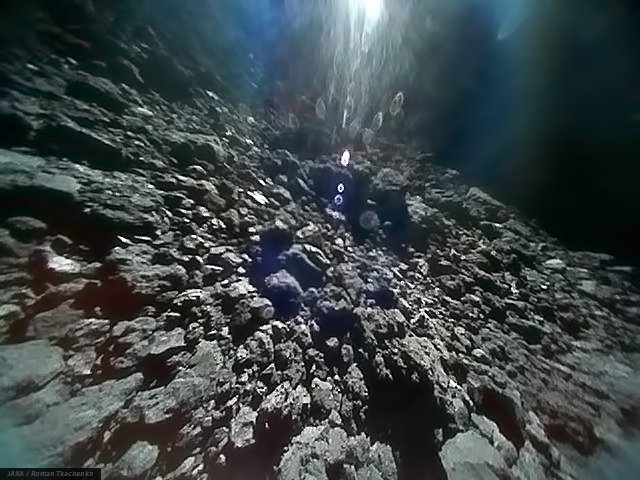
Photo taken by Rover-1B on Sept 21 at ~13:07 JST. It was captured just after separation from the spacecraft. Ryugu's surface is in the lower right. The misty top left region is due to the reflection of sunlight. 1B seems to rotate slowly after separation, minimising image blur.

index.php

This dynamic photo was captured by Rover-1A on September 22 at around 11:44 JST. It was taken on Ryugu's surface during a hop. The left-half is the surface of Ryugu, while the white region on the right is due to sunlight.

For more info about Hayabusa-2, visit: http://haya2now.jp/en.html

[ame="https://twitter.com/haya2e_jaxa/status/1038117430487265280"]HAYABUSA2@JAXA on Twitter: "Curious about what Hayabusa2 is doing right now? Our Haya2Now website is now in English! Just rollover each panel to find out more: https://t.co/UAbNVeHv1u… https://t.co/S9EA3kuuX5"[/ame]
 
Last edited:
[ame="https://twitter.com/DLR_en/status/1047360330685468672"]DLR - English on Twitter: "The @DLR_de @CNES @MASCOT2018 lander has landed safely on asteroid Ryugu and is in contact with its team! #AsteroidLanding… https://t.co/Hv8hYqhTP5"[/ame]
 
[ame="https://twitter.com/_RomanTkachenko/status/1098896082350891009"]Roman Tkachenko on Twitter: "Asteroid Ryugu as seen from an altitude of 30 m, right after Hayabusa2 touchdown.
#Ryugu #リュウグウ #Hayabusa2 #はやぶさ2 #haya2_TD… https://t.co/vPY7mAMdGk"[/ame]
 
Notebook, how can you make it sound so boring?
This is a video from a space probe.

This is a video of it kissing an asteroid and backing up slowly, 5 years of getting there all for these few seconds. Surface gravel held together for billions of years by nothing more than a faint promise of gravity is sent flying in a cloud, pinging off the hull, covering the camera's lens in stardust for a moment. Some of these bits and pieces are now little moons of Ryugu, some have achieved escape velocity and are lost forever, some would fall back and meet the ones from the other side. A lucky few would get a trip sunwards, to Hayabusa's home.

[ame="https://www.youtube.com/watch?v=-3hO58HFa1M"]「はやぶさ2」搭載小型モニタカメラ撮影映像 / Images from CAM-H - YouTube[/ame]
 
Its in my nature, I am British and live up to my stereotype.

This must be only recorded touch-down on another body since the Apollo programme?

N.
 
Not exactly, the Curiosity rover also had a down-looking camera on it filming the whole touchdown.
 
Its in my nature, I am British and live up to my stereotype.

This must be only recorded touch-down on another body since the Apollo programme?

N.


The video of the interpolated descent imager frames from Curiosity is amazing:


Forgot about the Huygens lander too:


The asteroid being explored by the Japanese mission Hayabusa-2 is a "rubble pile" formed when rocks were blasted off a bigger asteroid and came back together again.
The discovery means that asteroid Ryugu has a parent body out there somewhere, and scientists already have two candidates.
They have also found a chemical signature across the asteroid that can indicate the presence of water, but this needs confirmation.
Ryugu's unusual shape is also a sign that it must have been spinning much faster in the past.

https://www.bbc.co.uk/news/science-environment-47633649
 
The Japanese Hayabusa-2 spacecraft is thought to have detonated an explosive charge on the asteroid it is exploring.
The idea was to create an artificial crater on the object known as Ryugu.
If this is successful - and the early indications are positive - the probe will later return to gather samples from the gouged depression.

https://www.bbc.co.uk/news/science-environment-47818460
 
Back
Top