Humor Random Comments Thread

Too true. I'm happy to report that the :censored: woman was a Canadian, and I was the American visiting Canada for the first time. The experience with Air Canada was freaking awesome, they took great care of me flying out and coming home. Great first impression of Canada.

Coming home through Toronto and being given the "Papers please" treatment from the U.S. TSA jackbooted thugs made me less than proud to be an American. Flying into Canada, the security always seemed to be staffed by pleasant and lovely (but professional and thorough) women. Coming home it was like being interrogated by a mall cop.

I just a few days ago dealt with security staff in both Dallas and Toronto in the same day. The difference was quite stark.
 
New idea in the category "so cool there's no way this is ever gonna happen": A Cowboy Bebop reboot... with the Diablo Swing Orchestra doing the soundtrack :headbang:
 
New idea in the category "so cool there's no way this is ever gonna happen": A Cowboy Bebop reboot... with the Diablo Swing Orchestra doing the soundtrack :headbang:
They better have Christina Ricci as Faye Valentine, or I will :censored: somebody up:P
Christina-Ricci-Christina-Ricci-Haircut-Wallpaper-1235454.jpg
 
I did a search but I couldn't find this already posted here :
The Ruins of the Soviet Space Shuttles

That is so sad that those Buran shuttles are being left to rot like that. In many ways I think Buran was a smarter first incarnation of the shuttle concept where they were content to dispose of the booster.

The American shuttle simply needed too many bleeding edge technologies to play together to meet reusability requirements. The Challenger and Columbia accidents were both due to the push to minimize disposable components and to maximize reuse. The orbiter itself was not the problem.

I wonder how the Buran program, had it continued, would have compared to the U.S. shuttle program. It was less reusable, but at the same time less complicated, and perhaps safer and more cost effective.
 
This may lean towards tin foil hat theories but the thing that about the x-37 that intrigues me is the fact that the whatever its payload is... it is valuable and expensive enough that the air force had to develop a new space plane to launch it and retrieve it from space.
 
The American shuttle simply needed too many bleeding edge technologies to play together to meet reusability requirements. The Challenger and Columbia accidents were both due to the push to minimize disposable components and to maximize reuse. The orbiter itself was not the problem.

But the orbiter *was* the problem. Replace the ET with a stage with the same fuel volume and engines similar to the SSME block. Replace the orbiter with a reusable capsule mounted on top of the stack. Keep the SRBs, using the exact same design as flown on the real world shuttle. Challenger would have still happened, but would have been survivable, as a launch escape system usable from prelaunch through to SRB separation would have been workable, and crew survival would have been likely even without an LES. The Columbia accident wouldn't have been possible, as there would be no opportunity for a foam strike.

It's a good thing Buran did fail, otherwise it might have cannibalized Soyuz funding the way that STS cannibalized the possibility for a launch system developed from Apollo/Saturn IB, and the world would now have two space programs with no viable manned launch system.
 
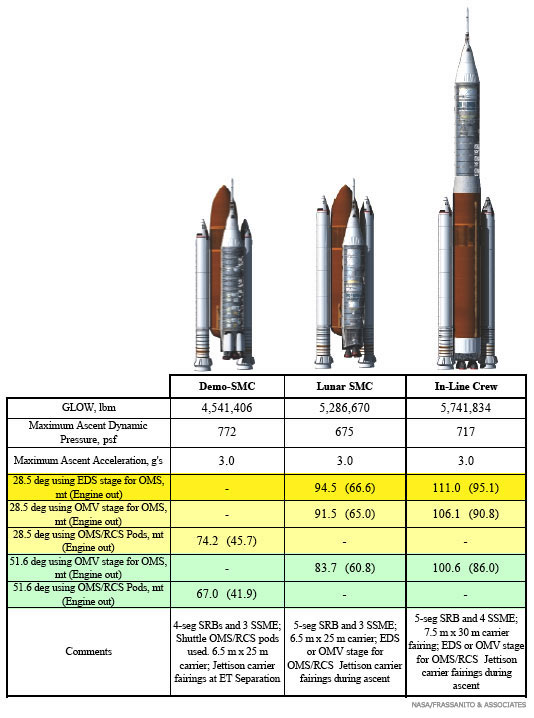
The U.S. space program could've been resumed almost immediately if NASA stopped using all but one of the space shuttle orbiters and spent that energy developing a smaller spaceplane like the dream chaser or a large capsule. That could've been mounted onto a modified liquid fuel tank like the shuttle c concept.

This would've been a perfect replacement IMO
cev.28.l.jpg
 
Last edited:
Could've, should've, would've....

There's no guarantee that canceling one program means money for another. Politics dictated the STS program be the way it was even before Gene Cernan climbed up the ladder off the moon for the last time. Nixon and others in his camp wanted to cancel Apollo and not paying for STS wasn't going to change their minds.

There's no use crying over what might've been. The space shuttle was a failure in some ways, but a fantastic technical achievement in many others. I think it's a shame not to take the huge leaps in technology from it and use them in the future. Just think: STS was only the first of its kind. Buran came too soon to really learn from any mistakes made in STS, but if a new shuttle program was designed today it would really benefit.

But since we're fantasizing about our pet ideas, my favorite idea is SERV.

serv.jpg
 
The U.S. space program could've been resumed almost immediately if NASA stopped using all but one of the space shuttle orbiters and spent that energy developing a smaller spaceplane like the dream chaser or a large capsule. That could've been mounted onto a modified liquid fuel tank like the shuttle c concept.

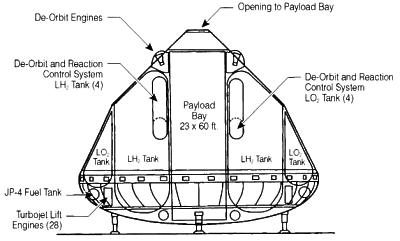
They could have used that HL-10.
 
Last edited:
When the last Shuttle is in a museum and the last spaceplane project cancelled ... you will see that capsules suck.

All that "Oh spaceplanes are unsafe, the Shuttle was unsafe, with a capsule it would have been survivable"... Face it: The Shuttle program management had been unsafe. If you use the same management on a capsule, it will be unsafe too. Ignoring risks and trying to change reality by memos has never worked in history.

Just repeat the "capsules are inherently safe" nonsense a few times more, and I bet capsules will even be less safe than the Shuttle ever was, because managers will also believe in that religious statement and trust the capsule way past its real capabilities.

Even if Apollo should have been a warning that being 12 times close to disaster does not mean you will never have a disaster after 24 flights.

(Especially if you look at what the STS meant for the US launch rates back then: A Saturn V had a 5 month launch campaign as minimum, the Shuttle really managed less than 30 days)
 
Last edited:
They could have used that HL-10.

Something based on X-24 could've been a possibility too, not only having been flight tested like the HL-10 from the Mach 1.4 to landing, but it also could draw on the testing done by the similarly-shaped X-23 from reentry to Mach 2.
 
Something based on X-24 could've been a possibility too, not only having been flight tested like the HL-10 from the Mach 1.4 to landing, but it also could draw on the testing done by the similarly-shaped X-23 from reentry to Mach 2.

Since we're on the "what if" game...

X-20.

*mic drop*
 
Face it: The Shuttle program management had been unsafe. If you use the same management on a capsule, it will be unsafe too.

Of course the Shuttle program management was unsafe: STS was such an accident waiting to happen that it never would have flown under safe management. But given equal management, the capsule will still be safer, not because capsules are heroically safe, but because STS was such a monumentally stupid and reckless idea.

Bad management might man-rate a seriously flawed capsule, or try something stupid with a good design, but good management would never man-rate an STS-type system built with current or plausible near-future technology.

Just repeat the "capsules are inherently safe" nonsense a few times more, and I bet capsules will even be less safe than the Shuttle ever was, because managers will also believe in that religious statement and trust the capsule way past its real capabilities.

It's not so much "capsules are inherently safe" as "STS-type systems are inherently dangerous".

(Especially if you look at what the STS meant for the US launch rates back then: A Saturn V had a 5 month launch campaign as minimum, the Shuttle really managed less than 30 days)

But we're not talking Saturn V, we're talking Saturn IB, and we're talking refinements for routine LEO operations rather than just continuing with unmodified moonshot hardware.
 
Of course the Shuttle program management was unsafe: STS was such an accident waiting to happen that it never would have flown under safe management. But given equal management, the capsule will still be safer, not because capsules are heroically safe, but because STS was such a monumentally stupid and reckless idea.

Monumentally stupid and reckless like leaving the safe ground behind at all? :P

Also, just to crash some fairy tale again: Every real system with less than 100% reliability is waiting for an accident. That's plain math. Even a perfectly safe system with a perfect management can have deadly accidents - but instead of one accident every 60 flights, we might be talking about one every 120 flights. And call that great in reality.

Bad management might man-rate a seriously flawed capsule, or try something stupid with a good design, but good management would never man-rate an STS-type system built with current or plausible near-future technology.

Wrong. We had it this discussion often before and again, you are just talking about things that you perceive as "That can't work", without even knowing it. Obviously the STS did work. And it was not even extremely unsafe, if you look at the pure number of LOCV events. Of course, you have a different statistic if you compare the number of deaths caused by a 777 and a C172 - even if both would be crashing equally seldom.

Just look at Apollo: Even if you ignore Apollo 1 as ground testing accident, would the Apollo 13 event happened on Apollo 8, the crew would have been dead as well, the LM as available lifeboat and a lot of excellent management saved the day. Was Apollo inherently safe? Of course not. It had been a very lucky program with luckily a small number of flights, that is insanely glorified by todays NASA managers and spaceflight fanboys without brain. The biographies of Gene Krantz or John Young tell you a much different story there from their own perspective. Same with Soyuz. Orion will maybe be safer because of the experience.


It's not so much "capsules are inherently safe" as "STS-type systems are inherently dangerous".

Is it? Do you even know what "inherently dangerous" means, aside of just saying it, because it sounds impressive?


But we're not talking Saturn V, we're talking Saturn IB, and we're talking refinements for routine LEO operations rather than just continuing with unmodified moonshot hardware.


Sorry, wrong. First of all, the Saturn IB was a much different launcher, in performance as well as in necessary complexity. And still, the Saturn IB had the same long check-out times as the Saturn V, because it was based on the same process technology. Only because you are only flying in LEO with a Shuttle, that does not mean that Apollo with a Saturn IB could have done the same job.

And if we would go back to the beginning of my post: The Shuttle had statistically one deadly accident every 60 flights. Apollo CSM had just 19 flights and already 2 failures, one of it deadly. There had been just 6 LEO missions with the Apollo CSM (because it was way more expensive to operate than the Space Shuttle. Yes, today you would not believe it), two of it had been near deadly accidents (Skylab 3 almost needed a rescue mission and ASTP had only not killed the crew by plain luck again). Apollo was rated with a 1 deadly accident in 18 flights statistic in a NASA report after STS-107, the Shuttle with a 1 in 55 - the CEV (and thus the new Orion capsule) was expected to reach a 1 in 120 statistic on a SRB stick in the same report.

 
Last edited:
Back
Top