Humor Random Comments Thread

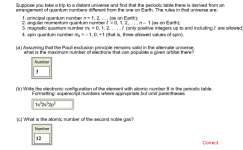
My chem teacher today:
Elements in the first family have 1 valence electron. Those in the second family have two. Then jump across the d block and subtract 10 from the family. (13 has 3, 14 has 4, etc) Don't worry about transition metals. They're only about a third of the table, and you won't have to know about their valence electrons.

I think I might learn better just googling the material... :uhh:
 
well anti-differentiation pretty much just teaches itself, so i don't really see the issue here... ;)
 
So wrong...
picture.php
 
Hehe. I expected first-semester freshman college chemistry to be that easy. So far...uh...

Interestingly, in reality, the Pauli exclusion principle only holds when there are an even number of allowed values for spin (which is why they had to say "assuming the Pauli exclusion principle remains valid", since it normally wouldn't).

In other news, gzipping a 30 megabyte directory on a 75 megahertz Pentium is unbelievably slow...
 
I still got my 33 mHZ 386

fun times.

My Atari 1040 STF (10 Mhz) is still at my parents house. And my girlfriend has a Commodore C128 around.
 
33mHz would be much more interesting than 33MHz. :lol:
A room full of mathematicians, passing notes around?
That's how they did "computers" back in manhattan project days.
 
A room full of mathematicians, passing notes around?
That's how they did "computers" back in manhattan project days.

Yes, but the mathematics had also been quite different to today in such projects. Also mechanic special purpose computers did already exist at this time, what had been missing had been general purpose computers in the USA, Germany had the Z3 at that time already and used it for gliding bomb calculations.
 
When it comes to computer nostalgia, the only thing I can look back on is an original IBM 086, and there's not much nostalgia there... It was too incompetent at everything to really feel sorry about not having it anymore, even with the memory expansion to run DOS 3.6.

The next computer we had was already a 486 with 66 MHz. The next upgrade I already bought myself, a pentium 75 with a whopping 8 MB of ram. Yeah, my Dad was kind of really slow in updating his home system... :shifty:

He was of the old school "buy the best you can, it'll serve you longer and you'll save money" school and just couldn't make the switch to the "don't buy the newest, but more often" that was more sensible in the computing world. I think it actually pained him to buy a new computer although the 086 hadn't actually physically broken down yet.
 
Last edited:
A room full of mathematicians, passing notes around?
That's how they did "computers" back in manhattan project days.

Or it could be a bunch of computer scientists sitting at a mainframe front panel single-stepping through a program they're debugging.

Though it's actually more likely that they'd be pausing longer on some instructions and shorter on others (or spending longer reading/writing some notes and shorter with other notes, in the case of the mathematicians), with the average being one step every 30 seconds, than that they'd be doing exactly one step every 30 seconds. So it would actually be 33 millibecquerels, not millihertz.
 
My first computer was a [ame="http://en.wikipedia.org/wiki/Mattel_Aquarius"]Mattel Aquarius[/ame] I bought off my neighbor for $2. Yeah...
 
Back
Top