Project N1 Lunar

Will this N1 have failure modes like what unfortunately happened historically?
Yes!!! At least I would certainly wish it so.
Currently I think there are 3 options:

1. @Urwumpe is working on some code, but no idea on progress or scope, tailored code would be the best.
2. Multistage. I've already built an LV using the realistic flight model and damage (the only one I know of?) that works correctly (titan for the Viking). Downside: not compatible with Orb24 (yet?).
3. VesselM family: this has a damage model and would be the perfect home fo a soviet rocket, need to look closer at it.

Launch is still a little away, so many stages! and would really like to make a complete lunar program of it. Still feels a little like a "moon shot", but intend to get further off the ground than, the original, and (sadly) other addons.
It has a very interesting/tricky flight plan, a 2 part TLI with stage sep., EVA only access to the Lander, and other complicated maneuvers, should be a lot of fun to fly. :)
 
1. @Urwumpe is working on some code, but no idea on progress or scope, tailored code would be the best.

I decided to stick to the unflown N-1F for my project scope. Not more, not less. Historic failures thus are not planned, but I consider adding the known failure modes of the NK-33 to it. Otherwise its largely the same flight profile unless I also include larger landers for later missions. Would be a one burn TLI then, but still a two stage lunar landing.

Generally, I don't think the historic version of the N-1 could have worked out for a lunar mission, it has absolutely no performance reserves, less than optimal launch windows would be impossible to use.
 
Nick Stevens has just (May 17) posted some interesting LK lander details at his Soviet Space Program Substack:


At the bottom there are photos of enthusiasts installing a large scale model of the N1 at Baikonur.
 
I decided to stick to the unflown N-1F for my project scope. Not more, not less. Historic failures thus are not planned, but I consider adding the known failure modes of the NK-33 to it. Otherwise its largely the same flight profile unless I also include larger landers for later missions. Would be a one burn TLI then, but still a two stage lunar landing.

Generally, I don't think the historic version of the N-1 could have worked out for a lunar mission, it has absolutely no performance reserves, less than optimal launch windows would be impossible to use.

AFAIR it was worse than that. The historic project was in debt of like 100 m/s of dV. They had not the engines the rocket was designed to work with, so hardly a surprise.
 
AFAIR it was worse than that. The historic project was in debt of like 100 m/s of dV. They had not the engines the rocket was designed to work with, so hardly a surprise.

For the classic first-order approximation, this is true, but again, on a favorable launch window and with some more consideration on the Russian mission profile (out of plane transfers at lower velocity), it could just work. But not more than that. More wind, more solar activity, some more outgassing than expected, and the mission would fall short.

Again, thats why I decided for the N-1F, that was supposed to do the 8L flight. Better engines, better performance, theoretically much higher translunar payload (If the reserves are not eaten up by engineering)... it might be more real fun and less masochistic "fun". Also a better flight computer for launcher and spacecraft, but I can't find much information about the differences except it being all digital and thus, something like an indirect precursor to the Argon-16 computer used in the Soyuz T and later.
 
Last edited:
@Buck Rogers In case you also make a N-1F mesh (set), how many sections do you make the aerodynamic fairing and the "LK fairing" (between Blok D and Soyuz LOK)? And do you add a hatch into the "LK fairing" for entering the LK, that could be animated? AFAIR, you also add the engine section fairings to the N-1 stages.
 
AFAIR it was worse than that.
That makes it easier if I don't have to make it work properly ;)
In case you also make a N-1F mesh (set), how many sections do you make the aerodynamic fairing and the "LK fairing" (between Blok D and Soyuz LOK)? And do you add a hatch into the "LK fairing" for entering the LK, that could be animated? AFAIR, you also add the engine section fairings to the N-1 stages.
I'm currently modeling L3. L5, L6, and L7 are visually very similar with only small changes. N-F1 is similar to L7?
The Payload fairing seems to be 2 piece, all other are 3*, LK fairing: don't know yet, 2 I think?
LK hatch animation= yes
3 piece eng. fairings for Block B and V.

*The further up the more guess work!
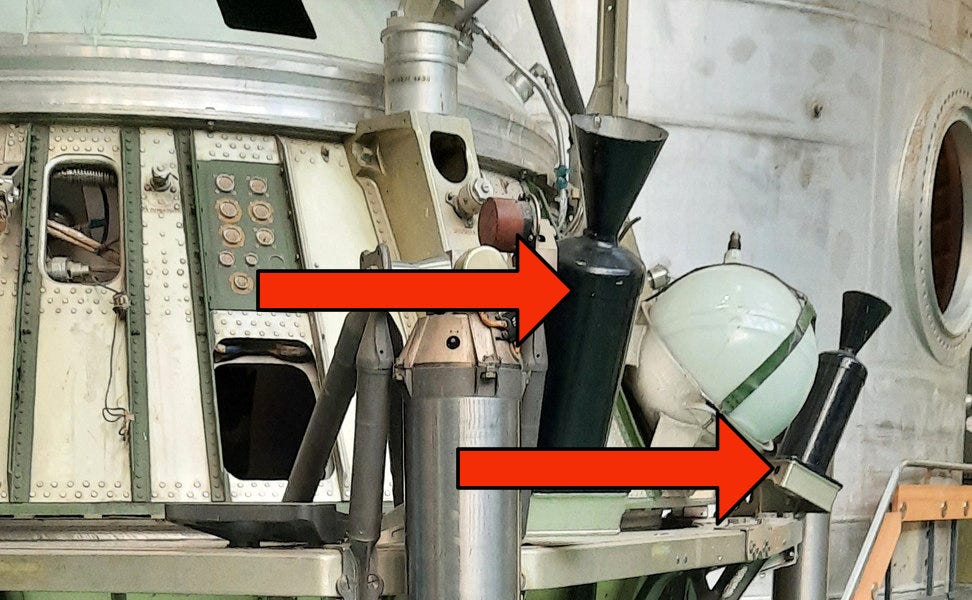
I'm trying to at least emulate the different engines, but it's very confusung, in illustrations of engines alone and in renders of the N1 there are red caps, in very bad pictures of engines in situ they don't seem to be present, I'm beginning to think some of these are actually storage caps for fuel lines!?, (in the N1 renders the fuel line connections are not decernable). Anyway the original N1 plumbing looks like it was made by Mario on acid! Just hope it looks convincing enough.
Unsure about Block V stage/payload adapter I presumed it was a similar structure to the lower stage adapters but in the only depiction I've found it seems to be solid?
 
I'm currently modeling L3. L5, L6, and L7 are visually very similar with only small changes. N-F1 is similar to L7?

Sadly not, there are most likely a few more differences, but generally it is a further evolution of the L7 configuration. The Blok A engines were NK-33, the Blok-B uses NK-43 and the Blok V uses NK-39, which was likely causing some changes to the engine sections. The Blok G is most likely the same again.

The Payload fairing seems to be 2 piece, all other are 3*, LK fairing: don't know yet, 2 I think?

I also don't really know, there are multiple different depictions of it. The best always show an additional fairing around the LK with a opening to access the LK. Some show a manually discarded hatch, others a classic door with a (useless) window. Some just show a flimsy support structure too offload the structural loads from the LK (which makes the least sense, but at least some sense)

What is sure: This Hazegrayart video of the lunar moonlanding, that lets the LOK directly rest on top of the LK without a fairing, is highly unlikely to be correct. But sure satisfies the rule of cool. But it lacks any EVA aids, which would be mandatory.


I would suggest a two-part fairing there since thermal protection during the cruise to the moon is very smart for using an inert lander, not fully sure with the hatch. With the low level of EVA confidence in the USSR at that time, I doubt they would make opening the hatch a too complex operation. But I would not model a window there unless you can imagine a reason why it exists.

LK hatch animation= yes

I'll plan this into the concept once I actually reach this configuration. Currently I am still working on lift-off and Blok A staging. Sorry, the ESC today makes me slower than last weekend.

*The further up the more guess work!
I'm trying to at least emulate the different engines, but it's very confusung, in illustrations of engines alone and in renders of the N1 there are red caps, in very bad pictures of engines in situ they don't seem to be present, I'm beginning to think some of these are actually storage caps for fuel lines!?, (in the N1 renders the fuel line connections are not decernable). Anyway the original N1 plumbing looks like it was made by Mario on acid! Just hope it looks convincing enough.
Unsure about Block V stage/payload adapter I presumed it was a similar structure to the lower stage adapters but in the only depiction I've found it seems to be solid?

I would say, there the Blok G has a simple ring shaped adapter to hold the Blok D in position. In all later launchers (Proton, Zenit), the Blok D is hanging from the top of its "interstage", the LK fairing would rest on top of this. Maybe thats the real solution? I dunno. But RussianSpaceWeb shows a different fairing configuration, were the Blok D remains inside a thermal protection shell, the interface between Blok G and Blok D is a simple enclosed interstage ring.


Would you also be interested in modelling the larger L3M spacecraft?


It is pretty much a direct ascent lunar landing configuration, where the return capsule is landed on the moon as well. It was supposed to be the main payload for the N-1F, but the first lunar missions were most likely done by the L3 payload.

 
interesting LK lander details
Thank you, very useful information, I saw those on the model and thought they were a mistake! Should make landing easier/ more interesting!
And good to know what the others are for as well.:)
 
The Blok A engines were NK-33, the Blok-B uses NK-43 and the Blok V uses NK-39, which was likely causing some changes to the engine sections.
Blok A engines are covered, so nothing to see, the others are derivitives of the respective engines so I'm not expecting major visual changes.
For example currently modeling the NK19 for Blok V, can't find any pics of a NK39, except this pic (bot. right) are apparently NK39s? There seems to be something on the inside?
i.webp
I think (hope) that a lot will become practically clear (or not) when it comes to modeling it.
I'll probably have a lot of questions :)
Would you also be interested in modelling the larger L3M spacecraft?
Yes, I've been looking at those for years, but little detail so a lot of creativety/work and all much further down the line. It would be nice to have a comlete program with the previous unmanned missions and the following ones but certainly no small task, and I'm noticing that without details I'm having to eyeball with many readjustments which takes a lot of time...
 
Blok V NK19
Unbenannt-1.jpg
Pretty much guess work on my part as I've found no direct reference material for the Blok V.
 
This page is still one of the best, but hardly detailled enough.

 
And the only depiction of the "stage IV adapter" I've found, looks like a solid structure?

Seems to be correct if you compare this to photograph below on that page - the "Stage IV adapter" is the aft end of the L3 complex, to the right of the photograph.

EDIT: See also on this page:

 
The next stage is the same, the adapter seems to be a simple extension of the tank body structure, slowly getting familiar with the construction.
 
I would say, there the Blok G has a simple ring shaped adapter to hold the Blok D in position. In all later launchers (Proton, Zenit), the Blok D is hanging from the top of its "interstage", the LK fairing would rest on top of this. Maybe thats the real solution? I dunno. But RussianSpaceWeb shows a different fairing configuration, were the Blok D remains inside a thermal protection shell, the interface between Blok G and Blok D is a simple enclosed interstage ring.
Blok D "Fairing/interstage": What looks like a payload adapter is apparently a radiator, has structural elements on the inside and on the cutout of the Flagman tug connects to the outer casing. The so called "Fairing/interstage" is the structural connection to the Blok G adapter and the LK "Thermal fairing", and that is the structural connection to the LOK. Blok D is supposed to be used right up to/and for the final landing de-orbit braking burn! So I conclude that it never sheds it's "Fairing/interstage".

The LK Blok E must be connected to the Blok D structural elements on the inside of the radiator.

The LK "Thermal fairing" is still a bit of a mystery, no decernable seperation elements, and is the structural connection for the LOK. Maybe a 2 piece fairing, or I'm beginning to suspect that it is simply pulled off in 1 piece like a sleeve!
 
The LK "Thermal fairing" is still a bit of a mystery, no decernable seperation elements, and is the structural connection for the LOK. Maybe a 2 piece fairing, or I'm beginning to suspect that it is simply pulled off in 1 piece like a sleeve!

I think a two-piece fairing makes most sense there. The Block D has no retro thrusters and the LOK must also separate from it. But I can't find any pictures or fairing separation tests.
 
The Block D has no retro thrusters and the LOK must also separate from it
Lok thrusters seperate from Blok D, LOK and thermal cover together, turn 180, discard term. cover, dock with LK, EVA, undock, land?
 
Lok thrusters seperate from Blok D, LOK and thermal cover together, turn 180, discard term. cover, dock with LK, EVA, undock, land?

Or you keep it simple, just separate the fairing into two halves and let the LK spacecraft and the Block D go on with their mission. Who cares about more junk on the moon?
 
Who cares about more junk on the moon?
Certainly not a junk problem :)
This mission has so many expendable parts!
It's just that (with the limited information) I can't see how? There must be (at least) seperater motors somewhere?

The way the LOK looks bolted down on the thermal cover in the L3 system pic looks like 1 piece and detachment in a forward direction?
 
Last edited:
Back
Top