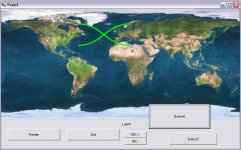
Don't be afraid of radians. While they are maybe strange to work with on the paper (where I would prefer degrees too), they are less hard to use inside software. After all, you only need to do the calculations once... and the computer does the rest.

You can limit degrees for the input/output then.
Why don't you render the orbit
ground track by splitting the orbit into segments, with the number of sample points and their positions depending on eccentricity or other selection conditions.
Let's say, I want to write a application, which shows me two things:
- A history of the last orbit in the past, created from real orbit data.
- A prediction of the orbit calculated iteratively by concatenating segments of osculating orbits.
The first task would be simple - just a watered FIFO structure, where I take one data point out for each new data point added after being full.
The second task would propagate the state vector into time. The important factor is the right distribution of sample points. If I choose the distribution to sparse, I get stronger errors making my predictions inaccurate. If I choose too many sampling points, I can't calculate the data in real time.
My personal experience from university was, that choosing constant 5° steps is working perfectly for most low earth orbits.
But when you want to support also orbits with higher eccentricity or other strange parameters relative to Earth (for example geostationary orbits), a more flexible way to propagate the state vector would be good - you could for example exploit the knowledge that the spacecraft spends more time around apogee - the higher the eccentricity, the higher is the difference between time spent at the region around apogee and time spent around perigee.



 rbiterMC.exe