Math simple question about areas

Gerdih

Member
Joined
Jan 8, 2010
Messages
776
Reaction score
7
Points
18
Location
Barcelona
Ok, since a professor at my university keeps saying that the area between 2 functions (R2) is ALWAYS Af(x)-Ag(x) I would like to ask you guys:

Are you agree that the area between f(x)=3x^3 -x^2 -10x and g(x)= -x^2+2x is 24u^2 ?

I know that this question is simple but the professor says one thing and I say another thing, while the Larson calculus book gives him the answer of 24 it doesnt says that the area between two functions is ALWAYS Af(x)-Ag(x). Anyway I am not agree with the result of 24 but maybe I am wrong because of bad choosing the limits of integration, the reason is that there is a piece of area where the functions cross that its not on one of the axis so that makes me think that there will be areas that cant be calculed by simply doing Af(x)-Ag(x).

So just for a little fun, can anyone check this?
 
Last edited:
The area should always be Af(x)-Ag(x) as long as you choose the limits to be the same for each integration. You can sometimes get negative area (under the x axis) but even then, it should give you the right answer if you take one away from the other. The difference might also be negative, but it should still be OK if you take the modulus of it.
 
Ok, since a professor at my university keeps saying that the area between 2 functions (R2) is ALWAYS Af(x)-Ag(x) I would like to ask you guys:

Are you agree that the area between f(x)=3x^3 -x^2 -10x and g(x)= -x^2+2x is 24u^2 ?

I know that this question is simple but the professor says one thing and I say another thing, while the Larson calculus book gives him the answer of 24 it doesnt says that the area between two functions is ALWAYS Af(x)-Ag(x). Anyway I am not agree with the result of 24 but maybe I am wrong because of bad choosing the limits of integration, the reason is that there is a piece of area where the functions cross that its not on one of the axis so that makes me think that there will be areas that cant be calculed by simply doing Af(x)-Ag(x).

So just for a little fun, can anyone check this?
By "area" your professor most likely means [ame="http://en.wikipedia.org/wiki/Integral"]the integral[/ame] of function on a certain range. The integral of a function can be negative, and/or it can be smaller than the actual area between the coordinate axis and the graph:
220px-Integral_example.svg.png


The integral of a function ("area") has a property of [ame="http://en.wikipedia.org/wiki/Linear_map"]linearity[/ame], i.e.:
attachment.php

(and by taking f(x)-g(x), you'll have you Af(x)-Ag(x) formula)
Hence, IF he talks about the integral (and not about total area between the axis and the function graph), he is right
 

Attachments

  • CodeCogsEqn.gif
    CodeCogsEqn.gif
    1.8 KB · Views: 156
Last edited:
Yep I know that DarkWanderer, I was only wondering if the area between two functions ( not the area between a function and the axis whatever is negative or positive) will be always calculed doing integral(f(x))-integral(g(x)) being f(x) > g(x) in the interval of the integral, or if you have to sum or subtract some pieces of the integral to get the right area. The functions I wrote in the previous post made me think about it but I see I was wrong, it can still be calculed doing what I've said previously.
 
Not so fast, Gerdih, I didn't tell you everything :)

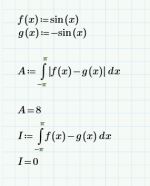
Consider two functions: f(x) = sin(x) and g(x) = -sin(x) on the range of [-pi,pi].
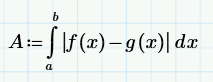
Now (you have to believe me on this one, but it can be proven), the area between the graphs of 2 functions is computed as:
attachment.php


Hence, with our two functions:
attachment.php

The integral of both functions on this range is 0 (check it yourself), as is their difference, however, the area between two functions is non-zero - it is equal to 8.
So, as you can see, the Af(x)-Ag(x) is not equal to the area between the two graphs in general case.

Hence, the answer is:
  • If you professor talked about area between two functions, he is wrong. The example above illustrates it.
  • If he was talking about the integral difference between two functions, he is right.
So, just ask him what he meant, and you can possibly prove him wrong :)
 

Attachments

  • integral1.png
    integral1.png
    4.5 KB · Views: 130
  • integral2.png
    integral2.png
    16.8 KB · Views: 130
Last edited:
You could also take the opposite action and ultimately pass the semester ;)

Good teachers usually encourage students to do own research and argue (provided the argument is well backed). This is their job, afterall - to teach people to think...

I've earned quite a bit of respect by arguing in my time ;)

DarkWanderer (using Tapatalk)
 
The problem is that there are not only good teachers, but also useless grumpos, who couldn't find their way into the industry and hence, they vent their complexes on poor students... unless you are a student who pays for his studies. Then it's a totally different thing.
 
Last edited:
Back
Top