Question Math: Catapult: Numbers

Kaito

Orbiquiz Coordinator
Joined
Jul 24, 2008
Messages
857
Reaction score
0
Points
0
Alrighty, so my friend and I are planning on building a big catapult, just for fun. For some reason, I cannot use my physics equations correctly, and I get different numbers each time I do them. So, since you guys are a bunch of math and physics nerds (i love you all), I figure you'd be the best guys to ask.

Heres what I know:
The mass is 2 kg
The radius that the swing arm will be moving (point of rotation to the mass) is .62 meters
The arc is 1.06 meters
The "spring constant" of my surgical tubing (the power) is 55.118 N/m
The tubing is stretched .89 meters
Launch angle is 55 degrees
(If you need it)The central angle is 98 degrees between when its "cocked" and when it releases the projectile

I hope that's enough to figure out things. What I'm mainly looking for is the final velocity, but any info helps. When I plugged in the numbers, i got a final velocity of 65 m/s, which i'm almost sure is wrong.

Any help would be appreciated
~Kaito
 
Using energy:

The energy stored in the elastic bands = .5 * k * x^2 = .5 * 55.118 * .89^2 = 21.83 J

This energy will be converted into kinetic energy, so 21.83 = .5*m*V^2 solving this for V gives a velocity of 4.67 m/s or 10.45 mph.
 
Dang, okay, thank you
Time for a MASSIVE re-design
 
Using energy:

The energy stored in the elastic bands = .5 * k * x^2 = .5 * 55.118 * .89^2 = 21.83 J

This energy will be converted into kinetic energy, so 21.83 = .5*m*V^2 solving this for V gives a velocity of 4.67 m/s or 10.45 mph.

This is the theoretical best case as you haven't taken the mass of the swing-arm into account. The energy of the stretched tubing will also go into kinetic energy of the swing arm, reducing the final speed of the projectile.
 
Yeah thats true. I was thinking it was a type of slingshot but it's really a catapult.
 
You have to calculate the moment of inertia of your swing arm and the mass:

For the mass it is easy, if you assume a mass point: I1=m1*r^2
where m1 is the mass and r is Radius from the point where the swing arm rotates to the mass.

The swing arm is a bit more complicated. If it is only fixed at one end and the mass is at the other end than I2=(1/12)*m2*l^2
where m2 is the mass and l the length of the swing arm.

If your swing arm is more complicated you can use Steiner's parallel axis theorem or just assume a usefull amount of mass points and calculate their moment of inertia as above. Then you have to sum them up.

Now you can write your rotation energy as:
E1=(1/2)*(I1+I2)*w^2

where w is your angular velocity.

Just equal this with your energy in the elastic bands: E2=(1/2)*k*x^2
where k is the spring constant (or how it is called) and x the way of the deformation of the bands.

Then get w from this.

The final velocity is then, when we assume that all the energy gets converted, v=w*r

Good luck :cheers:
 
You'll need to tell us the mass of the swing arm, it's geometry and the starting stretch and final stretch of the spring to do any meaningful calculations...

Other then that, to increase your range, use 45° launch angle. That will pretty much give you the furthest distance. We'll neglect the loss by the air resistance, because that only changes the angle by a few degrees.

Also, if you're using twisted rubber bands as your spring, turn them a couple of turns before you're actually loading the catapult. The distance the rubber bands unwind will always be the same - 89 cm - but the amount of energy released in the release between 89 cm to 0 cm or between 289 cm to 200 cm is far greater:

Energy between 89 cm and 0 cm: (0.5 * 55.118 * 0.792) - (0.5 * 55.118 * 0) = 21.83 J

Energy between 289 cm and 200 cm: (0.5 * 55.118 * 8,352) - (0.5 * 55.118 * 4) = 230.176 - 110.263 = 119.913 J

The calculations before assumed you're gonna do a release between 89 cm and 0... and that ended up with a small velocity. Just do more twists on the bands and you'll get far greater release velocity.

But do be careful... if the bands break, they can take your arm off...
 
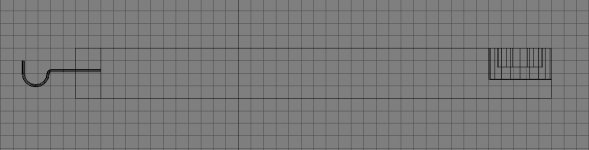
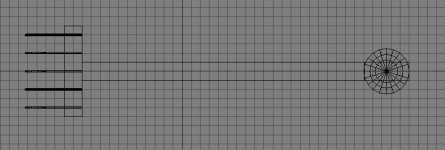
Each "grid" in the image is 1 inch. They are standard 2x4's

I'm not sure the exact mass.

Oh, and the pivot (forgot to put it in there, and i dont want to take more pictures):
1 inch metal rod

Looking from the FRONT (where the "cup) is, from the very tip of the "cup", it is 25 inches (grid units) to the LEFT. Its placement is DEAD CENTER of the board.

All I need are the equations. I can do the math once i have those
Oh, and its using Surgical tubing as its power source. When its in the "ready-to-launch" position, the tubing length 1.19 meters, or 47 inches
And, another number (just for your sheer enjoyment): the arm will stop when the tubing is .93 meters or 37 inches. I still need to figure out its non-stretched length tho...
 

Attachments

  • SwingArm1.jpg
    SwingArm1.jpg
    73.6 KB · Views: 10
  • SwingArm2.jpg
    SwingArm2.jpg
    75.5 KB · Views: 9
Physics isn't about entering values into the equation... it's about understanding the principles and arriving to the equation in the first place.

It's 5.20 am right now so I don't know if this is correct. Please correct me if I'm wrong.

This assumes no other loss of energy such as drag, loss due to vibrations, imperfect spring, catapult moving,... but it should give you a good estimate.


Catapult.jpg
 
For catapult design, work to find the launch velocity and angle; forget about distance. The distance flown will depend on the projectile and its ballistic coefficient and is best left as a seperate problem.
 
Back
Top