Updates Mars Science Laboratory (Curiosity)

NASA JPL:
Computer Swap on Curiosity Rover

February 28, 2013

Mars Science Laboratory Mission Status Report

PASADENA, Calif. - The ground team for NASA's Mars rover Curiosity has switched the rover to a redundant onboard computer in response to a memory issue on the computer that had been active.

The intentional swap at about 2:30 a.m. PST today (Thursday, Feb. 28) put the rover, as anticipated, into a minimal-activity precautionary status called "safe mode." The team is shifting the rover from safe mode to operational status over the next few days and is troubleshooting the condition that affected operations yesterday. The condition is related to a glitch in flash memory linked to the other, now-inactive, computer.

"We switched computers to get to a standard state from which to begin restoring routine operations," said Richard Cook of NASA's Jet Propulsion Laboratory, project manager for the Mars Science Laboratory Project, which built and operates Curiosity.

Like many spacecraft, Curiosity carries a pair of redundant main computers in order to have a backup available if one fails. Each of the computers, A-side and B-side, also has other redundant subsystems linked to just that computer. Curiosity is now operating on its B-side, as it did during part of the flight from Earth to Mars. It operated on its A-side from before the August 2012 landing through Wednesday.

"While we are resuming operations on the B-side, we are also working to determine the best way to restore the A-side as a viable backup," said JPL engineer Magdy Bareh, leader of the mission's anomaly resolution team.

The spacecraft remained in communications at all scheduled communication windows on Wednesday, but it did not send recorded data, only current status information. The status information revealed that the computer had not switched to the usual daily "sleep" mode when planned. Diagnostic work in a testing simulation at JPL indicates the situation involved corrupted memory at an A-side memory location used for addressing memory files.

Scientific investigations by the rover were suspended Wednesday and today. Resumption of science investigations is anticipated within several days. This week, laboratory instruments inside the rover have been analyzing portions of the first sample of rock powder ever collected from the interior of a rock on Mars.

{...}


NASA JPL - Mars Exploration Program: Computer Swap on Curiosity Rover

CBS News Space: Engineers assess Curiosity computer glitch
 
Ouch.. Already a failure? Perhaps the B-side will last the rest of the mission.

But if it's a memory issue (flash has never been reliable), can't they just work around it and exclude the bad blocks?
 
Double bit error ?

A little more details on Spaceflight Now : looks like what is called a "double bit error", caused by a very unlucky energetic particle hit, and it should be corrected by rebooting computer A. But it shows that 2 computers is a strict minimum for that kind of complex robotic mission.

[FONT=VERDANA, ARIAL, HELVETICA, SANS-SERIF][SIZE=+2]Curiosity rover suffers computer glitch on Mars

[/SIZE][/FONT][FONT=VERDANA, ARIAL, HELVETICA, SANS-SERIF][SIZE=-2]BY WILLIAM HARWOOD
STORY WRITTEN FOR CBS NEWS "SPACE PLACE" & USED WITH PERMISSION
Posted: March 1, 2013[/SIZE][/FONT]


Space radiation may be to blame for corrupted memory used by the Curiosity Mars rover's flight computer, resulting in software glitches that interrupted the flow of science data Wednesday and prompted ground controllers to switch over to a redundant computer Thursday, NASA officials said.

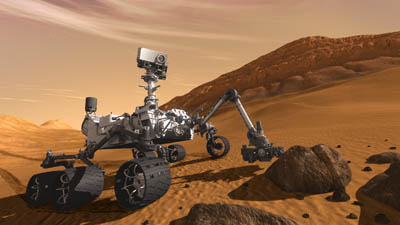
onmove.jpg

[FONT=Verdana, Arial, Helvetica, sans-serif][SIZE=-3]The Curiosity rover, on the move in Gale Crater. Credit: NASA/JPL-Caltech[/SIZE][/FONT]

Engineers are reviewing telemetry and diagnostic tests using ground systems to figure out what went wrong and how to restore the original computer system to normal operation.

"We were in a state where the software was partially working and partially not, and we wanted to switch from that state to a pristine version of the software running on a pristine set of hardware," Curiosity Project Manager Richard Cook told CBS News late Thursday. "The easiest way to do that is to essentially swap sides ... and start up with the redundant (computer)."

Curiosity is equipped with twin flight computers, known as A and B, and either one is capable of carrying out the rover's mission. The B-side computer was used during the cruise from Earth to Mars while the A-side computer has been running the show since before landing last August.

The switch from the A-side computer to the B-side processor took place around 5:30 p.m. EDT (GMT-5) Thursday, putting the nuclear-powered rover into a low-activity state known as "safe mode." Over the next few days, engineers will tie the B-side computer into the rover's myriad systems and systematically restore normal operation.

The computer problem is the first glitch of any significance since Curiosity's landing last August in Gale Crater.

"I think we'll get back to routine operations," Cook said. "It is a good humbling experience, however, in the sense that this thing is a very complicated vehicle. ... It does not take very much for things to not go as well as you want. And we've got to be conscious of that all the time."

The problem came to light Wednesday morning on Mars when flight controllers at the Jet Propulsion Laboratory in Pasadena, Calif., noticed what appeared to be memory corruption in the computer's solid-state memory system. The flight software was not recording new data or playing back data already recorded. Instead, it was only sending back real-time telemetry.

Later in the day, during a communications session using NASA's Mars Reconnaissance Orbiter, telemetry from Curiosity indicated the corrupted memory was still present. In addition, Cook said, flight controllers saw the computer had not completed several pre-planned activities.

At that point, the computer was expected to put itself to sleep for an hour or so and then to wake up for a communications session with NASA's Odyssey orbiter.

"It was after that second overflight that we got some more information saying hey, the memory is still corrupted and oh by the way, I didn't go to sleep when I was supposed to, I stayed awake," Cook said.

The next communications session came late Wednesday night Earth time, between 10:30 p.m. and midnight at the Jet Propulsion Laboratory. The rover's computer was still awake and engineers decided to switch over to the B-side system.

Cook said the memory in question is "hardened" to resist upsets caused by cosmic rays or high-energy particles from the sun. But it is possible an energetic particle hit in a particularly sensitive area -- the directory that tells the computer where data is stored.

"In general, there are lots of layers of protection, the memory is self correcting and the software is supposed to be tolerant to it," Cook said. "But what we are theorizing happened is that we got what's called a double bit error, where you get an uncorrectable memory error in a particularly sensitive place, which is where the directory for the whole memory was sitting.

"So you essentially lost knowledge of where everything was. Again, software is supposed to be tolerant of that. ... But it looks like there was potentially a problem where software kind of got into a confused state where parts of the software were working fine but other parts of software were kind of waiting on the memory to do something ... and the hardware was confused as to where things were."

Cook said the odds of a cosmic ray or solar particle causing a problem like that were remote, but similar events have happened before.
"It's a little bit like a phone book full of addresses and instead of the cosmic ray hitting some random person's phone number it hits the table of contents," he said. "It's a very low probability event but it certainly can happen."

If that theory is correct, powering the A-side computer back up should clear the problem. But engineers plan to take their time, carrying out a detailed analysis before attempting a reset or any other corrective action.
"We can operate on the B side just as well as we can operate on the A side," Cook said. "So for the next week or so, we're going to spend time getting things going again running on the B side.

"We're going to eventually want to turn on the A side. If it is a memory corruption thing, it should clear it up with a power cycle. At that point, the software rebuilds the table of contents and starts from scratch."

Curiosity landed in Gale Crater on Aug. 6. The $2.5 billion mission is devoted to searching for signs of past or present habitability and for evidence of organic compounds like those necessary for life as it is known on Earth.

The mission is intended to last for at least two years and possibly longer, depending on funding and the health of the spacecraft.
 
NASA / NASA JPL:
Curiosity Rover's Recovery on Track

March 04, 2013

PASADENA, Calif. - NASA's Mars rover Curiosity has transitioned from precautionary "safe mode" to active status on the path of recovery from a memory glitch last week. Resumption of full operations is anticipated by next week.

Controllers switched the rover to a redundant onboard computer, the rover's "B-side" computer, on Feb. 28 when the "A-side" computer that the rover had been using demonstrated symptoms of a corrupted memory location. The intentional side swap put the rover, as anticipated, into minimal-activity safe mode.

Curiosity exited safe mode on Saturday and resumed using its high-gain antenna on Sunday.

"We are making good progress in the recovery," said Mars Science Laboratory Project Manager Richard Cook, of NASA's Jet Propulsion Laboratory. "One path of progress is evaluating the A-side with intent to recover it as a backup. Also, we need to go through a series of steps with the B-side, such as informing the computer about the state of the rover -- the position of the arm, the position of the mast, that kind of information."

The cause for the A-side's memory symptoms observed last week remains to be determined.

{...}
 
Mars spam clay spam phyllosillicates spam carbonate spam salty spam chlorinated spam, Spam Spam Spam Spam, SPAM SPAM SPAM SPAM LOVELY SPAM WONDERFUL SPAM SPAM SPAM SPAM, SPAM SPAM SPAM SPAM... :stirpot: :spam:

I apparently overheard Curiosity singing this over the telemetry channel yesterday in a cheerful mood, and apparently with good reason: it (or rather the scientists) found robust evidence of a fresh water environment at bedrock layers in Gale crater, so much that it was described as "Conditions Once Suited for Ancient Life on Mars"! :cheers:

I will defer the geological details to NASA:

NASA JPL: NASA Rover Finds Conditions Once Suited for Ancient Life on Mars

NASA MSL page: Minerals at 'Rocknest' and 'John Klein'
 
The panorama vista is nothing but spectacular. It really give me a nice perspective of the Martian terrain.
That vista is so eerie familiar to Terran terrain, it make my hair rise at the back of my neck.
It is very easy to forget the fact that the atmosphere is so thin...
The close up photos is remarkable. You can even see the dent's in the rover wheels.
Thanks Orb.
 
NASA / NASA JPL: Used Parachute on Mars Flaps in the Wind

[table="head;width=225"]
Click on image for details​


This sequence of seven images from the High Resolution Imaging Science Experiment (HiRISE) camera on NASA's Mars Reconnaissance Orbiter shows wind-caused changes in the parachute of NASA's Mars Science Laboratory spacecraft as the chute lay on the Martian ground during months after its use in safe landing of the Curiosity rover.
Image credit: NASA/JPL-Caltech/Univ. of Arizona​
[/table]​

VideoFromSpace:

NASA JPL - Mars Exploration Program: Used Parachute On Mars Flaps In The Wind

SPACE.com: Curiosity Rover Goes Solo on Mars for 1st Time Today

Discovery News:
SpaceRef: Used Parachute Flaps in the Martian Wind

NBCNEWS.com: Parachute flaps in the Martian breeze

Mars Daily: Used Parachute on Mars Flaps in the Wind

Science Daily: Used Parachute On Mars Flaps in the Wind
 
I missed this story when it came out last month:

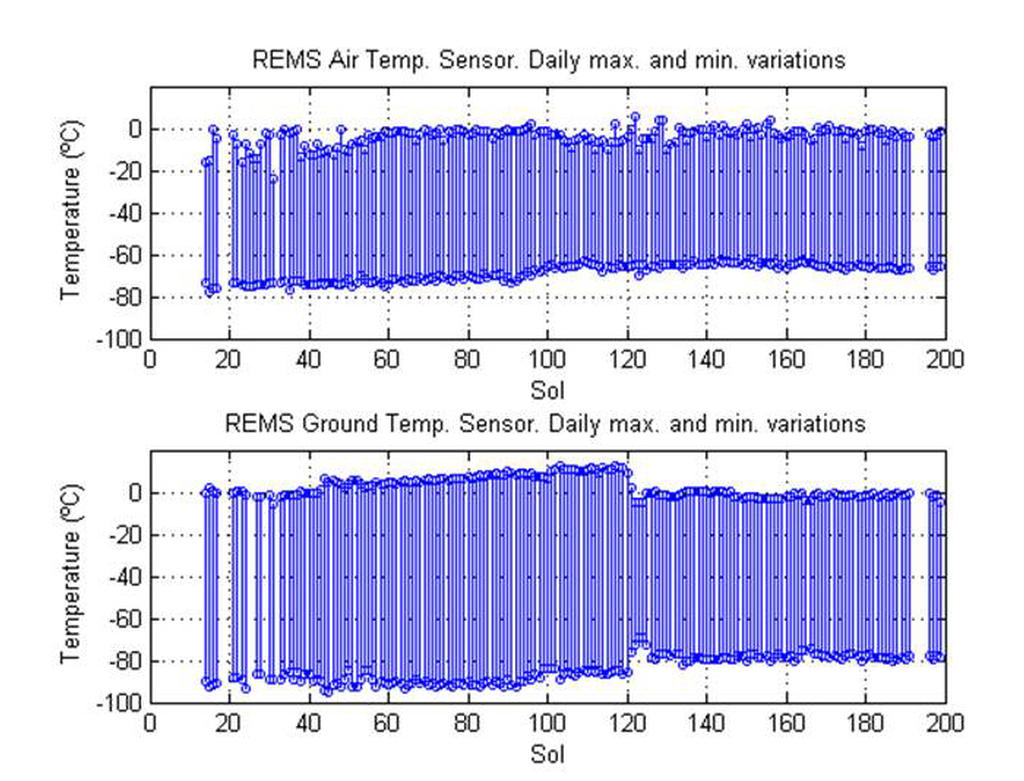
Weather On Mars Surprisingly Warm, Curiosity Rover Finds.
by SPACE.com Staff
Date: 01 October 2012 Time: 07:00 AM ET
"If this warm trend carries on into summer, we might even be able to foresee temperatures in the 20s [Celsius], and that would be really exciting from a habitability point of view," Gómez said. "In the daytimes, we could see temperatures high enough for liquid water on a regular basis. But it’s too soon to tell whether that will happen or whether these warm temperatures are just a blip.”
http://www.space.com/17828-mars-weather-curiosity-rover-discovery.html
Bob Clark

The Winds Still Blow in Thin but Active Martian Atmosphere.
PIA16913-br2.jpg

http://www.americaspace.com/?p=33999&cpage=1

It is notable that daytime ground temperatures are above the air temperatures. Eyeballing the ground temperature plot, I estimate the highest ground temperature reached as about 15 C, about 60 F. Depending on the amount of water vapor in the air near the surface this could allow small amounts of water to condense to liquid for short periods.
It would be interesting to find out if the relative humidity would allow water to condense on the surface in the thin Martian atmosphere.

Bob Clark
 
Last edited:
SwRI study finds liquid water flowing above and below frozen Alaskan sand dunes, hints of a wetter Mars.
San Antonio TX (SPX) Apr 01, 2013
Recent measurements of air temperature and pressure recorded by the Mars Science Laboratory on the Curiosity Rover, which landed in Gale Crater last August, suggest that liquid water potentially would be stable there during the warmest portion of each day.
http://www.marsdaily.com/reports/Sw...an_sand_dunes_hints_of_a_wetter_Mars_999.html

Bob Clark
 
NASA JPL: NASA Curiosity Rover Wins Prestigious Awards


NASA / NASA JPL:
NASA Curiosity Rover Team Selects Second Drilling Target on Mars

May 09, 2013

PASADENA, Calif. -- The team operating NASA's Curiosity Mars rover has selected a second target rock for drilling and sampling. The rover will set course to the drilling location in coming days.

This second drilling target, called "Cumberland," lies about nine feet (2.75 meters) west of the rock where Curiosity's drill first touched Martian stone in February. Curiosity took the first rock sample ever collected on Mars from that rock, called "John Klein." The rover found evidence of an ancient environment favorable for microbial life. Both rocks are flat, with pale veins and a bumpy surface. They are embedded in a layer of rock on the floor of a shallow depression called "Yellowknife Bay."

This second drilling is intended to confirm results from the first drilling, which indicated the chemistry of the first powdered sample from John Klein was much less oxidizing than that of a soil sample the rover scooped up before it began drilling.

[table="head;width=450"]{colsp=2}
Click on images for details​

|

This map shows the location of "Cumberland," the second rock-drilling target for NASA's Mars rover Curiosity, in relation to the rover's first drilling target, "John Klein," within the southwestern lobe of a shallow depression called "Yellowknife Bay." Cumberland, like John Klein, is a patch of flat-lying bedrock with pale veins and bumpy surface texture. The bumpiness is due to erosion-resistant nodules within the rock, which have been identified as concretions resulting from the action of mineral-laden water.
Credit: NASA/JPL-Caltech/Univ. of Arizona​
|This patch of bedrock, called "Cumberland," has been selected as the second target for drilling by NASA's Mars rover Curiosity. The rover has the capability to collect powdered material from inside the target rock and analyze that powder with laboratory instruments. The favored location for drilling into Cumberland is in the lower right portion of the image.[/table]​

"We know there is some cross-contamination from the previous sample each time," said Dawn Sumner, a long-term planner for Curiosity's science team at the University of California at Davis. "For the Cumberland sample, we expect to have most of that cross-contamination come from a similar rock, rather than from very different soil."

Although Cumberland and John Klein are very similar, Cumberland appears to have more of the erosion-resistant granules that cause the surface bumps. The bumps are concretions, or clumps of minerals, which formed when water soaked the rock long ago. Analysis of a sample containing more material from these concretions could provide information about the variability within the rock layer that includes both John Klein and Cumberland.

Mission engineers at NASA's Jet Propulsion Laboratory in Pasadena, Calif., recently finished upgrading Curiosity's operating software following a four-week break. The rover continued monitoring the Martian atmosphere during the break, but the team did not send any new commands because Mars and the sun were positioned in such a way the sun could have blocked or corrupted commands sent from Earth.

{...}


Phys.org: Curiosity rover team selects second drilling target on Mars
 
Radiation shields, new engines mandatory for Mars

spacer.gif

[FONT=VERDANA, ARIAL, HELVETICA, SANS-SERIF][SIZE=+2]Radiation shields, new engines mandatory for Mars[/SIZE][/FONT]
[FONT=VERDANA, ARIAL, HELVETICA, SANS-SERIF][SIZE=-2]
BY STEPHEN CLARK
SPACEFLIGHT NOW

Posted: May 30, 2013

[/SIZE][/FONT]A detector on NASA's Curiosity rover has confirmed previous research findings on the hazards of space radiation on the way to Mars, scientists announced Thursday, and future astronauts making the trip will need protection from the danger.

30rad_400270.jpg

[FONT=Verdana, Arial, Helvetica, sans-serif][SIZE=-2]Artist's concept of the Mars Science Laboratory approaching Mars. Credit: NASA/JPL-Caltech

[/SIZE][/FONT]The Mars rover's radiation-detecting instrument, called RAD, collected data on the mission's eight-month cruise to the red planet in 2011 and 2012, verifying computer models predicting radiation levels on the way to Mars are several hundred times higher than the dose humans receive on Earth.

Nestled deep inside a heat shield and aerodynamic shell - not too different than astronauts inside a space capsule - the rover's detector still picked up particles from a harmful flow of radiation from the sun and galactic sources.

"This cruise data is critical to the understanding of the impacts of galactic cosmic rays and solar particle events inside a platform similar to the vehicle we're developing for human exploration missions," said Eddie Semones, a spaceflight radiation health officer at NASA's Johnson Space Center in Houston.

Against a near-steady stream of galactic cosmic rays streaming into the solar system from supernova explosions and other sources across the galaxy, Curiosity encountered five spikes in another type of radiation called solar energetic particles, which blow outward from the sun during solar flares and coronal mass ejections.

Semones said the radiation data from the Mars rover confirmed estimates based on models and information from other missions.

"We found during the cruise that galactic cosmic rays were averaging 1.8 milliSieverts per day throughout," said Cary Zeitlin, principal scientist from the Southwest Research Institute. "That's actually a value that's very much in line with earlier data from Apollo and Skylab."

Scientists measure radiation in units called Sieverts. According to Semones, exposure to 1 Sievert of radiation raises a person's risk of developing fatal cancer in their lifetime by 5 percent.

In six months, Curiosity's RAD instrument detected 330 milliSieverts of cosmic radiation. On the International Space Station, which is clad in polyethylene shielding and flies below Earth's radiation belts, astronauts typically see about 100 milliSieverts in a six-month rotation.

The figures don't include solar energetic particles, which accounted for about 5 percent of the radiation detected by the rover on the cruise to Mars. During periods of elevated solar activity, astronauts could be exposed to more solar radiation, Zeitlin said.

graph.jpg

[FONT=Verdana, Arial, Helvetica, sans-serif][SIZE=-2]This graphic compares the radiation dose equivalent for several types of experiences, including a calculation for a trip from Earth to Mars based on measurements made by the Radiation Assessment Detector instrument shielded inside NASA's Mars Science Laboratory spacecraft during the flight from Earth to Mars in 2011 and 2012. The vertical scale is logarithmic; each labeled value is 10 times greater than the next lowest one. Credit: NASA/JPL-Caltech/SwRI

[/SIZE][/FONT]"The radiation environment in deep space is several hundred times more intense than it is on Earth, and that's even inside a shielded spacecraft, such as MSL, where we made our measurements," Zeitlin said.

According to Zeitlin, radiation levels detected by Curiosity - adjusted to gauge their impact on human issues - are equivalent to the dosage received in abdominal CT scans every five or six days.

Over the course of a 500-day Mars mission, Semones said most astronauts would exceed NASA's health standard, which limits an individual's radiation exposure to levels that would cause no more than a 3 percent increase in the risk of fatal cancer.

"We're looking at that 3 percent standard and its applicability on exploration-type missions," Semones said.

The radiation results from the rover's cruise to Mars are published in Friday's issue of Science.

Curiosity's RAD instrument continues collecting daily measurements since its landing on Mars in August 2012. Scientists are using the data to see what radiation levels astronauts would encounter on the planet's surface on landing missions.

Engineers and scientists will use the rover's radiation measurements in development of spacecraft to carry astronauts beyond low Earth orbit. Semones said the data are applicable to NASA's asteroid capture mission and manned trips to the vicinity of the moon, which are planned to begin in 2021.

"The RAD data will help us to design deep space habitats in which astronauts would live on the way to Mars, and it will help us to improve radiation shielding to protect them from the harmful effects of space radiation," said Chris Moore, deputy director of advanced exploration systems at NASA.

For transient events such as solar storms, which temporarily raise radiation levels, NASA could provide 'storm shelters' to house astronauts and protect against radiation until the threat passes, Moore said.

msl_orion.jpg

[FONT=Verdana, Arial, Helvetica, sans-serif][SIZE=-2]This artist's concept compares the Mars Science Laboratory cruise stage and heat shield with the Orion spacecraft, which is being developed to carry astronauts into deep space. Credit: NASA/JPL-Caltech/JSC

[/SIZE][/FONT]Astronaut habitats will need more permanent shielding against galactic cosmic rays. Moore said water in the walls of space modules would help blunt radiation, or astronauts could store hydrogen-rich food and supplies around their living quarters as a shield.

But efforts to protect astronauts on trips to Mars will not stop there.

According to NASA, advanced propulsion systems must be developed to make more speedy journeys possible because the type of shielding necessary to protect against cosmic radiation - several meters thick, Semones said - is impractical due to the size and mass limitations of spacecraft and launch vehicles.

"You need both," Semones said, referring to shielding and advanced propulsion. "You need to get there faster to reduce the impact of galactic cosmic rays, but you also need to have local shielding on-board to eliminate the effects of solar particles."

Moore said NASA is working on solar-electric propulsion, which uses electricity to accelerate ions and generate low, but sustained, thrust, as part of the agency's technology development for deep space exploration, including NASA's proposed initiative to capture and study an asteroid.

"But to get really fast trip times and cut down on the radiation exposure, we would probably need nuclear thermal propulsion," Moore said. "We're working with U.S. Department of Energy to look at various types of fuel elements for these rockets. But it's a long-range technology development activity, and it will probably be many years before that is ready."

According to Moore, nuclear propulsion could cut the one-way transit time from Earth to Mars to about 180 days.
 
Last edited:
Back
Top