Updates Mars Science Laboratory (Curiosity)

NASA / NASA JPL:
Curiosity Rover Explores 'Yellowknife Bay'

January 04, 2013

Mars Science Laboratory Mission Status Report

PASADENA, Calif. - After imaging during the holidays, NASA's Mars rover Curiosity resumed driving Jan. 3 and pulled within arm's reach of a sinuous rock feature called "Snake River."

Snake River is a thin curving line of darker rock cutting through flatter rocks and jutting above sand. Curiosity's science team plans to get a closer look at it before proceeding to other nearby rocks.

"It's one piece of the puzzle," said the mission's project scientist, John Grotzinger of the California Institute of Technology in Pasadena. "It has a crosscutting relationship to the surrounding rock and appears to have formed after the deposition of the layer that it transects."

[table="head;width=640"]
Click on image for details​


The sinuous rock feature in the lower center of this mosaic of images recorded by the NASA Mars rover Curiosity is called "Snake River." The images in the mosaic were taken by Curiosity's Navigation Camera during the 133rd Martian day, or sol, of the rover's mission on Mars (Dec. 20, 2012).
Image Credit: NASA/JPL-Caltech​
[/table]​


The drive during the mission's 147th Martian day, or sol, on the Red Planet took Curiosity about 10 feet (3 meters) northwestward and brought the mission's total driving distance to 2,303 feet (702 meters). The rover is within a shallow depression called "Yellowknife Bay," which is a flatter and lighter-toned type of terrain from what the mission crossed during its first four months inside Gale Crater.

During a holiday break for the rover team, Curiosity stayed at a location within Yellowknife Bay from which the rover took images of its surroundings. The team is evaluating possible first targets for use of Curiosity's hammering drill in coming weeks. The drill will collect powdered samples from the interior of rocks for analysis by instruments inside the rover.

"We had no surprises over the holidays," said the mission's project manager, Richard Cook of NASA's Jet Propulsion Laboratory, Pasadena. "Now, Curiosity is back on the move. The area the rover is in looks good for our first drilling target."

{...}


Discovery News: Curiosity Spots Mystery Mars 'Flower'

SPACE.com: Mars Rover Curiosity Finds Martian 'Flower' and Snake-Like Rock

SpaceRef: 'Snake River' Rock Feature Viewed by Curiosity Mars Rover

Science Daily: Mars Rover Curiosity Explores 'Yellowknife Bay'

Universe Today: Curiosity Touches Mars at Yellowknife Bay and Drives to Snake River for Drilling
 
NASA / NASA JPL:
NASA's Big Mars Rover Makes First Use of its Brush

January 07, 2013

PASADENA, Calif. -- NASA's Mars rover Curiosity has completed first-time use of a brush it carries to sweep dust off rocks.

Nearing the end of a series of first-time uses of the rover's tools, the mission has cleared dust away from a targeted patch on a flat Martian rock using the Dust Removal Tool.

The tool is a motorized, wire-bristle brush designed to prepare selected rock surfaces for enhanced inspection by the rover's science instruments. It is built into the turret at the end of the rover's arm. In particular, the Alpha Particle X-ray Spectrometer and the Mars Hand Lens Imager, which share the turret with the brush and the rover's hammering drill, can gain information after dust removal that would not be accessible from a dust-blanketed rock.

Choosing an appropriate target was crucial for the first-time use of the Dust Removal Tool. The chosen target, called "Ekwir_1," is on a rock in the "Yellowknife Bay" area of Mars' Gale Crater. The rover team is also evaluating rocks in that area as potential targets for first use of the rover's hammering drill in coming weeks.

[table="head;width=450"]{colsp=2}
Click on images for details​

|

This image from the Mars Hand Lens Imager (MAHLI) on NASA's Mars rover Curiosity shows the patch of rock cleaned by the first use of the rover's Dust Removal Tool (DRT).
Image Credit: NASA/JPL-Caltech/MSSS​
|This image from the Mars Hand Lens Imager (MAHLI) on NASA's Mars rover Curiosity shows details of rock texture and color in an area where the rover's Dust Removal Tool (DRT) brushed away dust that was on the rock. This rock target, "Ekwir_1" was brushed and this image was recorded on the same Martian day, or sol, Sol 150 of Curiosity's mission on Mars (Jan. 6, 2013.)
Image Credit: NASA/JPL-Caltech/MSSS​
[/table]​


Images of the brushed area on Ekwir are online at http://photojournal.jpl.nasa.gov/catalog/PIA16565 and http://photojournal.jpl.nasa.gov/catalog/PIA16566.

"We wanted to be sure we had an optimal target for the first use," said Diana Trujillo of NASA's Jet Propulsion Laboratory, Pasadena, Calif., the mission's activity lead for the Dust Removal Tool. "We need to place the instrument within less than half an inch of the target without putting the hardware at risk. We needed a flat target, one that wasn't rough, one that was covered with dust. The results certainly look good."

Honeybee Robotics, New York, N.Y., built the Dust Removal Tool for Curiosity, as well as tools for two previous Mars rovers, Spirit and Opportunity, which included wire brushes plus rock-grinding mechanisms.

{...}
 
700+ meters in a few months. Pretty impressive. For a reference Opportunity has managed to drive a total of 35 km over her years on the Red Planet. I wonder what the total will be for Curiosity. Her larger size and nuclear power give her the potential to cover very long distances...
 
700+ meters in a few months. Pretty impressive. For a reference Opportunity has managed to drive a total of 35 km over her years on the Red Planet. I wonder what the total will be for Curiosity. Her larger size and nuclear power give her the potential to cover very long distances...

Yes, she is really in good shape.
And then they claimed to "go slow".
I only can imagine what her potential really is if they decided to put the pedal to the metal.:)
 
Its rather amazing what kind of technology goes into brushing some dust off of a rock on another planet
 
NASA / NASA JPL:
NASA Mars Rover Preparing to Drill Into First Martian Rock

January 15, 2013

PASADENA, Calif. -- NASA's Mars rover Curiosity is driving toward a flat rock with pale veins that may hold clues to a wet history on the Red Planet. If the rock meets rover engineers' approval when Curiosity rolls up to it in coming days, it will become the first to be drilled for a sample during the Mars Science Laboratory mission.

The size of a car, Curiosity is inside Mars' Gale Crater investigating whether the planet ever offered an environment favorable for microbial life. Curiosity landed in the crater five months ago to begin its two-year prime mission.

[table="head;width=675"]{colsp=3}
Click on images for details​

||

'John Klein' Site Selected for Curiosity's Drill Debut
This view shows the patch of veined, flat-lying rock selected as the first drilling site for NASA's Mars rover Curiosity.
Image credit: NASA/JPL-Caltech/MSSS​
|
Diversity in Vicinity of Curiosity's First Drilling Target
The right Mast Camera (Mastcam) of NASA's Curiosity Mars rover provided this contextual view of the vicinity of the location called "John Klein," selected as Curiosity's first drilling site.
Image credit: NASA/JPL-Caltech/MSSS​
|
'Yellowknife Bay' Veins and Concretions
The right Mast Camera (Mastcam) of NASA's Curiosity Mars rover provided this view of the lower stratigraphy at "Yellowknife Bay" inside Gale Crater on Mars.
Image credit: NASA/JPL-Caltech/MSSS​
[/table]​


"Drilling into a rock to collect a sample will be this mission's most challenging activity since the landing. It has never been done on Mars," said Mars Science Laboratory project manager Richard Cook of NASA's Jet Propulsion Laboratory in Pasadena, Calif. "The drill hardware interacts energetically with Martian material we don't control. We won't be surprised if some steps in the process don't go exactly as planned the first time through."

Curiosity first will gather powdered samples from inside the rock and use those to scrub the drill. Then the rover will drill and ingest more samples from this rock, which it will analyze for information about its mineral and chemical composition.

The chosen rock is in an area where Curiosity's Mast Camera (Mastcam) and other cameras have revealed diverse unexpected features, including veins, nodules, cross-bedded layering, a lustrous pebble embedded in sandstone, and possibly some holes in the ground.

[table="head;width=675"]{colsp=3}
Click on images for details​

||

Calcium-Rich Veins in Martian Rocks
This graphic from NASA's Curiosity mission shows close-ups of light-toned veins in rocks in the "Yellowknife Bay" area of Mars together with analyses of their composition.
Image credit: NASA/JPL-Caltech/LANL/CNES/IRAP/LPGNantes/CNRS​
|
Signs of Hydrated Calcium Sulfates in Martian Rocks
This graphic from NASA's Curiosity mission shows an analysis of the composition of two rocks called "Crest" and "Rapitan" in the "Yellowknife Bay" area of Mars.
Image credit: NASA/JPL-Caltech/LANL/CNES/IRAP/LPGNantes/CNRS​
|
Veins in Rocks on Mars and Earth
This set of images shows the similarity of sulfate-rich veins seen on Mars by NASA's Curiosity rover to sulfate-rich veins seen on Earth.
Image credit: NASA/JPL-Caltech/LANL/CNES/IRAP/LPGNantes/CNRS/LGLyon/Planet-Terre​
[/table]​


The rock chosen for drilling is called "John Klein" in tribute to former Mars Science Laboratory deputy project manager John W. Klein, who died in 2011.

"John's leadership skill played a crucial role in making Curiosity a reality," said Cook.

The target is on flat-lying bedrock within a shallow depression called "Yellowknife Bay." The terrain in this area differs from that of the landing site, a dry streambed about a third of a mile (about 500 meters) to the west. Curiosity's science team decided to look there for a first drilling target because orbital observations showed fractured ground that cools more slowly each night than nearby terrain types do.

[table="head;width=675"]{colsp=3}
Click on images for details​

||

Texture of 'Gillespie Lake' Rock
This image from NASA's Curiosity rover shows the great diversity of grains found on the surface of a Martian rock.
Image credit: NASA/JPL-Caltech/MSSS​
|
Before and After a Little Dusting
This set of images from NASA's Curiosity rover shows a patch of rock before and after it was cleaned by Curiosity's Dust Removal Tool (DRT).
Image Credit: NASA/JPL-Caltech/MSSS​
|
Veins in 'Sheepbed' Outcrop
This image of an outcrop at the "Sheepbed" locality, taken by NASA's Curiosity Mars rover with its right Mast Camera (Mastcam), shows show well-defined veins filled with whitish minerals, interpreted as calcium sulfate.
Image credit: NASA/JPL-Caltech/MSSS​
[/table]​


"The orbital signal drew us here, but what we found when we arrived has been a great surprise," said Mars Science Laboratory project scientist John Grotzinger, of the California Institute of Technology in Pasadena. "This area had a different type of wet environment than the streambed where we landed, maybe a few different types of wet environments."

One line of evidence comes from inspection of light-toned veins with Curiosity's laser-pulsing Chemistry and Camera (ChemCam) instrument, which found elevated levels of calcium, sulfur and hydrogen.

"These veins are likely composed of hydrated calcium sulfate, such as bassinite or gypsum," said ChemCam team member Nicolas Mangold of the Laboratoire de Planetologie et Geodynamique de Nantes in France. "On Earth, forming veins like these requires water circulating in fractures."

[table="head;width=675"]{colsp=3}
Click on images for details​

||

Spherules in 'Yellowknife Bay'
This image from the right Mast Camera (Mastcam) of NASA's Curiosity Mars rover shows roughly spherical features.
Image credit: NASA/JPL-Caltech/MSSS​
|
'Shaler' Unit's Evidence of Stream Flow
This image from the Mast Camera (Mastcam) on NASA's Mars rover Curiosity shows inclined layering known as cross-bedding in an outcrop called "Shaler" on a scale of a few tenths of meters, or decimeters (1 decimeter is nearly 4 inches).
Image credit: NASA/JPL-Caltech/MSSS​
|
Curiosity's Traverse into Different Terrain
This image maps the traverse of NASA's Mars rover Curiosity from "Bradbury Landing" to "Yellowknife Bay," with an inset documenting a change in the ground's thermal properties with arrival at a different type of terrain.
Image credit: NASA/JPL-Caltech/Univ. of Arizona/CAB(CSIC-INTA)/FMI​
[/table]​


Researchers have used the rover's Mars Hand Lens Imager (MAHLI) to examine sedimentary rocks in the area. Some are sandstone, with grains up to about peppercorn size. One grain has an interesting gleam and bud-like shape that have brought it Internet buzz as a "Martian flower." Other rocks nearby are siltstone, with grains finer than powdered sugar. These differ significantly from pebbly conglomerate rocks in the landing area.

"All of these are sedimentary rocks, telling us Mars had environments actively depositing material here," said MAHLI deputy principal investigator Aileen Yingst of the Planetary Science Institute in Tucson, Ariz. "The different grain sizes tell us about different transport conditions."

{...}


NASA / NASA JPL:
Mars Rover Curiosity's Team to Receive Space Foundation Award

January 15, 2013

PASADENA, Calif. -- The NASA mission that had the nation holding its breath as it tested an ingenious but never-before-used landing technique, and continues to amaze with new discoveries about Mars has been selected as the 2013 recipient of the Space Foundation's John L. "Jack" Swigert, Jr., Award for Space Exploration.

NASA's Mars Science Laboratory project is using the rover Curiosity to investigate whether the study area within Gale Crater has offered environmental conditions favorable for microbial life.

"We are recognizing the NASA Mars Science Laboratory mission team for its aggressive and technologically advanced exploration of another planet," said Space Foundation Chief Executive Officer Elliot Pulham. "This incredible mission will yield valuable science about conditions on Mars and enable critical technologies for future missions."

The award is given annually to the person or organization that has made the most significant accomplishment in advancing the exploration of space during the previous year. It will be presented April 8 during the opening ceremony of the 29th National Space Symposium at The Broadmoor Hotel in Colorado Springs, Colo.

The John L. "Jack" Swigert, Jr., Award for Space Exploration honors NASA Apollo astronaut Jack Swigert. The Space Foundation, founded in 1983 in part to honor Swigert's memory, created the Swigert Award in 2004 in tribute to his lasting legacy of space exploration. Previous recipients include NASA's Phoenix Mars Lander Team, the Japan Aerospace Exploration Agency, the California Institute of Technology, NASA's Jet Propulsion Laboratory, NASA's Mars Exploration Rover team from JPL, President George W. Bush, the LCROSS mission and, in 2012, NASA's Kepler Mission.

{...}


NASA News Release: RELEASE : 13-022 - NASA Mars Rover Preparing to Drill Into First Martian Rock

SpaceRef: Curiosity is Preparing to Drill

CBS News Space: Mars rover finds more evidence of watery past

Spaceflight Now: Rover finds intriguing rocks indicative of watery past

The Planetary Society Blog: Curiosity update, sol 157: Glenelg isn't just a test site anymore; it's a scientific "candy store"

SPACE.com:
Florida Today:
Aviation Week: Curiosity Team Identifies First Martian Drilling Target

Universe Today: About That ‘Flower’ on Mars….

Discovery News: Mars Rock Targeted for Curiosity's Drill

Science Daily: NASA Mars Rover Preparing to Drill Into First Martian Rock
 
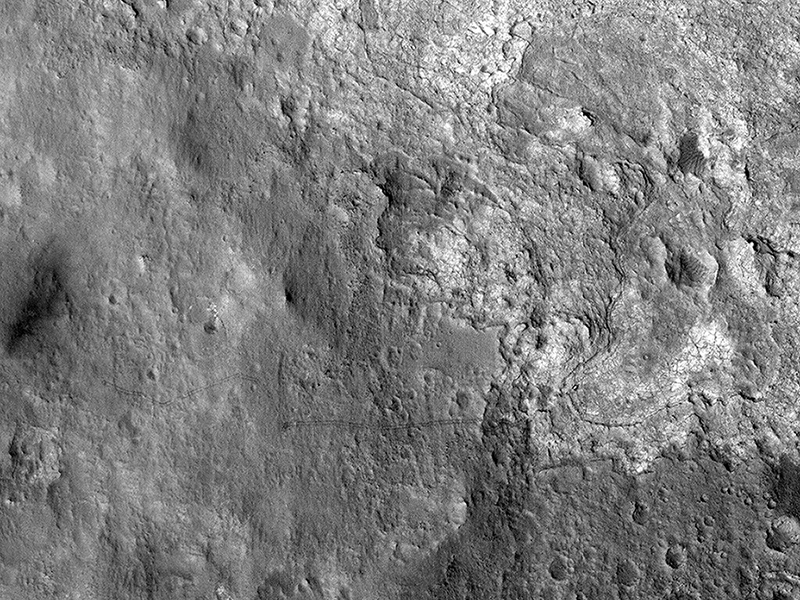
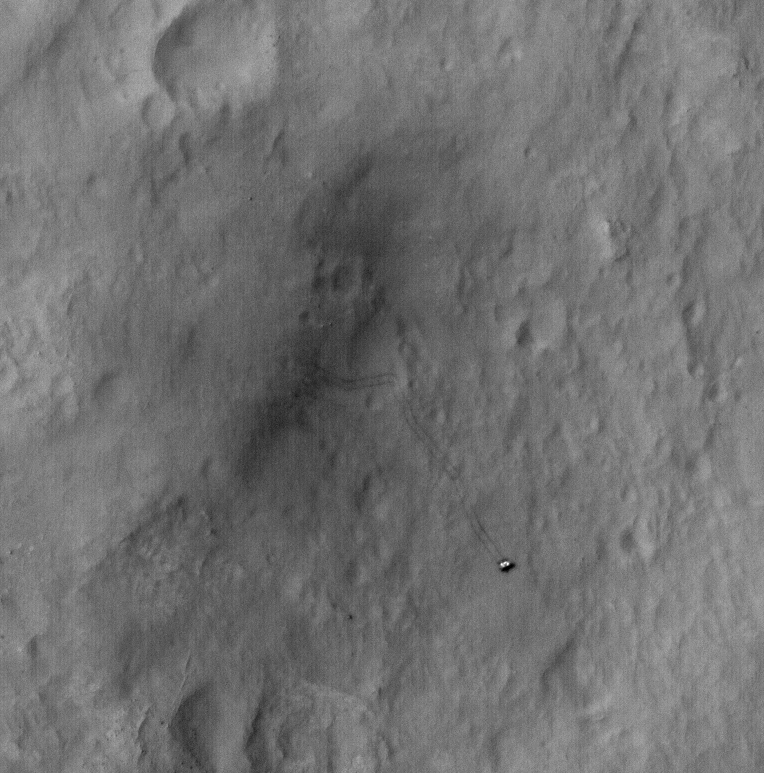
HiRISE: The Tracks of Curiosity

Universe Today: Curiosity’s Rambling Tracks Visible from Mars Orbit


ESP_030168_1755-1.jpg

Tracks from the Curiosity rover were imaged by the HiRISE camera on the Mars Reconnaissance Orbiter on January 2, 2013.
Credit: NASA/JPL/University of Arizona.


ESP_028678_1755-3.jpg

Curiosity rover tracks seen from orbit by HiRISE on September 8, 2012.
Credit: NASA/JPL/University of Arizona.​

Discovery News: Orbiting Mars Robot Spies On Curiosity's Tracks
 
rover peels out like a champion while looking around @ T = 1:15 in the video :lol:
 
Last edited:
NASA / NASA JPL:
Mars Rover Curiosity Uses Arm Camera at Night

January 23, 2013

PASADENA, Calif. -- NASA's Mars rover Curiosity has for the first time used the camera on its arm to take photos at night, illuminated by white lights and ultraviolet lights on the instrument.

Scientists used the rover's Mars Hand Lens Imager (MAHLI) instrument for a close-up nighttime look at a rock target called "Sayunei," in an area where Curiosity's front-left wheel had scuffed the rock to provide fresh, dust-free materials to examine. The site is near where the rover team plans to begin using Curiosity to drill into a rock in coming weeks. The images of the rock Sayunei and of MAHLI's calibration target were taken on Jan. 22 (PST) and received on Earth Jan. 23.

[table="head;width=450"]{colsp=2}
Click on images for details​

|

MAHLI's First Night Imaging of Martian Rock, White Lighting
This image of a Martian rock illuminated by white-light LEDs (light emitting diodes) is part of the first set of nighttime images taken by the Mars Hand Lens Imager (MAHLI) camera at the end of the robotic arm of NASA's Mars rover Curiosity.
Image Credit: NASA/JPL-Caltech/MSSS​
|
MAHLI's First Night Imaging of Martian Rock Under Ultraviolet Lighting
This image of a Martian rock illuminated by ultraviolet LEDs (light emitting diodes) is part of the first set of nighttime images taken by the Mars Hand Lens Imager (MAHLI) camera at the end of the robotic arm of NASA's Mars rover Curiosity.
Image Credit: NASA/JPL-Caltech/MSSS​

|

First Night Image of MAHLI Calibration Target in White Lighting
This image of a calibration target illuminated by white-light LEDs (light emitting diodes) is part of the first set of nighttime images taken by the Mars Hand Lens Imager (MAHLI) camera at the end of the robotic arm of NASA's Mars rover Curiosity.
Image Credit: NASA/JPL-Caltech/MSSS​
|
First Night Image of MAHLI Calibration Target Under Ultraviolet Lights
This image of a calibration target illuminated by ultraviolet LEDs (light emitting diodes) is part of the first set of nighttime images taken by the Mars Hand Lens Imager (MAHLI) camera at the end of the robotic arm of NASA's Mars rover Curiosity.
Image Credit: NASA/JPL-Caltech/MSSS​
[/table]​


The MAHLI, an adjustable-focus color camera, includes its own LED (light-emitting diode) illumination sources. Images of Sayunei taken with white-LED illumination and with illumination by ultraviolet LEDs are available online at: http://www.jpl.nasa.gov/spaceimages/details.php?id=PIA16711 and http://www.jpl.nasa.gov/spaceimages/details.php?id=PIA16712.

"The purpose of acquiring observations under ultraviolet illumination was to look for fluorescent minerals," said MAHLI Principal Investigator Ken Edgett of Malin Space Science Systems, San Diego. "These data just arrived this morning. The science team is still assessing the observations. If something looked green, yellow, orange or red under the ultraviolet illumination, that'd be a more clear-cut indicator of fluorescence."

{...}


NASA JPL - Mars Exploration Program: Mars Rover Curiosity Uses Arm Camera At Night

Universe Today: Curiosity’s Robotic Arm Camera Snaps 1st Night Images

SPACE.com: Curiosity Rover Snaps 1st Photos of Mars at Night

Mars Daily: Mars Rover Curiosity Uses Arm Camera at Night

Phys.org: Mars rover Curiosity uses arm camera at night

Science Daily: Mars Rover Curiosity Uses Arm Camera at Night
 
NASA / NASA JPL:
Weekend Test on Mars Was Preparation to Drill a Rock

February 04, 2013

PASADENA, Calif. - The bit of the rock-sampling drill on NASA's Mars rover Curiosity left its mark on a Martian rock this weekend during brief testing of the tool's percussive action.

The successful activity, called a "drill-on-rock checkout" by the rover team at NASA's Jet Propulsion Laboratory, Pasadena, is part of a series of tests to prepare for the first drilling in history to collect a sample of rock material on Mars.

[table="head;width=225"]
Click on image for details​


The bit in the rotary-percussion drill of NASA's Mars rover Curiosity left its mark in a target patch of rock called "John Klein" during a test on the rover's 176th Martian day, or sol (Feb. 2, 2013), in preparation for the first drilling of a rock by the rover.
Image Credit: NASA/JPL-Caltech/MSSS​
[/table]​


An image of the bit mark on the rock target called "John Klein" is available online at http://www.jpl.nasa.gov/spaceimages/details.php?id=PIA16717.

Another preparatory test, called "mini drill," will precede the full drilling. The mini drill test will use both the rotary and percussive actions of the drill to generate a ring of rock powder around a hole. This will allow for evaluation of the material to see if it behaves as a dry powder suitable for processing by the rover's sample handling mechanisms.


{...}


NASA / NASA JPL:
Preparatory Drill Test Performed on Mars

February 07, 2013

PASADENA, Calif. - The drill on NASA's Mars rover Curiosity used both percussion and rotation to bore about 0.8 inch (2 centimeters) into a rock on Mars and generate cuttings for evaluation in advance of the rover's first sample-collection drilling.

Completion of this "mini drill" test in preparation for full drilling was confirmed in data from Mars received late Wednesday at NASA's Jet Propulsion Laboratory, Pasadena, Calif. If the drill cuttings on the ground around the fresh hole pass visual evaluation as suitable for processing by the rover's sample handling mechanisms, the rover team plans to proceed with commanding the first full drilling in coming days.

[table="head;width=675"]{colsp=3}
Click on images for details​

||

In an activity called the "mini drill test," NASA's Mars rover Curiosity used its drill to generate this ring of powdered rock for inspection in advance of the rover's first full drilling.
Image credit: NASA/JPL-Caltech/MSSS​
|After an activity called the "mini drill test" by NASA's Mars rover Curiosity, the rover's Mars Hand Lens Imager (MAHLI) camera recorded this close-up view of the results during the 180th Martian day, or sol, of the rover's work on Mars (Feb. 6, 2013).
Image credit: NASA/JPL-Caltech/MSSS​
|A blink pair of images taken before and after Curiosity performed a "mini drill" test on a Martian rock shows changes resulting from that activity. The resulting hole and surrounding pile of drill cuttings are not the only changes.
Image Credit: NASA/JPL-Caltech/MSSS​
[/table]​


An image of the hole and surrounding cuttings produced by the mini drill test is online at http://www.jpl.nasa.gov/spaceimages/details.php?id=PIA16760.

The test was performed on a patch of flat, vein-bearing rock called "John Klein." The locations of earlier percussion-only testing and planned sample-collection drilling are also on John Klein. Pre-drilling observations of this rock yielded indications of one or more episodes of wet environmental conditions. The team plans to use Curiosity's laboratory instruments to analyze sample powder from inside the rock to learn more about the site's environmental history.

The planned full drilling will be the first rock drilling on Mars to collect a sample of material for analysis.

During a two-year prime mission, researchers are using Curiosity's 10 science instruments to assess whether the study area in Gale Crater on Mars ever has offered environmental conditions favorable for microbial life.

{...}


NASA JPL - Mars Exploration Program: Preparatory Drill Test Performed on Mars

SpaceRef: CuriousMars: Drilling For Martian Secrets

SPACE.com:
Phys.org:
Universe Today:
Discovery News: Curiosity Drills into Pristine Mars Rock

NASASpaceflight: Curiosity will help humans reach Mars
 
NASA / NASA JPL:
NASA Curiosity Rover Collects First Martian Bedrock Sample

February 09, 2013

PASADENA, Calif. -- NASA's Curiosity rover has, for the first time, used a drill carried at the end of its robotic arm to bore into a flat, veiny rock on Mars and collect a sample from its interior. This is the first time any robot has drilled into a rock to collect a sample on Mars.

The fresh hole, about 0.63 inch (1.6 centimeters) wide and 2.5 inches (6.4 centimeters) deep in a patch of fine-grained sedimentary bedrock, can be seen in images and other data Curiosity beamed to Earth Saturday. The rock is believed to hold evidence about long-gone wet environments. In pursuit of that evidence, the rover will use its laboratory instruments to analyze rock powder collected by the drill.

"The most advanced planetary robot ever designed is now a fully operating analytical laboratory on Mars," said John Grunsfeld, NASA associate administrator for the agency's Science Mission Directorate. "This is the biggest milestone accomplishment for the Curiosity team since the sky-crane landing last August, another proud day for America."

[table="head;width=225"]{colsp=3}
Click on images for details​

||

At the center of this image from NASA's Curiosity rover is the hole in a rock called "John Klein" where the rover conducted its first sample drilling on Mars. The drilling took place on Feb. 8, 2013, or Sol 182, Curiosity's 182nd Martian day of operations. Several preparatory activities with the drill preceded this operation, including a test that produced the shallower hole on the right two days earlier, but the deeper hole resulted from the first use of the drill for rock sample collection.
Image credit: NASA/JPL-Caltech/MSSS​
|NASA's Mars rover Curiosity used its Mast Camera (Mastcam) to take the images combined into this mosaic of the drill area, called "John Klein." The label "Drill" indicates where the rover ultimately performed its first sample drilling.
Image credit: NASA/JPL-Caltech/MSSS​
|An animated set of three images from NASA's Curiosity rover shows the rover's drill in action on Feb. 8, 2013, or Sol 182, Curiosity's 182nd Martian day of operations. This was the first use of the drill for rock sample collection. The target was a rock called "John Klein," in the Yellowknife Bay region of Gale Crater on Mars.
Image credit: NASA/JPL-Caltech​
[/table]​


For the next several days, ground controllers will command the rover's arm to carry out a series of steps to process the sample, ultimately delivering portions to the instruments inside.

"We commanded the first full-depth drilling, and we believe we have collected sufficient material from the rock to meet our objectives of hardware cleaning and sample drop-off," said Avi Okon, drill cognizant engineer at NASA's Jet Propulsion Laboratory, Pasadena, Calif.

Rock powder generated during drilling travels up flutes on the bit. The bit assembly has chambers to hold the powder until it can be transferred to the sample-handling mechanisms of the rover's Collection and Handling for In-Situ Martian Rock Analysis (CHIMRA) device.

Before the rock powder is analyzed, some will be used to scour traces of material that may have been deposited onto the hardware while the rover was still on Earth, despite thorough cleaning before launch.

"We'll take the powder we acquired and swish it around to scrub the internal surfaces of the drill bit assembly," said JPL's Scott McCloskey, drill systems engineer. "Then we'll use the arm to transfer the powder out of the drill into the scoop, which will be our first chance to see the acquired sample."

"Building a tool to interact forcefully with unpredictable rocks on Mars required an ambitious development and testing program," said JPL's Louise Jandura, chief engineer for Curiosity's sample system. "To get to the point of making this hole in a rock on Mars, we made eight drills and bored more than 1,200 holes in 20 types of rock on Earth."

Inside the sample-handling device, the powder will be vibrated once or twice over a sieve that screens out any particles larger than six-thousandths of an inch (150 microns) across. Small portions of the sieved sample will fall through ports on the rover deck into the Chemistry and Mineralogy (CheMin) instrument and the Sample Analysis at Mars (SAM) instrument. These instruments then will begin the much-anticipated detailed analysis.

The rock Curiosity drilled is called "John Klein" in memory of a Mars Science Laboratory deputy project manager who died in 2011. Drilling for a sample is the last new activity for NASA's Mars Science Laboratory Project, which is using the car-size Curiosity rover to investigate whether an area within Mars' Gale Crater has ever offered an environment favorable for life.

{...}


NASA News Release: RELEASE : 13-044 - NASA Curiosity Rover Collects First Martian Bedrock Sample

NASA JPL - Mars Exploration Program: NASA Curiosity Rover Collects First Martian Bedrock Sample

Spaceflight Now: Curiosity collects powder sample in first drill on Mars

Universe Today: Curiosity Drills Historic 1st Bore Hole into Mars Rock for First Ever Science Analysis

CBS News Space: In major milestone, Curiosity drills into Mars rock

SPACE.com: Curiosity Rover Drills Into Mars Rock, Collects Sample - A Space First

Phys.org: Curiosity rover collects first martian bedrock sample

SpaceRef: NASA Curiosity Rover Drills Hole into Martian Surface

RIA Novosti: Curiosity Rover Gets First Martian Bedrock Samples
 
Back
Top