Updates Mars Science Laboratory (Curiosity)

NASA / NASA JPL:
NASA Mars Rover Curiosity Begins Arm-Work Phase

September 06, 2012

PASADENA, Calif. -- After driving more than a football field's length since landing, NASA's Mars rover Curiosity is spending several days preparing for full use of the tools on its arm.

Curiosity extended its robotic arm Wednesday in the first of six to10 consecutive days of planned activities to test the 7-foot (2.1-meter) arm and the tools it manipulates.

"We will be putting the arm through a range of motions and placing it at important 'teach points' that were established during Earth testing, such as the positions for putting sample material into the inlet ports for analytical instruments," said Daniel Limonadi of NASA's Jet Propulsion Laboratory in Pasadena, Calif., lead systems engineer for Curiosity's surface sampling and science system. "These activities are important to get a better understanding for how the arm functions after the long cruise to Mars and in the different temperature and gravity of Mars, compared to earlier testing on Earth."

[table="head;width=450"]{colsp=2}
Click on images for details​

|

Camera on Curiosity's Arm as Seen by Camera on Mast
The left eye of the Mast Camera (Mastcam) on NASA's Mars rover Curiosity took this image of the camera on the rover's arm, the Mars Hand Lens Imager (MAHLI), during the 30th Martian day, or sol, of the rover's mission on Mars (Sept. 5, 2012).
Image credit: NASA/JPL-Caltech/MSSS​
|
A Rover's Journey Begins
Tracks from the first drives of NASA's Curiosity rover are visible in this image captured by the High-Resolution Imaging Science Experiment (HiRISE) camera on NASA's Mars Reconnaissance Orbiter.
Image credit: NASA/JPL-Caltech/Univ. of Arizona​

|

Relics of Rover's Landing
This color view of the parachute and back shell that helped deliver NASA's Curiosity rover to the surface of the Red Planet was taken by the High-Resolution Imaging Science Experiment (HiRISE) camera on NASA's Mars Reconnaissance Orbiter.
Image credit: NASA/JPL-Caltech/Univ. of Arizona​
|
Dissecting the Scene of Sky Crane Crash
After a rocket-powered descent stage, also known as the sky crane, delivered NASA's Curiosity rover to Mars on Aug. 5 PDT (Aug. 6 EDT), 2012, it flew away and fell to the surface.
Image credit: NASA/JPL-Caltech/Univ. of Arizona​

|

Curiosity's Robotic Arm
This engineering drawing shows the location of the arm on NASA's Curiosity rover, in addition to the arm's turret, which holds two instruments and three tools.
Image credit: NASA/JPL-Caltech​
|
Tools at Curiosity's 'Fingertips'
This engineering drawing shows the five devices that make up the turret at the end of the arm on NASA's Curiosity rover.
Image credit: NASA/JPL-Caltech​

|

Curiosity's Work Bench
This engineering drawing shows various components needed to support tools at the end of the arm on NASA's Curiosity rover
Image credit: NASA/JPL-Caltech​
|
Flexing Curiosity's Arm
This engineering drawing shows the arm on NASA's Curiosity's rover in its "ready-for-action" position, or "ready out" as engineers say, in addition to the position it assumes to drop off samples.
Image credit: NASA/JPL-Caltech​
[/table]​


Since the Mars Science Laboratory spacecraft placed Curiosity inside Mars' Gale Crater on Aug. 5 PDT (Aug. 6 EDT), the rover has driven a total of 358 feet (109 meters). The drives have brought it about one-fourth of the way from the landing site, named Bradbury Landing, to a location selected as the mission's first major science destination, Glenelg.

"We knew at some point we were going to need to stop and take a week or so for these characterization activities," said JPL's Michael Watkins, Curiosity mission manager. "For these checkouts, we need to turn to a particular angle in relation to the sun and on flat ground. We could see before the latest drive that this looked like a perfect spot to start these activities."

The work at the current location will prepare Curiosity and the team for using the arm to place two of the science instruments onto rock and soil targets. In addition, the activities represent the first steps in preparing to scoop soil, drill into rocks, process collected samples and deliver samples into analytical instruments.


Checkouts in the next several days will include using the turret's Mars Hand Lens Imager to observe its calibration target and the Canadian-built Alpha Particle X-Ray Spectrometer to read what chemical elements are present in the instrument's calibration target.

"We're still learning how to use the rover. It's such a complex machine -- the learning curve is steep," said JPL's Joy Crisp, deputy project scientist for the Mars Science Laboratory Project, which built and operates Curiosity.

After the arm characterization activities at the current site, Curiosity will proceed for a few weeks eastward toward Glenelg. The science team selected that area as likely to offer a good target for Curiosity's first analysis of powder collected by drilling into a rock.

"We're getting through a big set of characterization activities that will allow us to give more decision-making authority to the science team," said Richard Cook, Mars Science Laboratory project manager at JPL.

{...}


NASA News Release: RELEASE : 12-312 - NASA Mars Rover Curiosity Begins Arm-Work Phase

CBS News Space: Mars rover pauses for robot arm checkout

The Planetary Society Blog: Checking in on Curiosity after sol 30

Florida Today: Curiosity rover performs robotic arm checkouts

Universe Today: Curiosity on the Move! HiRISE Spies Rover Tracks on Mars

Aviation Week: Making Tracks On Mars

SPACE.com:
 
The Planetary Society Blog: Hello, beautiful!

20120907_curiosity_self-portrait_mahli_stretched_0032MH0040000000E1_DXXX_o-hai.jpg

Image Credit: NASA / JPL / MSSS / LOLspeak by Emily Lakdawalla
:rofl:​
 
Good one.
Is it possible to use the MAHLI camera to check on the REMS instruments to see what damage there is?
 
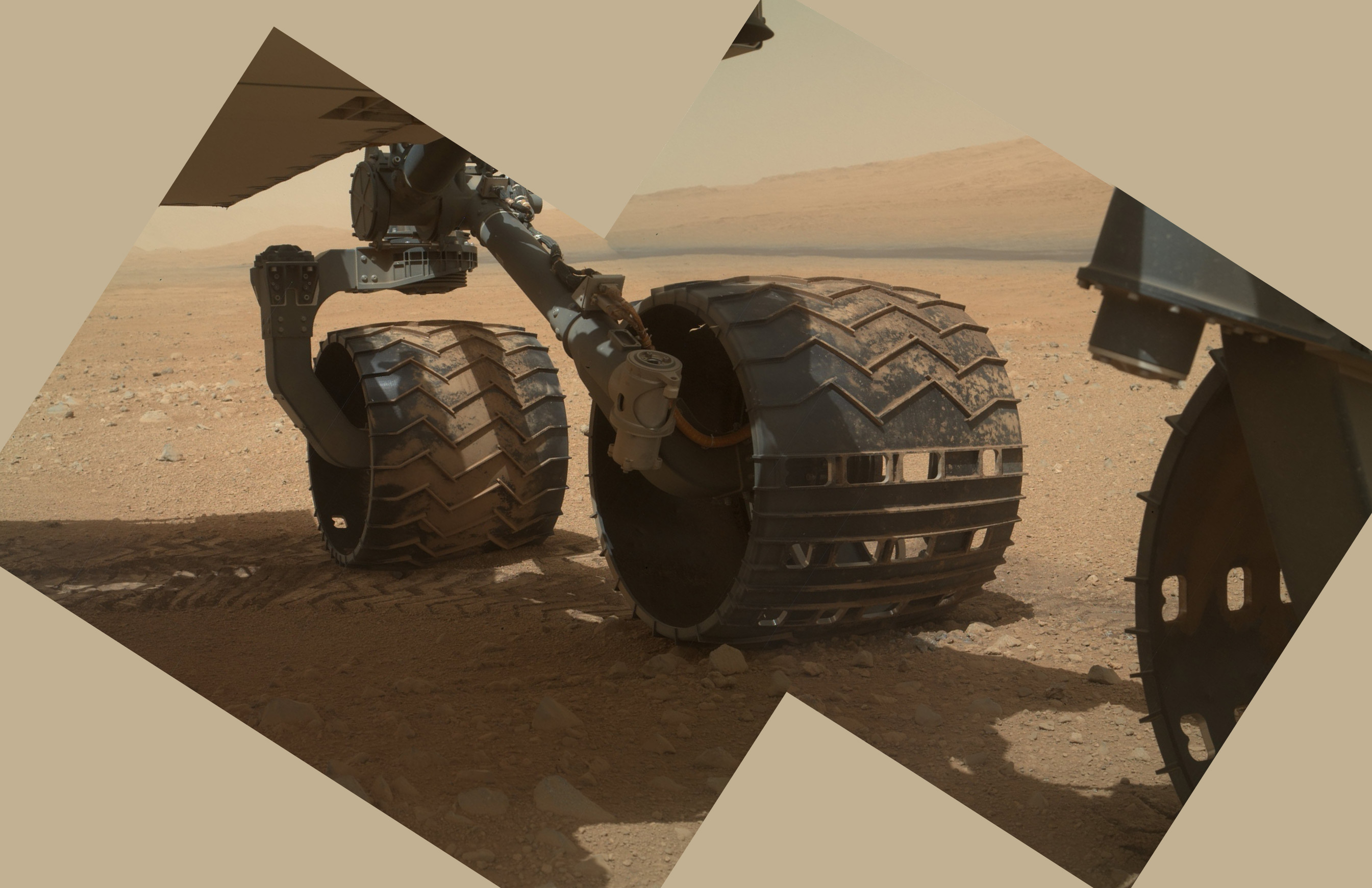
The Planetary Society Blog: MAHLI sees Curiosity's wheels firmly on Martian ground

20120909_msl_mahli_left-wheels_0034MH0066001000E1_DXXX-0034MH0067001000E1_DXXX.jpg

Curiosity's wheels firmly on Mars (MAHLI view, sol 34)

A mosaic of two images captured by Curiosity's Hand Lens Imager on sol 34 (September 10, 2012). The first "belly panorama" shows the wheels already to be coated with red Mars dust.
NASA / JPL / MSSS / Emily Lakdawalla​


20120909_msl_mahli_hazcams_0034MH0059001000E1_DXXX.jpg

Curiosity's forward Hazard Avoidance Cameras (Hazcams) as seen from MAHLI, sol 34

On sol 33, Curiosity used its Hand Lens Imager (MAHLI) to take the first views of previously unseen parts of the rover, including the two pairs of Hazard Avoidance Cameras (Hazcams). Curiosity currently only uses the left-hand pair ("FRA" and "FLA"); the right-hand pair is a backup that hopefully will not be needed.
NASA / JPL / MSSS / Emily Lakdawalla​


More photos there:
http://curiositymsl.com/table/view/
 
Water verboten to Curiosity.

If the Mars rover finds water, it could be H2 ... uh oh!.
By Louis Sahagun, Los Angeles Times
September 9, 2012, 5:30 p.m.
Curiosity was first proposed in 2004 under a mission category that would have allowed it to explore a region with ice and water. That category called for sterilizing portions of the spacecraft that would contact the surface of Mars to avoid contamination of moist areas where microbes — from Earth or from Mars — have the best chances of survival.
On Nov. 1, after learning that the drill bit box had been opened, Conley said she had the mission reclassified to one in which Curiosity could touch the surface of Mars "as long as there is no ice or water."
Conley's predecessor at NASA, John D. Rummel, a professor of biology at East Carolina University, said, partly in jest: "It will be a sad day for NASA if they do detect ice or water. That's because the Curiosity project will most likely be told, 'Gee, that's nice. Now turn around.' "
If water is found, Curiosity could still conduct tests from a distance with instruments including a laser and spectrometers.
http://www.latimes.com/news/local/la-me-mars-contaminate-20120910,0,365701.story


Bob Clark
 
Last edited:
All these self-portraits of the machinery on the surface really add to sense of being there.
 
I agree, these photos are breathtaking. It's something new, Mars became closer.
Good luck Curiosity on your mission!
 
NASA / NASA JPL:
Mars Rover Curiosity Arm Tests Nearly Complete

September 12, 2012

PASADENA, Calif. -- NASA's Mars Curiosity team has almost finished robotic arm tests in preparation for the rover to touch and examine its first Martian rock.

Tests with the 7-foot (2.1-meter) arm have allowed the mission team to gain confidence in the arm's precise maneuvering in Martian temperature and gravity conditions. During these activities, Curiosity has remained at a site it reached by its most recent drive on Sept. 5. The team will resume driving the rover this week and use its cameras to seek the first rock to touch with instruments on the arm.

"We're about to drive some more and try to find the right rock to begin doing contact science with the arm," said Jennifer Trosper, Curiosity mission manager at NASA's Jet Propulsion Laboratory in Pasadena, Calif.

Two science instruments -- a camera called Mars Hand Lens Imager (MAHLI) that can take close-up, color images and a tool called Alpha Particle X-Ray Spectrometer (APXS) that determines the elemental composition of a target rock -- have passed preparatory tests at the rover's current location. The instruments are mounted on a turret at the end of the arm and can be placed in contact with target rocks.

[table="head;width=675"]{colsp=3}
Click on images for details​

||


Say 'Ahh' on Mars
This set of images from NASA's Curiosity rover shows the inlet covers for the Sample Analysis at Mars instrument opening and closing, as the rover continues to check out its instruments in the first phase after landing.
Image credit: NASA/JPL-Caltech​
|
Portrait of APXS on Mars
This image shows the Alpha Particle X-Ray Spectrometer (APXS) on NASA's Curiosity rover, with the Martian landscape in the background.
Image credit: NASA/JPL-Caltech/MSSS​
|
Hello, MAHLI
This image shows the Mars Hand Lens Imager (MAHLI) on NASA's Curiosity rover, with the Martian landscape in the background.
Image credit: NASA/JPL-Caltech/MSSS​

||

Getting Ready for Sampling on Mars
This image from NASA's Curiosity rover shows the cover on an inlet that will receive powdered rock and soil samples for analysis.
Image credit: NASA/JPL-Caltech/MSSS​
|
Opening and Closing SAM
This set of images from NASA's Curiosity rover shows the inlet covers for the Sample Analysis at Mars instrument opening and closing, as the rover continues to check out its instruments in the first phase after landing.
Image credit: NASA/JPL-Caltech/MSSS​
|
Calibrating APXS on Mars
This graphic from NASA's Curiosity rover shows data obtained by the Alpha Particle X-Ray Spectrometer (APXS) from its calibration target on the 34th Martian day, or sol, of operations (Sept. 10, 2012).
Image credit: NASA/JPL-Caltech/University of Guelph​

{colsp=3}

{colsp=3}
Martian Sand Grains on Penny
This close-up image shows Martian sand grains that settled on the penny that serves as a calibration target on NASA's Curiosity rover.
Image credit: NASA/JPL-Caltech/MSSS​
[/table]​


Curiosity's Canadian-made APXS had taken atmospheric readings earlier, but its first use on a solid target on Mars was this week on a calibration target brought from Earth. X-ray detectors work best cold, but even the daytime APXS tests produced clean data for identifying elements in the target.

"The spectrum peaks are so narrow, we're getting excellent resolution, just as good as we saw in tests on Earth under ideal conditions," said APXS principal investigator Ralf Gellert of the University of Guelph, in Ontario, Canada. "The good news is that we can now make high-resolution measurements even at high noon to support quick decisions about whether a sample is worthwhile for further investigations."

The adjustable-focus MAHLI camera this week has produced sharp images of objects near and far.

"Honestly, seeing those images with Curiosity's wheels in the foreground and Mount Sharp in the background simply makes me cry," said MAHLI principal investigator Ken Edgett of Malin Space Science Systems in San Diego. "I know we're just getting started, but it's already been an incredible journey."

MAHLI is also aiding evaluation of the arm's ability to position its tools and instruments. Curiosity moved the arm to predetermined "teach points" on Sept. 11, including points above each of three inlet ports where it will later drop samples of soil and powdered rock into analytical instruments inside the rover. Images from the MAHLI camera confirmed the placements. Photos taken before and after opening the inlet cover for the chemistry and mineralogy (CheMin) analytical instrument also confirmed good operation of the cover.

"Seeing that inlet cover open heightens our anticipation of getting the first solid sample into CheMin in the coming weeks," said CheMin principal investigator David Blake of NASA's Ames Research Center in Moffett Field, Calif.

A test last week that checked X-rays passing through an empty sample cell in CheMin worked well. It confirmed the instrument beneath the inlet opening is ready to start analyzing soil and rock samples.

{...}


NASA News Release: RELEASE : 12-319 - Mars Rover Curiosity Arm Tests Nearly Complete

CBS News Space: Curiosity set to resume roving after robot arm tests

SPACE.com: Mars Rover Curiosity 'Flawlessly' Acing Health Checks

Florida Today: Curiosity's scientists brief lawmakers, show favorite Mars photos


Those are stupid-crazy images. A Microscope on Mars. These are almost as good as my toy microscope I had when I was a kid.
 
I love checking in on this thread, always some new amazing images, and updates.
A little off topic, but anyone with an Android, there is a new game called Curiosity: The Mars Mission on the google store, free. Its a nice simulation of sending the rover to mars, and also the whole EDL phase(shortened a bit but still all there). Its very cool for someone who is real interested in this, which is why i thought i should post it here.
 
NASA / NASA JPL:
NASA Mars Rover Targets Unusual Rock Enroute to First Destination

September 19, 2012

PASADENA, Calif. -- NASA's Mars rover Curiosity has driven up to a football-size rock that will be the first for the rover's arm to examine.

Curiosity is about 8 feet (2.5 meters) from the rock. It lies about halfway from the rover's landing site, Bradbury Landing, to a location called Glenelg. In coming days, the team plans to touch the rock with a spectrometer to determine its elemental composition and use an arm-mounted camera to take close-up photographs.

[table="head;width=675"]{colsp=3}
Click on images for details​

||

'Jake Matijevic' Contact Target for Curiosity
The drive by NASA's Mars rover Curiosity during the mission's 43rd Martian day, or sol, (Sept. 19, 2012) ended with this rock about 8 feet (2.5 meters) in front of the rover.
Image credit: NASA/JPL-Caltech​
|
Phobos in Transit
Mars has two small, asteroid-sized moons named Phobos and Deimos. From the point of view of the rover, located near the equator of Mars, these moons occasionally pass in front of, or "transit," the disk of the sun.
Image credit: NASA/JPL-Caltech/MSSS​
|
Comparing Phobos Views
As part of a multi-mission campaign, NASA's Curiosity rover is observing Martian moon transits, the first of which involved the moon Phobos grazing the sun's disk.
Image credit: NASA/JPL-Caltech/MSSS​

||

Curiosity Traverse Map Through Sol 43
This map shows the route driven by NASA's Mars rover Curiosity through the 43rd Martian day, or sol, of the rover's mission on Mars (Sept. 19, 2012).
Image credit: NASA/JPL-Caltech/Univ. of Arizona​
|
On the Road to Glenelg
This mosaic from the Mast Camera on NASA's Curiosity rover shows the view looking toward the "Glenelg" area, where three different terrain types come together.
Image credit: NASA/JPL-Caltech/MSSS​
|
Dark Bands Run Through Light Layers
This mosaic from the Mast Camera on NASA's Curiosity rover shows a close-up view looking toward the "Glenelg" area, where three different terrain types come together.
Image credit: NASA/JPL-Caltech/MSSS​
[/table]​


Both the arm-mounted Alpha Particle X-Ray Spectrometer and the mast-mounted, laser-zapping Chemistry and Camera Instrument will be used for identifying elements in the rock. This will allow cross-checking of the two instruments.

The rock has been named "Jake Matijevic." Jacob Matijevic (mah-TEE-uh-vik) was the surface operations systems chief engineer for Mars Science Laboratory and the project's Curiosity rover. He passed away Aug. 20, at age 64. Matijevic also was a leading engineer for all of the previous NASA Mars rovers: Sojourner, Spirit and Opportunity.

Curiosity now has driven six days in a row. Daily distances range from 72 feet to 121 feet (22 meters to 37 meters).

"This robot was built to rove, and the team is really getting a good rhythm of driving day after day when that's the priority," said Mars Science Laboratory Project Manager Richard Cook of NASA's Jet Propulsion Laboratory in Pasadena, Calif.

The team plans to choose a rock in the Glenelg area for the rover's first use of its capability to analyze powder drilled from interiors of rocks. Three types of terrain intersect in the Glenelg area -- one lighter-toned and another more cratered than the terrain Curiosity currently is crossing. The light-toned area is of special interest because it retains daytime heat long into the night, suggesting an unusual composition.

"As we're getting closer to the light-toned area, we see thin, dark bands of unknown origin," said Mars Science Laboratory Project Scientist John Grotzinger of the California Institute of Technology, Pasadena. "The smaller-scale diversity is becoming more evident as we get closer, providing more potential targets for investigation."

Researchers are using Curiosity's Mast Camera (Mastcam) to find potential targets on the ground. Recent new images from the rover's camera reveal dark streaks on rocks in the Glenelg area that have increased researchers' interest in the area. In addition to taking ground images, the camera also has been busy looking upward.

On two recent days, Curiosity pointed the Mastcam at the sun and recorded images of Mars' two moons, Phobos and Deimos, passing in front of the sun from the rover's point of view. Results of these transit observations are part of a long-term study of changes in the moons' orbits. NASA's twin Mars Exploration Rovers, Spirit and Opportunity, which arrived at Mars in 2004, also have observed solar transits by Mars' moons. Opportunity is doing so again this week.

"Phobos is in an orbit very slowly getting closer to Mars, and Deimos is in an orbit very slowly getting farther from Mars," said Curiosity's science team co-investigator Mark Lemmon of Texas A&M University, College Station. "These observations help us reduce uncertainty in calculations of the changes."

In Curiosity's observations of Phobos this week, the time when the edge of the moon began overlapping the disc of the sun was predictable to within a few seconds. Uncertainty in timing is because Mars' interior structure isn't fully understood.

Phobos causes small changes to the shape of Mars in the same way Earth's moon raises tides. The changes to Mars' shape depend on the Martian interior which, in turn, cause Phobos' orbit to decay. Timing the orbital change more precisely provides information about Mars' interior structure.

During Curiosity's two-year prime mission, researchers will use the rover's 10 science instruments to assess whether the selected field site inside Gale Crater ever has offered environmental conditions favorable for microbial life.

{...}


NASA News Release: RELEASE : 12-332 - NASA Mars Rover Targets Unusual Rock En Route to First Destination

RIA Novosti: Mars Rover Approaches Unusual Rock

SpaceRef: NASA Mars Rover Targets Unusual Rock En Route to First Destination
 
Back
Top