
You are using an out of date browser. It may not display this or other websites correctly.
You should upgrade or use an alternative browser.
You should upgrade or use an alternative browser.
Updates Mars Science Laboratory (Curiosity)
- Thread starter Unstung
- Start date

- Joined
- Oct 30, 2009
- Messages
- 14,018
- Reaction score
- 4
- Points
- 0
The Planetary Society Blog: Nifty animation: Dust in the air for Curiosity
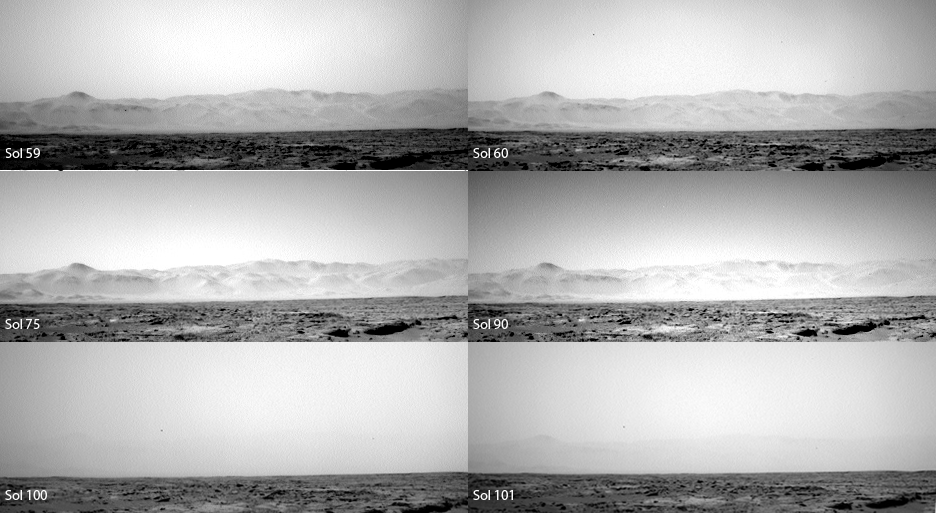
Six Navcam images pointed toward the horizon taken over the course of Curiosity's time near Rocknest document changes in the transparency of the atmosphere.
NASA / JPL / Egorov Vitaly ("Zelenyikot")
Six Navcam images pointed toward the horizon taken over the course of Curiosity's time near Rocknest document changes in the transparency of the atmosphere.
NASA / JPL / Egorov Vitaly ("Zelenyikot")

Ohh swell.. pictures of fog on another planet..
If it were fog, it would be quite a significant discovery. The reality is much more mundane.


Screamer7
Member
Pffaggh.. Some sort of gas concentration or new kind of radiation or something equally dumb. I hate these announcements and pay little attention to them anymore. Especially after what they announced in the past. None of it was exciting to the layperson.
My thoughts too!!!

- Joined
- Apr 14, 2012
- Messages
- 2,584
- Reaction score
- 0
- Points
- 36
Pffaggh.. Some sort of gas concentration or new kind of radiation or something equally dumb. I hate these announcements and pay little attention to them anymore. Especially after what they announced in the past. None of it was exciting to the layperson.
It can be. It just has to be explained in the right way.
- Joined
- Jun 22, 2008
- Messages
- 6,367
- Reaction score
- 0
- Points
- 0
It is pretty easy to understand that some discoveries by NASA are regarded as pretty boring by most people; it's because those discoveries are boring, in certain regards (if not any less scientifically interesting). It is perfectly understandable and perfectly acceptable.
But if NASA comes along with a really extraordinary statement, such as "We've made a discovery for the history books!" and then makes what can be quite fairly called a lackluster announcement, it damages their reputation. They need to be a bit more careful about how they act in that regard.
But if NASA comes along with a really extraordinary statement, such as "We've made a discovery for the history books!" and then makes what can be quite fairly called a lackluster announcement, it damages their reputation. They need to be a bit more careful about how they act in that regard.
It is pretty easy to understand that some discoveries by NASA are regarded as pretty boring by most people; it's because those discoveries are boring, in certain regards (if not any less scientifically interesting). It is perfectly understandable and perfectly acceptable.
But if NASA comes along with a really extraordinary statement, such as "We've made a discovery for the history books!" and then makes what can be quite fairly called a lackluster announcement, it damages their reputation. They need to be a bit more careful about how they act in that regard.
This is what I'm trying to say, instead of just being a naysayer or parade-rainer. I'm sure the scientific interest in whatever discovery has just been made is considerable, and I'm quite interested to read about it. But as you say, these grandiose claims, if unjustified for the masses, just make NASA look like the boy who cried wolf.
Last edited:

statisticsnerd
Active member
Then again, most people here are expecting it to be nothing. What if the announcement does live up to the hype and they have discovered ETs? NASA would deserve a lot of extra funding if that is the case. I hope it's fossilized microbes or something of that nature.

It is pretty easy to understand that some discoveries by NASA are regarded as pretty boring by most people; it's because those discoveries are boring, in certain regards (if not any less scientifically interesting). It is perfectly understandable and perfectly acceptable.
I think that whatever the discovery being boring or not, the knowledge of the person will determine his reaction. The other day I was talking with a friend about the recent discovered planet at 4.5 ly. He said that this is nothing interesting, that 4.5 ly is too far away and, therefore its not important. When we all know that 4.5 is the most near star we have. And that the centauri stars are our solar system neighbor.
Mader Levap
New member
- Joined
- Oct 31, 2012
- Messages
- 66
- Reaction score
- 0
- Points
- 0
Somehow I doubt this is case.What if the announcement does live up to the hype and they have discovered ETs?
- Joined
- Oct 30, 2009
- Messages
- 14,018
- Reaction score
- 4
- Points
- 0
NASA / NASA JPL:
One Year After Launch, Curiosity Rover Busy on Mars
November 26, 2012
PASADENA, Calif. - The NASA Mars rover Curiosity began its flight to Mars on Nov. 26, 2011, from Cape Canaveral Air Force Station, Fla., tucked inside the Mars Science Laboratory spacecraft. One year after launch and 16 weeks since its dramatic landing on target inside Gale Crater, Curiosity has returned more than 23,000 raw images, driven 1,696 feet (517 meters) and begun helping researchers better understand the area's environmental history.
The car-size rover is at a site called "Point Lake" overlooking lower ground to the east, where the rover team intends to find a target for first use of Curiosity's rock-sampling drill.
During a two-year prime mission, researchers are using Curiosity's 10 science instruments to assess whether the study area in Gale Crater ever has offered environmental conditions favorable for microbial life.
{...}
One Year After Launch, Curiosity Rover Busy on Mars
November 26, 2012
PASADENA, Calif. - The NASA Mars rover Curiosity began its flight to Mars on Nov. 26, 2011, from Cape Canaveral Air Force Station, Fla., tucked inside the Mars Science Laboratory spacecraft. One year after launch and 16 weeks since its dramatic landing on target inside Gale Crater, Curiosity has returned more than 23,000 raw images, driven 1,696 feet (517 meters) and begun helping researchers better understand the area's environmental history.
[table="head;width=675"]{colsp=3}
 |
| |
|
Click on images for details
||Panoramic View From 'Rocknest' Position of Curiosity Mars Rover
This panorama is a mosaic of images taken by the Mast Camera (Mastcam) on the NASA Mars rover Curiosity while the rover was working at a site called "Rocknest" in October and November 2012.Image credit: NASA/JPL-Caltech/Malin Space Science Systems
|A Martian Rock Called 'Rocknest 3'
This view of a Martian rock called "Rocknest 3" combines four images taken by the right-eye camera of the Mast Camera (Mastcam) instrument, which has a telephoto, 100-millimeter-focal-length lens.Image credit: NASA/JPL-Caltech/Malin Space Science Systems
|Mars Rock 'Rocknest 3' Imaged by Curiosity's ChemCam
This view of a rock called "Rocknest 3" combines two images taken by the Chemistry and Camera (ChemCam) instrument on the NASA Mars rover Curiosity and indicates five spots where ChemCam had hit the rock with laser pulses to check its composition. It covers an area 3.9 inches (10 centimeters) across.Image credit: NASA/JPL-Caltech/LANL/CNES/IRAP
[/table]The car-size rover is at a site called "Point Lake" overlooking lower ground to the east, where the rover team intends to find a target for first use of Curiosity's rock-sampling drill.
During a two-year prime mission, researchers are using Curiosity's 10 science instruments to assess whether the study area in Gale Crater ever has offered environmental conditions favorable for microbial life.
{...}
- Joined
- Oct 30, 2009
- Messages
- 14,018
- Reaction score
- 4
- Points
- 0
The Planetary Society Blog: Pretty Picture: Curiosity on the edge of a geologist's paradise
Curiosity Mastcam-100 panorama at Glenelg, sol 107
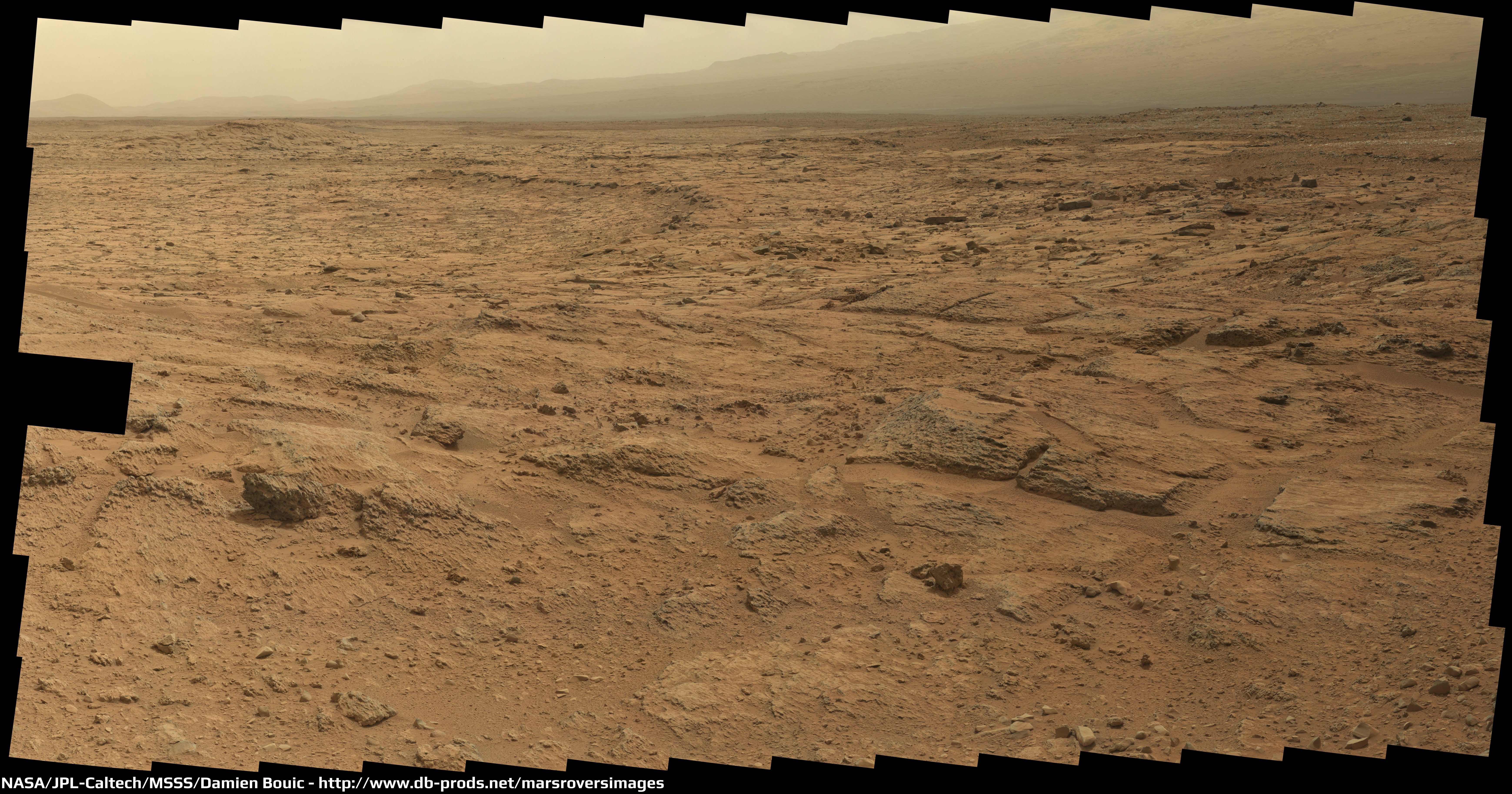
A 14-by-7 array of high-resolution Mastcam images covers a rocky landscape east of Curiosity. The rover had driven to the site (named Point Lake) on sol 102, right before the Thanksgiving holiday.
NASA / JPL / MSSS / Damien Bouic
Curiosity Mastcam-100 panorama at Glenelg, sol 107
A 14-by-7 array of high-resolution Mastcam images covers a rocky landscape east of Curiosity. The rover had driven to the site (named Point Lake) on sol 102, right before the Thanksgiving holiday.
NASA / JPL / MSSS / Damien Bouic


- Joined
- Apr 13, 2011
- Messages
- 2,215
- Reaction score
- 0
- Points
- 36
- Location
- Los Angeles
- Website
- www.youtube.com
The Planetary Society Blog: Pretty Picture: Curiosity on the edge of a geologist's paradise
https://planetary.s3.amazonaws.com/.../20121126_mars_msl_Sol107_Mastcam100_half.jpg
Curiosity Mastcam-100 panorama at Glenelg, sol 107
A 14-by-7 array of high-resolution Mastcam images covers a rocky landscape east of Curiosity. The rover had driven to the site (named Point Lake) on sol 102, right before the Thanksgiving holiday.
NASA / JPL / MSSS / Damien Bouic
these pics never get old.

Marvin42
Mostly Harmless
- Joined
- Nov 1, 2011
- Messages
- 67
- Reaction score
- 0
- Points
- 6
I see two large rocks that have clear sharp edges and almost straight sides in the top right side of the image. Where can this be found in nature (I guess clean faces like that with sharp edges are easy to spot and so we know a lot of the composition of those rocks on Earth)? I remember I've seen something like that rock in a place where they were extracting rock for constructions but they used drills+pyro to get clean cuts like that.

Wow, awesome pic. Those rocks are porous, there are bubbles of "air" inside of them if you look closely. Looks volcanic, interesting.
Well, I'm no geologist or don't pretend to be... but this looks to more more like a dried up lake bed, than volcanic activity.

- Joined
- Nov 23, 2008
- Messages
- 1,681
- Reaction score
- 4
- Points
- 38
to me it looks like a mixture of both sedimentary and volcanic. If you look closely the porous rock seems to be in an isolated strip going horizontally across the bottom of the pic. However the majority of the view looks like an old dried up sediment crust that is broke up everywhere. The crust might have broken up to reveal the porous rock underneath maybe?
It almost looks like an old worn out impact crater on the left side (easier to see in zoomed out view) perhaps those blocky pieces were blasted out from this...
I wonder what the rover team will say about all these rocks
It almost looks like an old worn out impact crater on the left side (easier to see in zoomed out view) perhaps those blocky pieces were blasted out from this...
I wonder what the rover team will say about all these rocks
Similar threads

- Replies
- 12
- Views
- 7K


- Replies
- 7
- Views
- 6K


- Replies
- 0
- Views
- 2K
- Replies
- 5
- Views
- 4K