
Kinematics question: How is that mechanism called and how does it act mathematically?

Urwumpe

Not funny anymore
Addon Developer
Donator
Joined
Feb 6, 2008
Messages
38,965
Reaction score
3,937
Points
203
Location
Wolfsburg
Preferred Pronouns
Sire
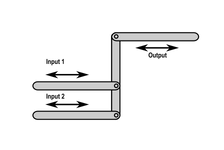
As written in the question, I stumbled about a mechanism and I can't find much about it in my mechanical engineering text book or in the internet. Can somebody with more engineering knowledge maybe help me there? It looks like that:
UnknownMechanism.png

Essentially, I just need to know how this mechanism would translate into mathematics, but having a name for such a tiny detail would also be nice. A similar mechanism is called "union link" in steam engines, but this isn't necessarily the same and the internet does not really know much about "union links" as well.
 
I think it's called a "motion mixer"

I've seen similar things called by that name in helicopter schematics, not sure if the term is universal across other engineering fields though.

edit:

A bit of google-fu later, and I've found it mentioned by the name of "Bell-Hiller Mixing Lever":
Bell-Hiller-system-with-angular-displacements.png


This arrangement can be seen on the rotor masts of early UH-1 "Huey" helicopters.
Similar mechanisms are used for various other purposes, mostly being referred to as "mixers" of some description...
 
Last edited:
I think it's called a "motion mixer"

I've seen similar things called by that name in helicopter schematics, not sure if the term is universal across other engineering fields though.

edit:

A bit of google-fu later, and I've found it mentioned by the name of "Bell-Hiller Mixing Lever":
Bell-Hiller-system-with-angular-displacements.png


This arrangement can be seen on the rotor masts of early UH-1 "Huey" helicopters.
Similar mechanisms are used for various other purposes, mostly being referred to as "mixers" of some description...

Thanks! From that name, I also found the "Floating Lever" as similar term, that comes closer to what I mean, especially the application of a floating lever in a "hunting gear" for hydraulic ship rudders is nearly the same that I search from the technical drawing.


So, I guess I have just a kind of floating lever here.

Also this drawing again goes into the direction, but it has not the same kinematic or mathematical function as in my example.

Steam_turbines%3B_a_practical_and_theoretical_treatise_for_engineers_and_students%2C_including_a_discussion_of_the_gas_turbine_%281917%29_%2814779709424%29.jpg


In my example, the output rod should depend on the ratio between the two inputs I think, not on the difference.
 
Last edited:
Does, look like something that Egide Walschaerts would come up with.

As for the math aspect, you just need to pick the coördinate system.

The input and output links are constrained to linear motion, so pick one of the pivot points as your origin. The mixing-link can only move in a circle about any of the pivots, so throw some lengths, angles and trig functions at it.
 
Back
Top