Vessel Jupiter Icy Moons Explorer

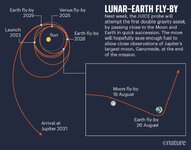
JUICE has a very "interesting" trajectory (by "interesting" I mean really difficult in Orbiter!)
Not just Earth flybys, but a Moon-Earth flyby....

d41586-024-02619-8_27461304.jpg

Are they sure about this?:
Next week, the JUICE probe will attempt the first double gravity assist, by passing close to the Moon and Earth in quick succession.

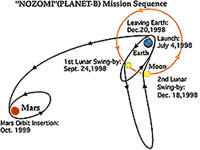
I seem to remember Nozomi doing something like this, going to Mars.
nozomi_traj.jpg

Cheers,
Brian
 
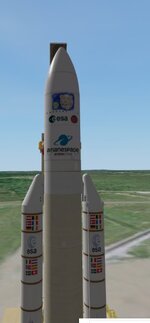
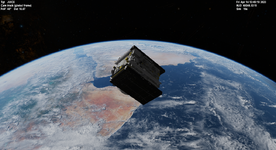
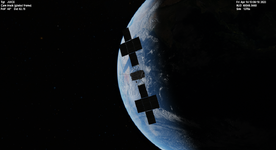
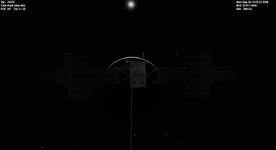
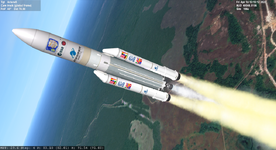
Here is JUICE shortly after separating from the Ariane 5. The orbital state vectors were based from the very first data defined on JPL HORIZONS
The trajectory implied that the spacecraft was launched into a 28.5 degree orbit around the Earth. What I'm not sure is if it was sent first into a parking orbit before making a ejection burn. AFAIK the Ariane 5 upper stage (ECA) wasn't designed for multiple burns, only the 5ES variant had that capability (that was retired in 2018). If so, the spacecraft was sent directly into an interplanetary escape trajectory.

Code:
BEGIN_HYPERDESC
<p>The <b>Jupiter Icy Moons Explorer (JUICE)</b> beginning its seven-year journey to Jupiter on April 14, 2023</p>
<br>
<h1>CONTROLS:</h1>
<p>1 = Magnetometer</p>
<p>2 = LGA</p>
<p>3 = Solar panels</p>
<p>4 = RIME</p>
<p>5 = RWPI</p>
<p>K = Enable solar tracking</p>
<br>
<h1 style="color:rgb(255,0,0)"><small><b>Notes:</b></small></h1>
<p>Orbital state vectors were retrieved from trajectory data available at JPL-HORIZONS (as of August 5, 2025)</p>
<br>
<p>https://ssd.jpl.nasa.gov/horizons/</p>
END_HYPERDESC

BEGIN_ENVIRONMENT
  System Sol
  Date JD 2460049.031250000
  Context SpaceX
END_ENVIRONMENT

BEGIN_FOCUS
  Ship JUICE
END_FOCUS

BEGIN_CAMERA
  TARGET JUICE
  MODE Extern
  POS 9.426817 171.358684 67.580039
  TRACKMODE GlobalFrame
  FOV 40.00
END_CAMERA

BEGIN_HUD
  TYPE Surface
END_HUD

BEGIN_MFD Left
  TYPE Orbit
  PROJ Frame
  FRAME Ecliptic
  REF Earth
  TARGET Moon
END_MFD

BEGIN_MFD Right
  TYPE Orbit
  PROJ Frame
  FRAME Ecliptic
  REF Sun
END_MFD

BEGIN_SHIPS
JUICE
  STATUS Orbiting Earth
  RPOS  1165568.628251553  -3857383.555947195   7281876.221593140
  RVEL -8258.386305489491  -3178.350854813503   4871.034560364275
  AROT -12.370 -56.762 -102.621
  AFCMODE 7
  PRPLEVEL 0:1.000000
  NAVFREQ 0 0
  XPDR 500
  RPWI 0 0.0000
  RIME 0 0.0000
  SPANEL 0 0.0000
  SOLP 2 0 0.0000
  HGA 0 0.0000
  MAG 0 0.0000
  AFCMODE 7
  PRPLEVEL 0:1.000000
  NAVFREQ 0 0
  XPDR 500
END
END_SHIPS
1755250712237.png
1755250344659.png
Later I'll extract data on its gravity assist flybys, Jupiter orbit insertion and Ganymede orbit insertion. For now, the postlaunch scenario will do
 
Last edited:
Which animations? I thought I had the solar tracking fixed.
On the solar panels I tried to match the video where one side opens and then the other.
 
Which animations? I thought I had the solar tracking fixed.
  • 3 = Solar array = the +X panel prematurely deploys through the main body while the -X panel moves flawlessly
  • 4 = RIME = Also deploys through the main body in later stages
  • K = Solar tracking = Non-responsive

The magnetometer, HGA and RWPI deployment animations are just fine. No problems found on them
 
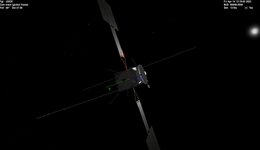
EDIT: The solar tracking does work, but the panels themselves do not point towards the Sun. And it wasn't autotracking unfortunately
 
Thanks. maybe the orientation of the tracking is off?

K does nothing. when the panels are deployed it tracks. No need for stowing I think.

double sunangle = atan2(rsunloc.z, rsunloc.x); // current angle of sun on ZX plane relative to X axis

maybe it should be yz axis?
 
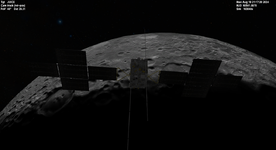
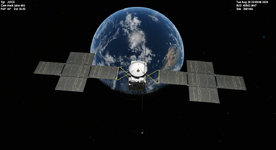
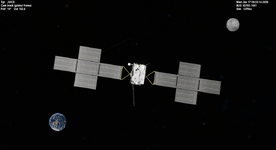
Scenario for JUICE's first Earth flyby on August 19-20, 2024
Code:
BEGIN_HYPERDESC
<p>The <b>Jupiter Icy Moons Explorer (JUICE)</b> approximately a day before its double flyby of the Earth and the Moon on August 19-20, 2024</p>
<br>
<h1><b>MOON</b> (Flyby)</h1>
<p><b>Encounter (Date):</b> August 19, 2024</p>
<p><b>Encounter (Time):</b> 21:16:00 UTC</p>
<p><b>Distance:</b> 700 km</p>
<br>
<h1><b>EARTH</b> (Flyby)</h1>
<p><b>Encounter (Date):</b> August 20, 2024</p>
<p><b>Encounter (Time):</b> 21:57:00 UTC</p>
<p><b>Distance:</b> 6,807 km</p>
<br>
<h1 style="color:rgb(255,0,0)"><small><b>Notes:</b></small></h1>
<p>Orbital state vectors were retrieved from trajectory data available at JPL-HORIZONS (as of August 5, 2025)</p>
<br>
<p>https://ssd.jpl.nasa.gov/horizons/</p>
END_HYPERDESC

BEGIN_ENVIRONMENT
  System Sol
  Date JD 2460540.500000000
  Context SpaceX
END_ENVIRONMENT

BEGIN_FOCUS
  Ship JUICE
END_FOCUS

BEGIN_CAMERA
  TARGET JUICE
  MODE Extern
  POS 12.037179 -1.728054 44.052358
  TRACKMODE AbsoluteDirection
  FOV 40.00
END_CAMERA

BEGIN_HUD
  TYPE Surface
  REF AUTO
END_HUD

BEGIN_MFD Left
  TYPE Orbit
  PROJ Frame
  FRAME Ecliptic
  ALT
  REF Sun
  TARGET Venus
END_MFD

BEGIN_MFD Right
  TYPE Orbit
  PROJ Frame
  FRAME Ecliptic
  ALT
  REF Sun
  TARGET Earth
END_MFD

BEGIN_SHIPS
JUICE
  STATUS Orbiting Sun
  RPOS 1251.601682795914E+08 -1835.196574370563E+04 -8677.620986738117E+07
  RVEL 1358.169791994347E+01  8.521076167351538E+00  2550.684211066330E+01
  AROT 179.188 29.988 87.835
  RPWI 1 1.0000
  RIME 1 1.0000
  SPANEL 1 1.0000
  SOLP 0 1 0.2316
  HGA 1 1.0000
  MAG 1 1.0000
  AFCMODE 7
  PRPLEVEL 0:0.663379
  NAVFREQ 0 0
  XPDR 500
END
END_SHIPS

1755255812094.png
1755255903197.png
Both flybys of the Earth and the Moon are almost exactly a day apart from each other
 
Last edited:
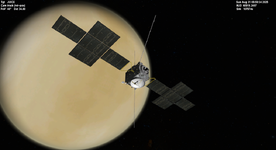
Scenario for JUICE's only flyby of Venus on August 31, 2025
Code:
BEGIN_HYPERDESC
<p>The <b>Jupiter Icy Moons Explorer (JUICE)</b> approximately a day before its flyby of Venus on August 31, 2025</p>
<br>
<h1><b>Venus</b> (Flyby)</h1>
<p><b>Encounter (Date):</b> August 31, 2025</p>
<p><b>Encounter (Time):</b> TBD</p>
<p><b>Distance:</b> 5,216 km</p>
<br>
<h1 style="color:rgb(255,0,0)"><small><b>Notes:</b></small></h1>
<p>Orbital state vectors were retrieved from trajectory data available at JPL-HORIZONS (as of August 5, 2025)</p>
<br>
<p>https://ssd.jpl.nasa.gov/horizons/</p>
END_HYPERDESC

BEGIN_ENVIRONMENT
  System Sol
  Date JD 2460917.500000000
  Context SpaceX
END_ENVIRONMENT

BEGIN_FOCUS
  Ship JUICE
END_FOCUS

BEGIN_CAMERA
  TARGET JUICE
  MODE Extern
  POS 12.037179 -1.728054 44.052358
  TRACKMODE AbsoluteDirection
  FOV 40.00
END_CAMERA

BEGIN_HUD
  TYPE Surface
  REF AUTO
END_HUD

BEGIN_MFD Left
  TYPE Orbit
  PROJ Frame
  FRAME Ecliptic
  ALT
  REF Sun
  TARGET Venus
END_MFD

BEGIN_MFD Right
  TYPE Orbit
  PROJ Frame
  FRAME Ecliptic
  ALT
  REF Sun
  TARGET Earth
END_MFD

BEGIN_SHIPS
JUICE
  STATUS Orbiting Sun
  RPOS  2397.705002849370E+07  3150.780168898329E+05 1058.180733079626E+08
  RVEL -3706.769290961559E+01 -76.65574081823479E+00 1248.459447450048E+00
  AROT 179.188 29.988 87.835
  RPWI 1 1.0000
  RIME 1 1.0000
  SPANEL 1 1.0000
  SOLP 0 1 0.2316
  HGA 1 1.0000
  MAG 1 1.0000
  AFCMODE 7
  PRPLEVEL 0:0.663379
  NAVFREQ 0 0
  XPDR 500
END
END_SHIPS
1755257057546.png
If not disturbed, the trajectory will take JUICE about 5,200 km from the surface of Venus at its closest approach
 
Last edited:
Scenario for JUICE's last two Earth flybys, projected to occur by 2026 and 2029 respectively:

Second Earth flyby:
Code:
BEGIN_HYPERDESC
<p>The <b>Jupiter Icy Moons Explorer (JUICE)</b> approximately a day before its second flyby of the Earth on September 29, 2026</p>
<br>
<h1><b>Earth</b> (Flyby)</h1>
<p><b>Encounter (Date):</b> September 29, 2026</p>
<p><b>Encounter (Time):</b> TBD</p>
<p><b>Distance:</b> 8,700 km</p>
<br>
<h1 style="color:rgb(255,0,0)"><small><b>Notes:</b></small></h1>
<p>Orbital state vectors were retrieved from trajectory data available at JPL-HORIZONS (as of August 5, 2025)</p>
<br>
<p>https://ssd.jpl.nasa.gov/horizons/</p>
END_HYPERDESC

BEGIN_ENVIRONMENT
  System Sol
  Date JD 2461311.500000000
  Context SpaceX
END_ENVIRONMENT

BEGIN_FOCUS
  Ship JUICE
END_FOCUS

BEGIN_CAMERA
  TARGET JUICE
  MODE Extern
  POS 12.994423 -177.818720 -95.905820
  TRACKMODE AbsoluteDirection
  FOV 40.00
END_CAMERA

BEGIN_HUD
  TYPE Surface
  REF AUTO
END_HUD

BEGIN_MFD Left
  TYPE Orbit
  PROJ Frame
  FRAME Ecliptic
  ALT
  REF Sun
  TARGET Jupiter
END_MFD

BEGIN_MFD Right
  TYPE Orbit
  PROJ Frame
  FRAME Ecliptic
  ALT
  REF Sun
  TARGET Earth
END_MFD

BEGIN_SHIPS
JUICE
  STATUS Orbiting Sun
  RPOS  1499.220954856971E+08  -5223.361516999081E+03 1185.805630704035E+07
  RVEL -1374.705976025296E+01   82.21268741376697E+00 2829.899313938251E+01
  AROT -179.558 -5.228 88.117
  RPWI 1 1.0000
  RIME 1 1.0000
  SPANEL 1 1.0000
  SOLP 0 1 0.2316
  HGA 1 1.0000
  MAG 1 1.0000
  AFCMODE 7
  PRPLEVEL 0:0.663379
  NAVFREQ 0 0
  XPDR 500
END
END_SHIPS
1755257993020.png

Third Earth flyby:
Code:
BEGIN_HYPERDESC
<p>The <b>Jupiter Icy Moons Explorer (JUICE)</b> approximately a day before its third (and final) flyby of the Earth on January 18, 2029</p>
<br>
<h1><b>Earth</b> (Flyby)</h1>
<p><b>Encounter (Date):</b> January 18, 2029</p>
<p><b>Encounter (Time):</b> TBD</p>
<p><b>Distance:</b> 4,676 km</p>
<br>
<h1 style="color:rgb(255,0,0)"><small><b>Notes:</b></small></h1>
<p>Orbital state vectors were retrieved from trajectory data available at JPL-HORIZONS (as of August 5, 2025)</p>
<br>
<p>https://ssd.jpl.nasa.gov/horizons/</p>
END_HYPERDESC

BEGIN_ENVIRONMENT
  System Sol
  Date JD 2462153.500000000
  Context SpaceX
END_ENVIRONMENT

BEGIN_FOCUS
  Ship JUICE
END_FOCUS

BEGIN_CAMERA
  TARGET JUICE
  MODE Extern
  POS 77.070847 43.105753 3.248143
  TRACKMODE GlobalFrame
  FOV 10.00
END_CAMERA

BEGIN_HUD
  TYPE Surface
  REF AUTO
END_HUD

BEGIN_MFD Left
  TYPE Orbit
  PROJ Frame
  FRAME Ecliptic
  ALT
  REF Sun
  TARGET Jupiter
END_MFD

BEGIN_MFD Right
  TYPE Orbit
  PROJ Frame
  FRAME Ecliptic
  ALT
  REF Sun
  TARGET Earth
END_MFD

BEGIN_SHIPS
JUICE
  STATUS Orbiting Sun
  RPOS -6568.632844552204E+07 -9900.435936294496E+03  1309.240371657800E+08
  RVEL -3511.683131656677E+01  6.867393972873614E+00 -6084.106006456766E+00
  AROT 178.403 44.872 87.354
  RPWI 1 1.0000
  RIME 1 1.0000
  SPANEL 1 1.0000
  SOLP 0 1 0.2316
  HGA 1 1.0000
  MAG 1 1.0000
  AFCMODE 7
  PRPLEVEL 0:0.663379
  NAVFREQ 0 0
  XPDR 500
END
END_SHIPS
1755259270166.png
There was supposed to be a flyby of a large main-belt asteroid called 229 Rosa, which was supposed to occur by October 2029, however that was cancelled so that more propellant are reserved for the eventual flybys of Jupiter's largest moons
 
Last edited:
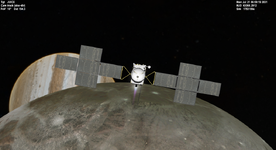
Scenario for JUICE's orbital insertion around Jupiter on July 2031:
Code:
BEGIN_HYPERDESC
<p>The <b>Jupiter Icy Moons Explorer (JUICE)</b> approximately 20 days before inserting itself into orbit around Jupiter on July 2031</p>
<br>
<p>A gravity assist flyby of Ganymede is conducted to help itself slow down and be captured by Jupiter's gravity</p>
<br>
<h1><b>Jupiter</b> (Orbit Insertion)</h1>
<p><b>Arrival (Date):</b> July 22, 2031</p>
<p><b>Arrival (Time):</b> TBD</p>
<br>
<h1><b>Ganymede</b> (Flyby)</h1>
<p><b>Encounter (Date):</b> July 21, 2031</p>
<p><b>Encounter (Time):</b> TBD</p>
<p><b>Distance:</b> ~1,000 km</p>
<br>
<h1 style="color:rgb(255,0,0)"><small><b>Notes:</b></small></h1>
<p>Orbital state vectors were retrieved from trajectory data available at JPL-HORIZONS (as of August 5, 2025)</p>
<br>
<p>https://ssd.jpl.nasa.gov/horizons/</p>
END_HYPERDESC

BEGIN_ENVIRONMENT
  System Sol
  Date JD 2463048.500000000
  Context SpaceX
END_ENVIRONMENT

BEGIN_FOCUS
  Ship JUICE
END_FOCUS

BEGIN_CAMERA
  TARGET JUICE
  MODE Extern
  POS 106.996158 112.902921 1.131629
  TRACKMODE GlobalFrame
  FOV 10.00
END_CAMERA

BEGIN_HUD
  TYPE Surface
  REF AUTO
END_HUD

BEGIN_MFD Left
  TYPE Orbit
  PROJ Frame
  FRAME Ecliptic
  ALT
  REF Jupiter
  TARGET Ganymede
END_MFD

BEGIN_MFD Right
  TYPE Orbit
  PROJ Frame
  FRAME Ecliptic
  ALT
  REF Sun
  TARGET Jupiter
END_MFD

BEGIN_SHIPS
JUICE
  STATUS Orbiting Sun
  RPOS -5562.842851468664E+07  4302.222112352610E+06 -7811.893343901244E+08
  RVEL  5917.252754817349E+00 -8.903555360610937E+00 -1794.136397052020E+00
  AROT 176.878 -85.501 -84.700
  RPWI 1 1.0000
  RIME 1 1.0000
  SPANEL 1 1.0000
  SOLP 0 1 0.2316
  HGA 1 1.0000
  MAG 1 1.0000
  AFCMODE 7
  PRPLEVEL 0:0.663379
  NAVFREQ 0 0
  XPDR 500
END
END_SHIPS
1755260330771.png
JUICE will pass by Ganymede shortly before it conducts its orbital insertion burn around Jupiter. I just turned its main engine on for the screenshot above
 
Last edited:
If I remember correctly, a few years ago, JPL HORIZONS had trajectory data available up to Ganymede orbit insertion. Unfortunately, when I revisited it again, the data just abruptly ends on Jupiter Arrival Day (July 21, 2031). I think that was removed sometime during its launch.

Despite this, it is planned to orbit around Jupiter at the same time as Europa Clipper, conduct a three-year study around the planet and its three Galilean moons (except Io) until it settles into orbit around Ganymede by December 2034. Afterwards, it will study the moon continually up close until it was commanded to be deorbited just a year later on 2035
 
Thanks. Yes I saw bad animation. So on the tracking. I made it y/z and get this. I think it is off 90 degrees. right?
 

Attachments

  • juicesoalr.jpg
    juicesoalr.jpg
    19.9 KB · Views: 2
Oh. I wonder what the launch orbit should be?
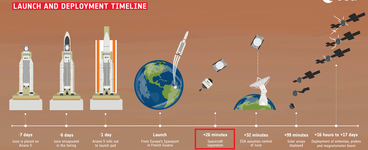
Just as I suspected. According to its Launch Press Kit (2023), JUICE was indeed launched directly into an interplanetary escape trajectory, as it was jettisoned from the Ariane 5 about T+26 minutes after liftoff (highlighted):
1755280069570.png
I'd like to attempt a modification of its guidance file that will hopefully match closely the launch during Orbiter simulation in real life
 
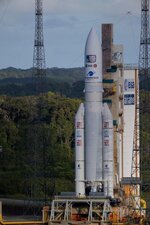
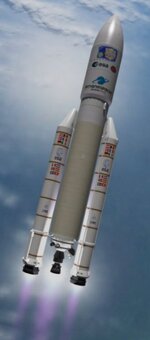
Alright, here's the new launch configuration and scenario. Fortunately, the original guidance file almost closely matched that of JUICE's actual launch profile, so I just simply removed every parameter that shuts off the upper stage's main engine. Also added a WAV file that plays the mission's actual launch livestream audio, which starts about T-15 seconds before launch, and lasts up to fairing jettison at T+190 seconds. The new scenario file has the auto-launch feature enabled upon starting the simulation, counting down at T-120 seconds, firing exactly at April 14, 2023 (12:36:14 UTC)
1755282310924.png
Also, @gattispilot if it's alright, I've changed the Ariane 5 with the newer models found on the Kourou 5.1 add-on by @jacquesmomo, making it fully compatible with that add-on and making it its only dependency.
 

Attachments

Last edited:
Back
Top