News Japan Earthquake, Tsunami, & Nuclear Disaster

I cant even imagine the destruction that it did. I hope that the nuclear power plant doesn't
make another chernobyl... :uhh:
I may be misunderstanding you, but you have to remember that a meltdown isn't the same as a nuclear weapon detonating. That seems to be a pretty common misconception.
 
This misunderstanding is not helped by language barrier. I don't know about other languages but in Spanish, meltdown is referred to as "fusión del reactor", implying a fusion chain reaction. A better word in Spanish would be "sobrecalentimiento" - overheating.
 
I may be misunderstanding you, but you have to remember that a meltdown isn't the same as a nuclear weapon detonating. That seems to be a pretty common misconception.

I have always assumend the concerns of explosion in reactors are about steam or hydrogen explosions. I think it is obvious that normal nuclear rector running on low enrichen uranium can't make actual nuclear explosion. At worst you might get a criticality accident rapidly releasing heat and causing steam explosion.
 
Some articles on the planned use of robots at Fukushima:

March 19, 2011 4:28 PM PDT
Where are the robots in Japan's nuclear crisis?
http://news.cnet.com/8301-17938_105-20044970-1.html#ixzz1HGK9OweV

Australian robotic equipment to aid in water dousing reactors.
Peter Alford
From: The Australian
March 22, 2011 12:00AM
http://www.theaustralian.com.au/aus...dousing-reactors/story-fn84naht-1226025692481

Japan Earthquake: iRobot Sending Packbots and Warriors to Fukushima
Dai-1 Nuclear Plant
POSTED BY: Evan Ackerman / Fri, March 18, 2011
http://spectrum.ieee.org/automaton/...ot-sending-packbots-and-warriors-to-fukushima


Bob Clark

---------- Post added at 03:34 AM ---------- Previous post was at 02:36 AM ----------

Interesting article here describing the steps leading to the bringing in of the elite firefighting Hyper Rescue Squad from Tokyo who appear to have stabilized the spent fuel pools:

ASIA NEWS
MARCH 21, 2011.Japan Makes Gains in Its Nuclear Fight
Radiation Levels Are Down and Two Reactors Are on Grid.
The head of the squad, Yasuo Sato, said at a news conference that his wife sent him a one-line email as the firefighters headed to the scene: "Please be the savior of Japan."
http://online.wsj.com/article/SB10001424052748704021504576211733745754772.html


Bob Clark
 
The first long awaited IR images are available:

heatAll.jpg


Doesn't look good at all, even the roof of unit 2 is hotter than a nuclear reactor should be. The white spots at Unit 1 and 3 are above 120°C according to the scale used at my newspaper for this set of images, which is pretty bad. Unit 4 looks at least under-control, the red spots show well the location of the spent fuel pool and translate to 80°-120°C, which is tolerable in the situation. Not known is, how old the images are, my newspaper claims them to be from Monday.

Both unit 1 and unit 3 are still overheating - the shutdown temperature of the coolant if the cooling system would be working properly is around 40°C-50°C, the containment structure much less, about half as many degrees Celsius.
 
Not known is, how old the images are, my newspaper claims them to be from Monday.
There is at the top-right corner of the image "20日", which is 20th day, so Sunday (UTC+9), so these can be IR images from either Sunday UTC, or Saturday UTC if they were taken at the morning, but I could be wrong as I only translated the date and nothing else.
 
There is at the top-right corner of the image "20日", which is 20th day, so Sunday (UTC+9), so these can be IR images from either Sunday UTC, or Saturday UTC if they were taken at the morning, but I could be wrong as I only translated the date and nothing else.

Japan is east of the UTC, so 20th day happens earlier there than in Europe or the rest of the world (except the islands east of Japan).

So this was even earlier, but still after the too early reports of success.
 
Now there is talk about iodine and cesium being washed to the sea.
Fukushima Daiichi Nuclear Accident Update (22 March 16:45 UTC)

22 March 2011

Announcements, Featured

Seawater Monitoring -UPDATED (new material in bold)

Japanese authorities have reported that the Tokyo Electric Power Company has detected radioactive materials in seawater at one location near the Southern discharge canal at the Fukushima Daiichi nuclear power plant. Samples taken included levels of iodine-131, cesium-134, and cesium-137.

To study a larger area of the marine environment, the Japan Agency for Marine-Earth Science and Technology (JAMSTEC) plans to measure radioactivity around the plant from 22-23 March. Seawater will be collected from eight locations, and the Japan Atomic Energy Agency plans to analyse the samples and release results on 24 March. The analysis will include radionuclide concentrations found in sea water and dose rate in the air. The IAEA will continue to follow this information.

The seawater used for cooling could have carried away A LOT of nasty stuff from the pellets:

Unit 3: >3742 tonnes of water
Unit 4: >255 tonnes of water
 
Can anyone enlighten me on the progress in providing off-site power to Units 3 and 4? The IAEA release of March 23 (http://www.iaea.org/press/?p=1621) says progress is uncertain, while the CNN link posted by steph has this:
The Tokyo Fire Department planned to start spraying water into the spent-fuel storage pool outside the plant's No.3 reactor Wednesday, said Hidehiko Nishiyama of Japan's Nuclear and Industrial Safety Agency. Power has been restored in the control room at that reactor -- which officials say could be a key step in bringing cooling systems back online.

NISA itself writes the following (http://www.nisa.meti.go.jp/english/files/en20110323-3-1.pdf):
Lighting was recovered in the Central Operation Room. (22:43 March 22nd {JST})

And by the way, what can be the latent + acute death toll under two competing scenarios:

a) Seawater cooling as it is done now
b) Localisation a la Chernobyl (with boron, dolomite and lead).

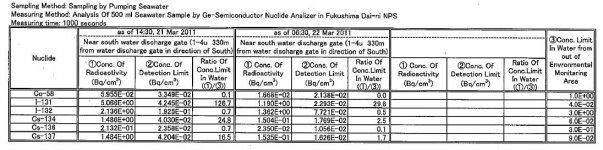
EDIT: attaching results of seawater sample nuclide analysis by NISA.
 

Attachments

  • seawater_sample.jpg
    seawater_sample.jpg
    88.2 KB · Views: 7
Last edited:
Can anyone enlighten me on the progress in providing off-site power to Units 3 and 4? The IAEA release of March 23 (http://www.iaea.org/press/?p=1621) says progress is uncertain, while the CNN link posted by steph has this:

That the lighting in the control rooms is restored is confirmed also by other sources now.

Essentially, without any power supply, including batteries, there is no control over the reactor in the control room. All sensors and actuators are dead. But you still have manual controls in the reactor building, but outside the containment. Most important valves are operated by pneumatic power, that can also be switched manually by valves, as long as there is enough pressure stored in the system. That happened in Fukushima from the first day on, as far as I can tell, even the emergency pressure relief valves had to be operated manually.

But you fly blind. You can't measure any quantity of the core anymore, except temperatures outside the containment. You can't even enter the primary containment anymore by workers, because the pressure and temperature inside it grows rapidly during the process.

And by the way, what can be the latent + acute death toll under two competing scenarios:

a) Seawater cooling as it is done now
b) Localisation a la Chernobyl (with boron, dolomite and lead).

Only one victim is guaranteed - the truth.

Otherwise, I wouldn't know, and I am sure, nobody could really tell in advance. Fukushima is not Chernobyl, and compared to Chernobyl, there is a huge lack in resolve by TEPCO to give up their reactors completely in favor of reducing the damage to the world around the plant.

If more than 20 people die by acute radiation poisoning, this would be an extraordinary surprise, especially now. I would rather expect something along maximal 12 workers getting radiation poisoning, but not directly lethal. The cancer rates, especially among young children in the whole region around the plant, up to 400 km along the coast, will skyrocket. Even less radiation has already deadly effects on children.

 
Japan Earthquake: iRobot Sending Packbots and Warriors to Fukushima
Dai-1 Nuclear Plant
POSTED BY: Evan Ackerman / Fri, March 18, 2011
http://spectrum.ieee.org/automaton/...ot-sending-packbots-and-warriors-to-fukushima


---------- Post added at 03:34 AM ---------- Previous post was at 02:36 AM ----------

Interesting article here describing the steps leading to the bringing in of the elite firefighting Hyper Rescue Squad from Tokyo who appear to have stabilized the spent fuel pools:

ASIA NEWS
MARCH 21, 2011.Japan Makes Gains in Its Nuclear Fight
Radiation Levels Are Down and Two Reactors Are on Grid.

More robots:

First Eyes Inside Nuclear Plant May Be A Robot's.
• GEOFF BRUMFIEL
• March 23, 2011, 12:01 AM
http://www.wbur.org/npr/134769065/first-eyes-inside-nuclear-plant-may-be-a-robots

Robot Helicopters Could Be Headed for Japan.
"The Pentagon is reportedly mulling over the use of experimental unmanned helicopters to help out in the emergency at Japan's Fukushima Daiichi nuclear plant, where human pilots risk high radiation exposure as they try to keep the reactor cores submerged in water and cool."
By Joe Pappalardo
March 21, 2011 4:00 PM
http://www.popularmechanics.com/tec...ers-could-be-headed-for-japan-5434307?src=rss

March 20, 2011
More robots are being used at Fukushima.
"The robots heading to Units One and Two were driving into the reactor to shovel earth and bulldoze walls, as well as carrying out more complex tasks such as sampling the atmosphere, detecting radiation and recovering debris for analysis. Some can even climb walls.
"They were designed after the 1986 Chernobyl disaster by GIE Intra, a company owned by EDF Energy, which is masterminding Britain’s nuclear rebuilding."
http://nextbigfuture.com/2011/03/more-robots-are-being-used-at-fukushima.html


Bob Clark
 
EDIT: attaching results of seawater sample nuclide analysis by NISA.

Quite a lot of stuff in there... From a quick look, some iodine and cesium concentrations are in the range of 2000 to 5000 becquerel per liter ... Numbers look way smaller when you put them in milliliter (cm³) than in liter, when the published norms are usually in becquerel per liter <-> kg of water...

Still not "glow-in-the-dark" concentrations, but now the question is: what is the total volume of that stuff drained out to sea, so that we can figure how much radionucleides will end up in the food chain of the Pacific...
 
Back
Top