News Japan Earthquake, Tsunami, & Nuclear Disaster

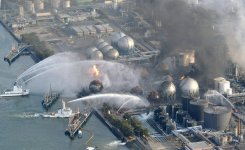
Update : water guns could be used to fill the pool from a distance.

(Local news)

...

This could indeed work. See the pic below of fireboats used to put out a fire on shore. Note that as shown in the pic such boats can also operate close to the pier.
According to this Wiki page there are fireboats that can pump out 2.4 m3/s of water:

[ame="http://en.wikipedia.org/wiki/Fireboat"]Fireboat - Wikipedia, the free encyclopedia[/ame]

Note that this is higher than the amount that Urwumpe said the cooling pumps put out at the reactors.
In addition to this use, you could extend the hoses and use such high power pumps on the boats to connect directly to the reactor cooling pipes, bypassing the inoperable diesel generators at the plant.
Or you could use the powerful diesel motors on board the boats with long cables attached to power the pumps at the plant.


Bob Clark
 

Attachments

  • 20110315085802349.jpg
    20110315085802349.jpg
    180.9 KB · Views: 16
As far as I know, we're not (yet) in those scales of radiation... But that could happen at extremely high level (also depending of the shielding of the robot circuitry).

Also, for the humanoid space robots, to operate in space they would have to be radiation hardened, though I don't know if in these test versions this type of computer chip was used.


Bob Clark
 
Last edited:
There was a crisis meeting at the Assemblée Nationale this afternoon. It has been said that there could be fallouts all over the Northern Hemisphere, possibly worsely than in 1986, and that "it was a situation of extreme emergency".
 
http://english.kyodonews.jp/news/2011/03/78680.html

U.S. to fly spy plane over Fukushima nuclear plant for closer look

TOKYO, March 17, Kyodo

The U.S. military will operate a Global Hawk unmanned high-altitude reconnaissance aircraft over a stricken nuclear power plant in Fukushima Prefecture, possibly on Thursday, to take a closer look at its troubled reactors, a Japanese government source said Wednesday.

Photographs taken by the plane equipped with infrared sensors could provide a useful clue to what is occurring inside the reactor buildings, around which high-level radiation has been detected.

The planned mission comes as the Japanese government appears unable to contain the crisis days after the coastal nuclear plant was struck by a magnitude 9.0 earthquake and tsunami.

It would represent a deepening of Japanese-U.S. cooperation in coping with the escalating crisis, with the U.S. military having already provided logistical transportation, and search and rescue efforts in the wake of the disaster that hit northeastern Japan.
 
There was a crisis meeting at the Assemblée Nationale this afternoon. It has been said that there could be fallouts all over the Northern Hemisphere, possibly worsely than in 1986, and that "it was a situation of extreme emergency".

At the news here they say that it could be worse than Chernobyl too. But of course, the news on TV here are not too reliable... they make everything seem so much worse than they actually is. Let's hope that it will be OK, or, at least, not very bad.
 
BBC quotes the head of the US Nuclear Regulatory Comission as saying that there is no water left in the reactor 4 storage pool and radiation levels may be very high. Does that smell of recriticality?
 
BBC quotes the head of the US Nuclear Regulatory Comission as saying that there is no water left in the reactor 4 storage pool and radiation levels may be very high. Does that smell of recriticality?

No. The pool should be full of neutron poison and water is the moderator.
 
AFAIK, nuclear EMP is only generated by actual nuclear detonations.

...but the energy radiated may induce overloads on sensible microcircuitry (I don't know how and I'm not an expert, my best try would be to say that some electrons get where they shouldn't be) which can damage components.
 
Ionizing radiation can damage unhardened integrated circuits easily. must not even be much radiation. Most electronics already fail when humans don't even get radiation poisoning.
 
Problem is with videocams. It (radiation) acts like very bright light directly into the camera. Robot operator cannot see what is going on. If we add together radiation, steam and water condensate and heat robots become useless. This is not nice clean vacuum on the moon surface. As result the only solution is with volunteers (do not say word "kamikaze"). Someone must put radiation suit on himself run into radiation zone (5 minutes) work for 5 to 10 minutes and after that run out (another 5 minutes). After that you need another volunteer, because previous one has got a 2 or 3 year radiation dosage and must not get more. It is possible to lose all nuclear specialists in Japan in several days. In such case things go really FUBAR and at this moment you are in need of REAL kamikazes
 
Last edited:
It's time for the world community to recognize this is not just a Japanese problem but potentially a world-wide problem. With the entire country of Japan in a crisis with the earthquake and tsunamis, dealing with this nuclear crisis is clearly straining Japans capability to deal with it.
It's time for the President to get off the golf course and tell Japan the U.S. and other members of the word-wide community are moving in to assist in solving the problems at these stricken plants.

Also, these plants were made by GE. Rather than defending the use of
these plants, now is the time for GE's best engineers to work with the
Japanese to find a solution. The plants failing completely and
undergoing a meltdown would be the worst possible advertising for
these GE modeled plants. GE should be doing everything possible to
ensure that doesn't happen, not spending their time sending out press
releases.
But it's not just GE engineers. The President should put out a call
to everyone with expertise in any of the systems involved about how to
come up with solutions to prevent meltdown.
To the mobile diesel generator providers, do you have types that are
compatible with those used by the Japanese plants?
To electrical engineers how do you adapt different generators to work
with incompatible electrical systems already in place?
To high power pump manufacturers, do you have portable types that can pump water at the high rates the plant cooling systems used,
reportedly in the range of hundreds of liters per second? Do you have
turbopumps that can pump such high volumes of water driven by
combustion without needing high power electrical generators?
To robotic engineers, do you have robots that can take over some of
the dangerous functions being done by the skeleton crew remaining at
the Japanese plants under high radiation levels?


ABC News last night with Diane Sawyer presented an effecting story on
the 50 brave men still remaining at the plants under high radiation
exposure trying to bring the reactors under control:

World News (03.15.11).
http://news.yahoo.com/video/politics-15795811/#video=24541160

These men are under danger of contracting fatal radiation poisoning
from the lengths of time they're spending under the high radiation
conditions. But it doesn't have to be just 50. There are dozens of
nuclear power plants in Japan. Japan should put the call out to all
their nuclear plants for workers to assist in dealing with the crisis.
You could easily have over 1,000 emergency trained workers doing the
work relegated to the 50 men now. That would greatly reduce the
radiation exposure these men would have to face.


Bob Clark

 
These men are under danger of contracting fatal radiation poisoning
from the lengths of time they're spending under the high radiation
conditions. But it doesn't have to be just 50. There are dozens of
nuclear power plants in Japan. Japan should put the call out to all
their nuclear plants for workers to assist in dealing with the crisis.
You could easily have over 1,000 emergency trained workers doing the
work relegated to the 50 men now. That would greatly reduce the
radiation exposure these men would have to face.


Bob Clark

And leave all other nuclear power stations without personnel?
And when you hear about 50 do you really think that they are same 50 men from one hour ago?
 
But it's not just GE engineers. The President should put out a call
to everyone with expertise in any of the systems involved about how to
come up with solutions to prevent meltdown.
To the mobile diesel generator providers, do you have types that are
compatible with those used by the Japanese plants?
To electrical engineers how do you adapt different generators to work
with incompatible electrical systems already in place?
To high power pump manufacturers, do you have portable types that can pump water at the high rates the plant cooling systems used,
reportedly in the range of hundreds of liters per second? Do you have
turbopumps that can pump such high volumes of water driven by
combustion without needing high power electrical generators?
To robotic engineers, do you have robots that can take over some of
the dangerous functions being done by the skeleton crew remaining at
the Japanese plants under high radiation levels?

I think your President has to consider how the involved companies should be rewarded for their emergency provisions of all such equipment before he makes the calls. And it sounds like something that should first get approval from the Congress, especially since the disaster isn't happening at US ground, yet.
 
Well just got back from a walk whats the most up to date news. Can't tell if there is a meltdown or not I've heard of a partial meltdown but has it finnaly just gone into meltdown fully?:uhh:
 
Hope you don't mind that I quote this leading article from Asahi Shimbun, Japan's leading daily, in full

http://www.facebook.com/AJW.Asahi

By KEIJI TAKEUCHI
Senior Staff Writer of the vernacular Asahi Shimbun

With the emergency surrounding the Fukushima No. 1 nuclear power plant, Japan now faces a question that has been taboo since the Chernobyl nuclear accident in 1986, namely, who has to step up and do the work to mitigate a high-radiation nuclear accident.
Now is the time for the central government to gather all available knowledge to consider and implement as many methods as possible, including the installation of all necessary equipment and power transmission lines as well as a major mobilization of personnel, to deal with the situation.
After a fire was detected Wednesday morning, a fire-fighting unit gave up fighting the fire because radiation levels were too high. In the afternoon, a Self-Defense Force helicopter tried to drop water from the air, but had to abandon that plan for the same reason.
Radiation levels of between 10 and 400 millisieverts per hour were recorded both within and outside the Fukushima nuclear plant. Those are very high figures.
However, the cooling of the reactor core has to be continued by all means. If the core continues to be damaged, it could lead to the emission of large amounts of radioactive materials.
When a criticality accident occurred in 1999 at a facility in Tokai, Ibaraki Prefecture, of JCO Co., a nuclear fuel reprocessing company, work was required under high radiation levels in order to prevent nuclear fuel from reaching a critical state.
The work was carried out by teams of two people. Each group only had about three minutes to run to where the accident occurred, do their work and return. The work was completed by nine groups.
The maximum level of radiation exposure incurred by an individual at that time was 103 millisieverts, which exceeded the 100-millisievert upper limit for workers in emergency situations.
The maximum exposure figure is equivalent to 70 years of the Japanese average for natural radiation exposure, but that was incurred in only three minutes.
Nuclear power is a technology which inevitably requires such dangerous work. Large radioactive contamination could make the land uninhabitable.
During the Chernobyl accident in 1986, sand was poured from the air by helicopter over the exposed reactor core. On the ground, many people worked at close range to the crippled reactor. However, the massive discharge of radioactive materials was stopped in one week.
Without that death-defying effort, the world would have been contaminated to a greater degree.
In the wake of that accident, the topic of working under very high radiation levels was also discussed in Japan.
However, that debate faded because it would have involved the fundamental social issue of whether a democratic state can order people to do work harmful to their health.
There was also the myth that major accidents just do not happen in Japan.
Now, however, we face an emergency situation. A quick decision and response is required.
The central government and Tokyo Electric Power Co. established on Tuesday a comprehensive headquarters to deal with the Fukushima nuclear accident. Information and decision-making authority should be concentrated there.
On Tuesday, the Health, Labor and Welfare Ministry raised the upper limit for radiation exposure for those doing emergency work at the Fukushima nuclear power plant. Similar flexibility is possible with other governmental systems.
It is time to bring together the expertise of all the people and businesses knowledgeable about nuclear energy, regardless of whether they promoted it or opposed it. The situation requires an immediate response.

If an "establishment" newspaper is talking like this about the handling of the disaster, there is evidently a lot of discontent. From the BBC video above, the mayor of the city in the 20km zone said "They are leaving us here to die" and the governor of Fukushima prefecture said "Anxiety and anger have reached boiling point."

http://www.bbc.co.uk/news/world-asia-pacific-12763273

Remember these are the same people whom we all praised over the last three days for their resilience and calm, they're not "moaning minnies" who love to grumble for no reason. There's some very serious discontent brewing.

EDIT: Not everyone feels that way. One unnamed foreign journalist (probably American from the language used) says this to the BBC reporter (quoted on the BBC live log)

0658: A journalist in Kamaguchi has told the BBC she is not planning on leaving any time soon: "I get the same calls from everybody, like 'why aren't you leaving?', and I am thinking, there is no reason to leave; I totally trust the engineering of the Japanese, I trust the system, I trust all the foreign experts who are coming here, checking it, helping out. I think we'll be fine."

As a journalist myself, I have to wonder what kind of journalist shows such blind trust in the authorities.
 
Last edited:
@Belisarius, Just read your post and when I saw what that possibly American journolist had said I was horrified:uhh: how can anyone show such ignorence in such dangerous cercemstances:idk:. We are proberly winessing the worst nuclear disaster since chernobyl and this journolist can be so laid back I would have left even before this all happend. New Zealand is nuclear free and I don't know if any of you Know I'm actualy from England. Since I left I feel better about being here without nuclear tecnology it may not be as bad as our super massive volcano but at least there's no nuc's ( they teach you all about Chernobyl in year nine social sciences). Hope thing dont deteriorate in Japan:uhh:
 
Back
Top