

-
ORBITER-FORUM will be temporarily closed at 2026-07-23 18:00 UTC while we complete some OF maintenance tasks. The amount of downtime is expected to take up to one hour, but probably less.
You are using an out of date browser. It may not display this or other websites correctly.
You should upgrade or use an alternative browser.
You should upgrade or use an alternative browser.
Updates James Webb Space Telescope updates
- Thread starter IronRain
- Start date

- Joined
- Feb 6, 2008
- Messages
- 38,938
- Reaction score
- 3,937
- Points
- 203
- Location
- Wolfsburg
- Preferred Pronouns
- Sire
Lets not go down that road.
Why not...
:RnR1:
I've got 25 add-ons on my workbench...
:lol:
I have heard of people getting paid to do add-on work. I have even been offered but turn it down. That is just me. As I don't deserve it. But I guess people offer take it?
. But I guess people offer take it?
- Joined
- Feb 6, 2008
- Messages
- 38,938
- Reaction score
- 3,937
- Points
- 203
- Location
- Wolfsburg
- Preferred Pronouns
- Sire
I have heard of people getting paid to do add-on work. I have even been offered but turn it down. That is just me. As I don't deserve it
I am just kidding there, but of course, getting paid to develop add-ons might mean spending less time working to get paid elsewhere. In the end, you are right: You also pay a high price, if you start taking money. More money, more problems.

[ame="https://twitter.com/jtuttlekeane/status/1011742589106569216"]https://twitter.com/jtuttlekeane/status/1011742589106569216[/ame]
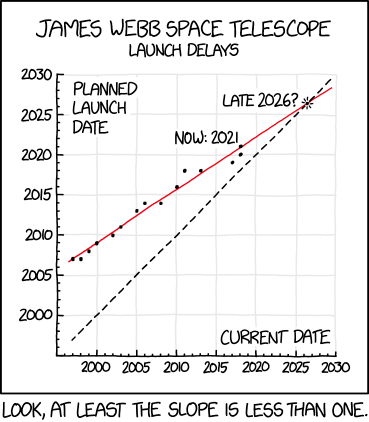
2026 then... :shifty:
2026 then... :shifty:

Unstung
Active member
As much as I like telescopes, both ground-based and spaceborne, I say cancel this project and call it a day. Build something that actually works.
They won't though because its a shelter for jobs. And no nasa administrator wants to launch this on his watch and have it fail anyways.. If it’s ever completed, the builders won’t be able to suck money from the government anymore. JWST makes more money on the ground than it ever could in space.
Unlike a planetary mission, a single astronomy mission can support many different kinds of scientists. JWST will study planets, exoplanets, astrobiology, cosmology, and stellar physics off the top of my head. So I think it's still worth the price tag and I'm sure the engineers are testing everything conceivable extremely thoroughly to give the telescope the best chance of working as planned straight out-of-fairing. If Webb is canceled or tragically thinks it's a submarine, a lot of science will be lost.
The risk of failure is an inherent part of any space mission, and the greatest NASA missions are the most audacious. The agency is at its best when it pushes boundaries. Webb may have been too complicated, but it will do amazing things that are only possible far away in space.
NASA is making sure future flagship astronomy missions won't have such a tumultuous development. WFIRST is a lot less groundbreaking and the agency is working to keep its budget close to $3 billion. The following flagship mission is capped at $5 billion, making scientists rethink some crazier proposals. Even the cost for more modest missions is more on the ground than in space. It's cheaper to fly a mission than to develop one (at least one that hasn't been flying for many years).
All the money JWST makes is on the ground anyway. Just think of all the families of scientists, engineers, and technicians that this mission feeds, before launch and after launch. At least the R&D money before launch is going to good jobs. Maybe some of the technologies developed will have further applications. Maybe that has already happened.



- Joined
- Jan 13, 2008
- Messages
- 2,303
- Reaction score
- 6
- Points
- 38
- Location
- Atlanta, GA, USA, North America
This is hysterical: https://xkcd.com/2014/

mahdavi3d
Well-known member
- Joined
- Nov 25, 2011
- Messages
- 535
- Reaction score
- 102
- Points
- 58
Is it right to say this graph tells me "NOW: 2026" ? :hmm:

barrygolden
Well-known member
At the hearing last week the $500 million dollar JWST was over $ 8 billion as of now and Northrop Grumman was asking for another $1.5 billion and 3 more years. Might should have called Space X.

- Joined
- Nov 20, 2007
- Messages
- 11,969
- Reaction score
- 768
- Points
- 188
Title Deployment test of Webb’s secondary mirror
Released 19/08/2019 10:00 am
Copyright NASA/C. Gunn
Description
The secondary mirror – visible in the top right corner of the image – is among the most important pieces of equipment on the NASA/ESA/CSA James Webb Space Telescope (JWST) and is essential to the success of the mission.
http://www.esa.int/spaceinimages/Images/2019/08/Deployment_test_of_Webb_s_secondary_mirror
- Joined
- Nov 20, 2007
- Messages
- 11,969
- Reaction score
- 768
- Points
- 188
James Webb Space Telescope comes together
By Jonathan Amos
BBC Science Correspondent
https://www.bbc.com/news/science-environment-49504866
Sbb1413
Well-known member
- Joined
- Aug 14, 2018
- Messages
- 1,012
- Reaction score
- 401
- Points
- 98
- Location
- West Bengal, India
- Preferred Pronouns
- he/his/him
http://spaceref.com/news/viewsr.html?pid=53234As of October 2019, the project had used about 76 percent of its available schedule reserve and no longer plans to launch in November 2020 (see figure). The project is now managing to a March 2021 launch date but estimates only a 12 percent likelihood that this date will be achieved. NASA plans to reassess the launch date in the spring of 2020.
:worfleave:
Similar threads

- Replies
- 10
- Views
- 5K


- Replies
- 0
- Views
- 5K


- Replies
- 12
- Views
- 7K