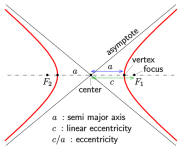
How calculate semi-latus rectum of parabola or hyperbola?

Kolodez

New member
Joined
Jun 18, 2018
Messages
21
Reaction score
0
Points
1
The semi-latus rectum is necessary for the formula
radius = semi-latus rectum / (1 + eccentricity * cos (true anomaly)).
However, if we refer to Wikipedia, we need to know the semi-major axis to calculate the semi-latus rectum. But the semi-major axis is only defined for circles and ellipses, if I am not getting it wrong.
So assume I am in a parabolic or hyperbolic orbit and I know my current location, velocity, true anomaly, specific energy, eccentricity and the periapsis radius. How can I calculate the semi-latus rectum from these values in order to be able to calculate future locations?
Thank you!
 
Thanks for your replies! So if I have a hyperbola, I can also use the formula
semi-major axis = - G * major body mass / (2 * orbit specific energy)
and the semi-major axis is then negative, whereas it is positive in the case of an ellipse, right? And that yields the same formula for the semi-latus rectum, i.e.
semi-latus rectum = semi-major axis * (1 - eccentricity^2)
no matter if we have an ellipse or a hyperbola.
But in the case of a parabola, the above formulas lead to
semi-major-axis = infinity,
semi-latus rectum = infinity * 0
which makes impossible to calculate the semi-latus rectum. Did I make an error anywhere?
 
Semi-latus rectum = 2 * periapsis radius
This is wrong.

periapsis radius = Semi-latus rectum / ( 1 + eccentricity )

Parabola in orbital mechanics in the Orbiter is something that you can forget. Doesn't really exists in practice.
 
I looked into the Orbiter manual once again. We have
semi-major axis = - G * major body mass / (2 * orbit specific energy),
eccentricity = sqrt (1 + 2 * orbit specific energy * h^2 / (G^2 * major body mass^2))

Hence
semi-latus rectum = semi-major axis * (1 - eccentricity^2)
= - G * major body mass / (2 * orbit specific energy) * ( - 2 * orbit specific energy * h^2 / (G^2 * major body mass^2))
= h^2 / (G * major body mass)

where h = radius x velocity. Since everything is continuous, we can use this for any eccentricity. Is this correct?
 
Since everything is continuous, we can use this for any eccentricity. Is this correct?
Yes. I don't recall any functions in orbital mechanics those would be limited to elliptical or hyperbolic orbits only, except the ones that deal with eccentric-anomaly "EcA" in which case hyperbolic versions of the functions must use hyperbolic "sin, cos" instead i.e. sinh cosh
 
Back
Top