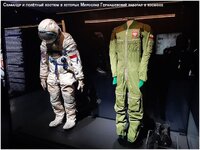
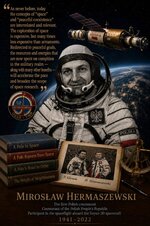
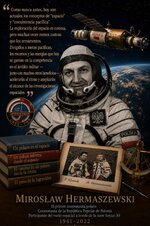
Скафандр и пилотный костюм в которых Мирослав Гермашевский работал в космосе. The spacesuit and pilot suit in which Miroslav Hermaszewski worked in space. El traje espacial y el traje de piloto que Miroslav Hermaszewski utilizó para trabajar en el espacio.
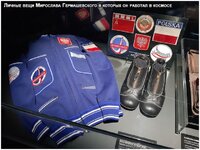
Личные вещи Мирослава Гермашевского в которых он работал в космосе. Personal belongings of Miroslav Hermaszewski, which he wore while working in space. Objetos personales de Miroslav Hermaszewski, que usó mientras trabajaba en el espacio.
21 декабря 2022 года, в столице Польши - городе Варшаве, в Полевом Кафедральном Соборе Войска Польского состоялась заупокойная месса, по Мирославу Гермашевскому - первому космонавту Польши, ушедшему из жизни 12 декабря 2022 года. Месса проходила по всем военным церемониальным правилам.
Перед алтарем на постаменте был установлен закрытый гроб с лежащей на нем генеральской фуражкой покойного.
Поочередно в почётном карауле у гроба стояли представители всех родов войск Войска Польского, а также - ветераны армии.
Собор был заполнен практически до отказа. Среди тех, кто присутствовал на последнем прощании генерала, была семья покойного, в том числе его дочь и зять Европарламента Ришард Чарнецкий, а также многочисленные военачальники.
польской армии.
По окончании мессы, гроб с телом Мирослава Гермашевского был вынесен из собора и загружен в катафалк, после чего траурный кортеж направился на Военное кладбище в Повонзках, где и состоялись похороны первого польского космонавта.
Церемонию похорон возглавлял полевой епископ Войска Польского Вислав Лехович.
На похоронах присутствовало множество людей: военнослужащие, ветераны Войска Польского, жители Варшавы, родные, близкие, знакомые и друзья покойного.
Последние горсти Земли и гроб с телом Мирослава Гермашевского был опущен в могилу, первоначально накрытую деревянной решёткой, на которую был установлены венки которых было очень много (от родных и близких, друзей, коллег, от Высшего руководства Польши...).
В момент погребения над кладбищем пролетели четыре истребителя.
В конце церемонии похорон, отдавая последние воинские почести Первому Польскому космонавту мимо могилы прошли представители родов войск Войска Польского и общественных организаций.
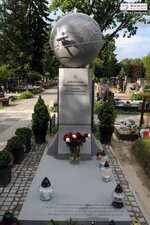
Могила космонавта расположена возле Мемориала "Слава польским лётчикам!". On 21 December 2022, in Warsaw, the capital of Poland, a requiem Mass for Mirosław Hermaszewski, the first Polish cosmonaut, who passed away on 12 December 2022, was celebrated at the Field Cathedral of the Polish Armed Forces. The Mass was conducted in full accordance with military ceremonial traditions.
In front of the altar stood a closed coffin placed on a catafalque, with the deceased general's peaked cap resting on top.
Representatives of all branches of the Polish Armed Forces, as well as military veterans, took turns standing guard of honor beside the coffin.
The cathedral was filled almost to capacity. Among those attending the farewell ceremony were members of the deceased's family, including his daughter and his son-in-law, Member of the European Parliament Ryszard Czarnecki, as well as numerous senior military commanders of the Polish Armed Forces.
After the Mass, the coffin containing the body of Mirosław Hermaszewski was carried out of the cathedral and placed into a hearse. The funeral procession then proceeded to the Powązki Military Cemetery, where the burial of Poland's first cosmonaut took place.
The funeral ceremony was led by the Military Bishop of the Polish Armed Forces, Wiesław Lechowicz.
A large number of people attended the funeral, including active-duty service members, veterans of the Polish Armed Forces, residents of Warsaw, relatives, friends, acquaintances, and colleagues of the deceased.
After the final handfuls of earth were cast, the coffin containing Mirosław Hermaszewski's body was lowered into the grave. The grave had initially been covered by a wooden lattice on which numerous wreaths were placed, sent by family members, friends, colleagues, and the highest authorities of Poland.
At the moment of burial, four fighter aircraft flew over the cemetery.
At the conclusion of the funeral ceremony, representatives of various branches of the Polish Armed Forces and public organizations marched past the grave, paying their final military honors to Poland's first cosmonaut. The cosmonaut's grave is located near the memorial "Glory to Polish Aviators!". El 21 de diciembre de 2022, en Varsovia, capital de Polonia, se celebró una misa funeral por Mirosław Hermaszewski, primer cosmonauta polaco, fallecido el 12 de diciembre de 2022, en la Catedral Castrense de las Fuerzas Armadas de Polonia. La misa se desarrolló de acuerdo con todas las normas ceremoniales militares.
Delante del altar se encontraba un féretro cerrado colocado sobre un catafalco, con la gorra de general del difunto reposando sobre él.
Representantes de todas las ramas de las Fuerzas Armadas de Polonia, así como veteranos del ejército, montaron guardia de honor junto al féretro por turnos.
La catedral estaba prácticamente llena. Entre los asistentes al último adiós al general se encontraban los familiares del fallecido, incluida su hija y su yerno, el eurodiputado Ryszard Czarnecki, así como numerosos altos mandos de las Fuerzas Armadas polacas.
Al finalizar la misa, el féretro con el cuerpo de Mirosław Hermaszewski fue trasladado fuera de la catedral y colocado en un coche fúnebre. Posteriormente, el cortejo fúnebre se dirigió al Cementerio Militar de Powązki, donde tuvo lugar el entierro del primer cosmonauta de Polonia.
La ceremonia fúnebre fue presidida por el obispo castrense de las Fuerzas Armadas de Polonia, Wiesław Lechowicz.
Al funeral asistieron numerosas personas: militares en servicio activo, veteranos de las Fuerzas Armadas polacas, habitantes de Varsovia, familiares, amigos, conocidos y colegas del difunto.
Tras arrojarse los últimos puñados de tierra, el féretro con el cuerpo de Mirosław Hermaszewski fue descendido a la tumba. Inicialmente, la sepultura estaba cubierta por una estructura de madera sobre la que se colocaron numerosas coronas funerarias enviadas por familiares, amigos, colegas y las más altas autoridades de Polonia.
En el momento del entierro, cuatro aviones de combate sobrevolaron el cementerio.
Al final de la ceremonia, representantes de las distintas ramas de las Fuerzas Armadas de Polonia y de organizaciones públicas desfilaron ante la tumba para rendir los últimos honores militares al primer cosmonauta polaco. La tumba del cosmonauta se encuentra junto al monumento conmemorativo «¡Gloria a los aviadores polacos!».
Республика Польша, г. Варшава, Воинское кладбище в городском районе Повонзки. Надгробие на могиле Мирослава Гермашевского (общий вид надгробия). Republic of Poland, Warsaw, Military Cemetery in the Powązki district.
Tombstone at the grave of Mirosław Hermaszewski (general view). República de Polonia, Varsovia, Cementerio Militar en el distrito de Powązki.
Lápida en la tumba de Mirosław Hermaszewski (vista general).
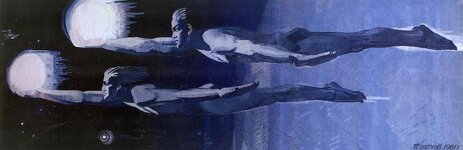
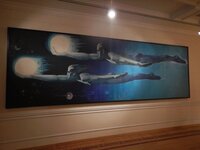
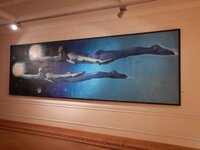
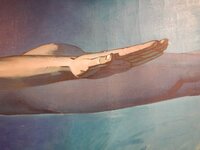
Особое место в коллекции Азербайджанского национального музея искусств занимает всемирно известное произвдение «Тебе, человечество!» народного художника Азербайджана Таира Салахова (1928-2021). Это монументальное полотно отражает удивительный талант Таира Салахова раскрывать суть не только своей эпохи, но и событий будущего, то есть опережать время. Видный представитель «сурового стиля», Таир Салахов представил публике эту работу 12 апреля 1961 года на республиканской художественной выставке в Баку. Две человеческие фигуры, летящие в голубом небе, были восприняты как романтический гимн храбрости Юрия Гагарина и вызвали широкий резонанс в обществе. На полотне отражено грандиозное торжество человеческого интеллекта – первый полет в космос, покорение Вселенной. Сам художник рассказывал о создании этой работы так: «Однажды, в 1959 году, за два года до первого полета человека в космос, я вдруг проснулся среди ночи и набросал эскиз: мужчина и женщина с античными ликами летят меж пылающих звезд в космическом пространстве. Вскоре я перенес этот эскиз на холст. А показал эту работу как раз на выставке, открывшейся в день полета Юрия Гагарина в космос». A special place in the collection of the Azerbaijan National Museum of Art is occupied by the world-famous painting “To You, Humanity!” by the People's Artist of Azerbaijan, Tahir Salahov (1928–2021). This monumental work reflects Tahir Salahov's remarkable talent for revealing the essence not only of his own era but also of future events, in other words, for being ahead of his time. A prominent representative of the “Severe Style” movement, Tahir Salahov presented this work to the public on April 12, 1961, at the Republican Art Exhibition in Baku. The two human figures soaring through the blue sky were perceived as a romantic hymn to the courage of Yuri Gagarin and caused a wide public response.
The painting depicts the grand triumph of human intellect—the first flight into space and humanity's conquest of the Universe.
The artist himself described the creation of this work as follows: “One day in 1959, two years before the first human flight into space, I suddenly woke up in the middle of the night and sketched an image: a man and a woman with classical features flying among blazing stars in outer space. Soon afterward, I transferred this sketch onto canvas. I happened to exhibit the work at the exhibition that opened on the very day of Yuri Gagarin's flight into space.” Un lugar especial en la colección del Museo Nacional de Arte de Azerbaiyán lo ocupa la obra mundialmente conocida «¡A ti, Humanidad!» del Artista del Pueblo de Azerbaiyán, Tahir Salahov (1928–2021). Este lienzo monumental refleja el extraordinario talento de Tahir Salahov para revelar la esencia no solo de su propia época, sino también de acontecimientos futuros; es decir, para adelantarse a su tiempo. Destacado representante del movimiento artístico conocido como «estilo severo», Tahir Salahov presentó esta obra al público el 12 de abril de 1961 en la Exposición Republicana de Arte celebrada en Bakú. Las dos figuras humanas que vuelan por el cielo azul fueron percibidas como un himno romántico al valor de Yuri Gagarin y suscitaron una amplia resonancia en la sociedad.
El lienzo refleja el grandioso triunfo de la inteligencia humana: el primer vuelo al espacio y la conquista del Universo por parte de la humanidad.
El propio artista relató así la creación de esta obra: «Un día de 1959, dos años antes del primer vuelo humano al espacio, me desperté de repente en mitad de la noche y realicé un boceto: un hombre y una mujer con rasgos clásicos volaban entre estrellas ardientes en el espacio cósmico. Poco después trasladé ese boceto al lienzo. Y presenté precisamente esta obra en la exposición que se inauguró el mismo día del vuelo de Yuri Gagarin al espacio».
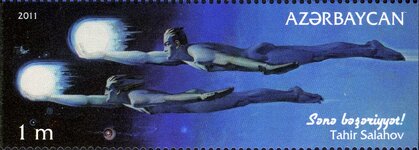
Картина Тахира Салахова «Тебе, человечество!» (1961), воспроизведённая на марке Азербайджана в 2011 году в годовщину 50-летия первого полёта в космос Юрия Гагарина. 12 апреля 2011 года в Азербайджане появился почтовый блок «50 годовщина первого полёта человека в космос». Блок включает три марки, на центральной почтовой миниатюре фантастический рисунок – обнажённые мужчина и женщина летят среди звёзд, держа в руках светящиеся шары, символизирующие «свет будущего».
На марке воспроизведена картина азербайджанского художника Тахира Салахова «Тебе, человечество!», созданная в 1961 году.
Первые эскизы картины датированы 1959 годом. По стечению обстоятельств картина показана впервые 12 апреля 1961 года, в день полёта Юрия Гагарина в космос.
В журнале «Техника – молодёжи» эту картину назвали «Двое», репродукция была помещена на обложку журнала за февраль 1974 года. Ленинградец Андрей Надиров посвятил этой картине стихи, кончающиеся строками: "Когда Ромео и Джульетта // Нам дарят изначальный свет, // И в галактическом прибое, // Где нет ни бездны, ни высот, // Всегда вершина мира – ДВОЕ, // Чья жизнь – грядущую несет.".
Картина «Тебе, человечество!» долгое время хранилась в запасниках, только в 2008 году она была вновь показана широкой общественности. Это произошло на Венецианском биеннале. После этого картина демонстрировалась в Москве, а сейчас находится в собрании Азербайджанского музея искусств. 50th Anniversary of the First Manned Space Flight. Painting by Takhir Salakhov "For You, Humanity!" (1961), reproduced on the stamp of Azerbaijan in 2011 on the 50th anniversary of Yuri Gagarin's first flight into space.
On April 12, 2011, a postal block "50th anniversary of the first manned space flight" appeared in Azerbaijan. The block includes three stamps, on the central postage miniature there is a fantastic drawing - a naked man and woman flying among the stars, holding glowing balls symbolizing the "light of the future" in their hands.
The stamp reproduces the picture of the Azerbaijani artist Tahir Salakhov "For You, Humanity!", created in 1961.
The first sketches of the painting are dated 1959. By coincidence, the picture was shown for the first time on April 12, 1961, on the day of Yuri Gagarin's flight into space.
In the Soviet magazine "Technics - Youth" this picture was called "Two", the reproduction was placed on the cover of the magazine for February 1974. Leningrader Andrei Nadirov dedicated poems to this picture, ending with lines: "When Romeo and Juliet // We are given the primordial light, // And in the galactic surf, // Where there is no abyss, no heights, // Always the top of the world - TWO, // Whose life - the coming one. "
Painting "For You, Humanity!" for a long time it was kept in storerooms, only in 2008 it was shown again to the general public. It happened at the Venice Biennale.
After that, the picture was shown in Moscow, and now it is in the collection of the Azerbaijan Art Museum. La pintura de Tahir Salahov, "¡A ti, Humanidad!" (1961), fue reproducida en un sello azerbaiyano en 2011 para conmemorar el 50.º aniversario del primer vuelo espacial de Yuri Gagarin.
El 12 de abril de 2011, Azerbaiyán emitió una hoja conmemorativa del "50.º aniversario del primer vuelo espacial tripulado". La hoja incluía tres sellos; el sello central presentaba una imagen fantástica de un hombre y una mujer desnudos volando entre las estrellas, sosteniendo esferas luminosas que simbolizaban la "luz del futuro".
El sello reproduce la pintura "¡A ti, Humanidad!" del artista azerbaiyano Tahir Salahov, creada en 1961.
Los primeros bocetos de la pintura datan de 1959. Casualmente, la pintura se exhibió por primera vez el 12 de abril de 1961, el día del vuelo espacial de Yuri Gagarin.
La revista «Tecnología para la Juventud» tituló esta pintura «Dos», y una reproducción apareció en la portada de su número de febrero de 1974. Andrei Nadirov, de Leningrado, le dedicó un poema que terminaba con los versos: «Cuando Romeo y Julieta // nos dan la luz primordial, // y en la ola galáctica, // donde no hay ni abismo ni alturas, // la cúspide del mundo es siempre DOS, // cuya vida trae el futuro».
La pintura «¡A ti, Humanidad!» permaneció almacenada durante mucho tiempo; no fue hasta 2008 que se volvió a mostrar al público en general. Esto ocurrió en la Bienal de Venecia. Posteriormente, la pintura se exhibió en Moscú y actualmente forma parte de la colección del Museo de Arte de Azerbaiyán.
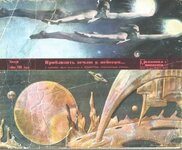
4-я страница обложки журнала "Техника - молодежи" №2; 1974 год. В верхней части обложки картина Тахира Салахова «Тебе, человечество!» (1961).
В нижней части обложки картина А. Бурмистрова "Первопроходцы космоса". Page 4 of the cover of the magazine "Technology for Youth" No. 2, 1974. At the top of the cover is Tahir Salakhov's painting "To You, Humanity!" (1961). At the bottom of the cover is A. Burmistrov's painting "Space Pioneers." Página 4 de la portada de la revista «Tecnología para la Juventud», n.º 2, 1974. En la parte superior de la portada se encuentra la pintura de Tahir Salakhov, «¡A ti, humanidad!» (1961). En la parte inferior de la portada se encuentra la pintura de A. Burmistrov, «Pioneros del espacio».
На XXIV Международном астронавтическом конгрессе в городе Баку журнал «Техника — молодежи» по просьбе Академии наук СССР развернул выставку научно-фантастических картин и рисунков о космических исследованиях в будущем. Это часть работ, присланных на международный конкурс журнала «Мир 2000 года». На открытии выставки «Космос завтрашнего дня» перед советскими и зарубежными корреспондентами выступили заместитель председателя Совета Министров Азербайджанской ССР И. Ибрагимов, министр культуры Азербайджанской ССР З. Багиров, Р. Аскеров, летчик-космонавт Герой Советского Союза В. Севастьянов, первый секретарь Союза художников СССР Т. Салахов, председатель организационного комитета конгресса академик Л. Седов, художник-фантаст А. Соколов.
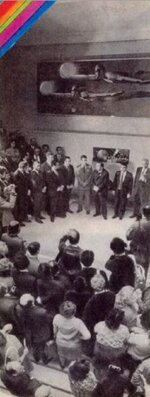
Выставка «Космос завтрашнего дня» пользовалась большим успехом среди участников и гостей конгресса, получила широкий общественный резонанс. Более полутора тысяч посетителей оставили свои записи в книге отзывов. На снимке: Открытие международной выставки научно-фантастических рисунков «Космос завтрашнего дня». At the 24th International Astronautical Congress in Baku, the magazine "Technology for Youth," at the request of the USSR Academy of Sciences, mounted an exhibition of science fiction paintings and drawings about future space exploration. This was part of the work submitted to the international competition of the magazine "World 2000." At the opening of the "Space of Tomorrow" exhibition, Soviet and foreign correspondents were addressed by Deputy Chairman of the Council of Ministers of the Azerbaijan SSR I. Ibragimov, Minister of Culture of the Azerbaijan SSR Z. Bagirov, R. Askerov, pilot-cosmonaut and Hero of the Soviet Union V. Sevastyanov, First Secretary of the Union of Artists of the USSR T. Salakhov, Chairman of the Congress Organizing Committee Academician L. Sedov, and science fiction artist A. Sokolov. The "Space of Tomorrow" exhibition was a great success among congress participants and guests, and received a wide public response. More than 1,500 visitors left their comments in the guest book.
Pictured: Opening of the international exhibition of science fiction drawings "Space of Tomorrow". En el XXIV Congreso Internacional de Astronáutica celebrado en Bakú, la revista «Tecnología para la Juventud», a petición de la Academia de Ciencias de la URSS, organizó una exposición de pinturas y dibujos de ciencia ficción sobre la exploración espacial del futuro. Esta exposición formaba parte de los trabajos presentados al concurso internacional de la revista «Mundo 2000». En la inauguración de la exposición «El Espacio del Mañana», se dirigieron a los corresponsales soviéticos y extranjeros el Vicepresidente del Consejo de Ministros de la RSS de Azerbaiyán, I. Ibragimov; el Ministro de Cultura de la RSS de Azerbaiyán, Z. Bagirov; R. Askerov; el piloto cosmonauta y Héroe de la Unión Soviética, V. Sevastyanov; el Primer Secretario de la Unión de Artistas de la URSS, T. Salakhov; el Presidente del Comité Organizador del Congreso, el académico L. Sedov; y el artista de ciencia ficción A. Sokolov.
La exposición «El Espacio del Mañana» fue un gran éxito entre los participantes e invitados del congreso y recibió una amplia acogida por parte del público. Más de 1500 visitantes dejaron sus comentarios en el libro de visitas.
En la imagen: Inauguración de la exposición internacional de dibujos de ciencia ficción "El espacio del mañana"
Своими впечатлениями о выставке «Космос завтрашнего дня» делится известный американский художник, главный редактор журнала «Леонардо» Фрэнк МАЛИНА. "Здесь, на выставке в Баку, оценивая творения моих собратьев — художников-фантастов, беседуя с восторженными, скептически настроенными, потрясенными посетителями, я не раз задавался вопросом: каковы пути и возможности изобразительных искусств в эпоху освоения околоземных просторов? Древняя мечта человека обрести крылья, летать в воздухе осуществилась, как известно, в начале нынешнего века. Естественно, развитие авиации повлияло и на зрительное восприятие художников. Некоторые из них пытались создать на холстах впечатление быстрого движения тел, пользуясь обычными приемами живописи. Другие разрабатывали так называемое «кинетическое» искусство, создающее у зрителя ощущение реального движения во времени. Третьи как бы вводили в свои произведения «авиационные» сюжеты: так рождались пейзажи, напоминающие просторы матушки Земли, наблюдаемые с борта летящего самолета. Но в общем-то я бы не сказал, что искусство эпохи воздухоплавания можно было сравнить — с точки зрения эстетики — с достижениями классической живописи.
Что же нового привнесла (или привнесет) в искусство астронавтика, чем обогатят его новые представления о Земле и вселенной?
Для большинства из нас первый полет в самолете — переживание более острое, нежели первая поездка верхом на лошади или в автомобиле. А первый космический полет вызывает еще более сильные ощущения.
Искусство «космического века» вплоть до недавнего времени носило характер иллюстрирования пейзажей других планет на основании либо скупых астрономических сведений, либо научно-фантастических домыслов; встречались и сюжеты, взятые из космической технологии. Советский космонавт Алексей Леонов сделал несколько замечательных зарисовок Земли, видимой из космоса, — и сразу стало ясно, что действительность может быть намного прекрасней и неожиданней воображаемого. Именно творчество Алексея Леонова и его соавтора Андрея Соколова навело меня на мысль разнообразить свои творческие приемы. Так, к примеру, я начал вводить в кинетические картины и композиции изображения космических траекторий и орбит, хотя и реальных, но невидимых как для человека, так и для его приборов.
Выход представителя земной цивилизации в космическое пространство можно сравнивать по своему значению с переходом наших предков с дерева на землю. Психологические и философские последствия этого выхода для будущего развития человечества могут быть огромными. Впервые в истории человек получил возможность наблюдать самого себя в чуждой ему среде, которая простирается бесконечно во все стороны мира. Обживая эту среду, он должен заботиться не только о запасах воздуха и пищи, но и о том, чтобы не угас в нем прометеев огонь творчества. Какие полотна будут висеть на стенах космических кораблей, бороздящих эфирные волны? Что увидят наши дети (а может быть, и мы?) в картинной галерее на Луне или на Марсе? Вопросы далеко не праздные. Ибо там, в небе, законы восприятия разительно отличаются от земных.
Представим себя, например, на Луне. Там нет атмосферы и, стало быть, нет рассеяния света. Небо кажется черным, а звезды и планеты видны всегда. Тени тоже совершенно черные. Оценивать расстояние на Луне труднее, чем на Земле, смотреть на Солнце или на отражающие его лучи полированные поверхности опасно. Очевидно, живописцу здесь легче всего будет создавать гравюры.
Зато возможностям скульптора на Луне позавидуешь! Тут можно без заметных усилий сооружать памятники под стать египетским пирамидам, . притом практически вечные! Кинетические объекты, движимые ветром, на Луне невозможны, но энергия солнечного света в вакууме заставит двигаться кинетические скульптуры. Какой они будут формы? В какие цвета окрашены? Засияют ли фосфоресцирующим светом или будут подсвечены изнутри? На эти и другие бесчисленные вопросы ответит недалекое будущее. Но уже сейчас убежден: результаты, полученные на нынешней стадии выхода человека в космос, заслуживают бóльшего внимания со стороны мастеров, работающих в области изобразительного искусства. Выставка «Мир 2000 года» — залог того, что искусство не стоит на месте , что оно вечно в движении, что спектр земных красок раздвигается в космические пределы. Удачи вам и вдохновения, собратья-живописцы!"
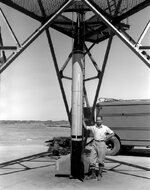
На фото:Френк Малина с ракетой Wac Corporal. The renowned American artist and editor-in-chief of the journal Leonardo, Frank Malina, shares his impressions of the exhibition “The Cosmos of Tomorrow”. “Here in Baku, while visiting this exhibition, contemplating the works of my fellow visionary artists, and speaking with enthusiastic, skeptical, and deeply impressed visitors, I repeatedly asked myself: what are the paths and possibilities of the visual arts in the age of humanity's expansion into near-Earth space?
Humanity’s ancient dream of gaining wings and flying through the air was realized, as we know, at the beginning of this century. Naturally, the development of aviation influenced the visual perception of artists. Some attempted to convey the impression of rapid motion on canvas using traditional painting techniques. Others developed the so-called ‘kinetic art,’ creating in the viewer a sensation of real movement through time. Still others introduced aviation themes into their works, giving rise to landscapes reminiscent of the vast expanses of Mother Earth as seen from an aircraft in flight.
Yet, generally speaking, I would not say that the art of the aviation era could, from an aesthetic standpoint, be compared with the achievements of classical painting.
What, then, has astronautics brought—or will bring—to art? How will new perceptions of Earth and the universe enrich it?
For most of us, our first airplane flight is a more profound experience than our first ride on horseback or in an automobile. A first journey into space evokes even stronger emotions.
Until recently, the art of the Space Age largely consisted of illustrating landscapes of other planets based either on limited astronomical data or on the imagination of science fiction. Subjects drawn from space technology also appeared. Soviet cosmonaut Alexei Leonov created several remarkable sketches of Earth as seen from space, and it immediately became clear that reality can be far more beautiful and unexpected than imagination.
It was precisely the work of Alexei Leonov and his collaborator Andrei Sokolov that inspired me to diversify my own artistic methods. For example, I began introducing images of space trajectories and orbital paths into my kinetic paintings and compositions—real trajectories, though invisible both to human beings and to their instruments.
The entry of a representative of Earth’s civilization into outer space can be compared in significance to the moment when our ancestors descended from the trees and set foot upon the ground. The psychological and philosophical consequences of this step for the future development of humanity may be enormous.
For the first time in history, human beings have gained the opportunity to observe themselves within an environment alien to them—an environment stretching infinitely in every direction. As humanity settles into this environment, it must care not only for supplies of air and food, but also ensure that the Promethean fire of creativity does not fade.
What paintings will hang on the walls of spacecraft sailing through the cosmic ocean? What will our children—and perhaps even we ourselves—see in art galleries on the Moon or on Mars? These are far from idle questions, for the laws of perception there differ dramatically from those on Earth.
Imagine ourselves on the Moon. There is no atmosphere and therefore no scattering of light. The sky appears black, while stars and planets remain visible at all times. Shadows are completely black as well. Estimating distances is more difficult than on Earth, and looking directly at the Sun or at polished surfaces reflecting its rays can be dangerous. It seems likely that engraving would become one of the most suitable forms of artistic expression there.
Sculptors, however, would have much to envy on the Moon. Monuments rivaling the Egyptian pyramids could be erected with relatively little effort and would be virtually eternal. Wind-driven kinetic objects would be impossible there, but sunlight in a vacuum could set kinetic sculptures into motion.
What shapes would they take? What colors would they display? Would they glow with phosphorescent light, or be illuminated from within? The near future will answer these and countless other questions.
Yet even now I am convinced that the results achieved during the present stage of humanity’s expansion into space deserve far greater attention from artists working in the visual arts.
The exhibition ‘The World of the Year 2000’ is proof that art does not stand still, that it is eternally in motion, and that the spectrum of earthly colors is expanding into cosmic dimensions.
I wish you success and inspiration, fellow artists!” Photo: Frank Malina with a WAC Corporal rocket. El reconocido artista estadounidense y redactor jefe de la revista Leonardo, Frank Malina, comparte sus impresiones sobre la exposición “El Cosmos del Mañana”. «Aquí, en esta exposición de Bakú, contemplando las obras de mis colegas artistas visionarios y conversando con visitantes entusiastas, escépticos y profundamente impresionados, me he preguntado en numerosas ocasiones: ¿cuáles son los caminos y las posibilidades de las artes visuales en la era de la exploración del espacio cercano a la Tierra?
El antiguo sueño de la humanidad de tener alas y volar por el aire se hizo realidad, como sabemos, a comienzos de este siglo. Naturalmente, el desarrollo de la aviación influyó también en la percepción visual de los artistas. Algunos intentaron transmitir en sus lienzos la sensación del movimiento rápido utilizando los recursos tradicionales de la pintura. Otros desarrollaron el llamado “arte cinético”, capaz de crear en el espectador la sensación de un movimiento real en el tiempo. Otros incorporaron temas aeronáuticos a sus obras, dando origen a paisajes que evocaban las vastas extensiones de la Madre Tierra vistas desde un avión en vuelo.
Sin embargo, en términos generales, no diría que el arte de la era de la aviación pudiera compararse, desde el punto de vista estético, con los logros de la pintura clásica.
¿Qué ha aportado —o aportará— la astronáutica al arte? ¿Cómo lo enriquecerán las nuevas concepciones de la Tierra y del universo?
Para la mayoría de nosotros, el primer vuelo en avión constituye una experiencia más intensa que el primer paseo a caballo o el primer viaje en automóvil. Un primer vuelo espacial provoca emociones aún más profundas.
Hasta hace poco, el arte de la Era Espacial consistía principalmente en ilustrar paisajes de otros planetas basándose en escasos datos astronómicos o en especulaciones de la ciencia ficción. También aparecían temas inspirados en la tecnología espacial. El cosmonauta soviético Alexéi Leónov realizó varios extraordinarios bocetos de la Tierra vista desde el espacio, y de inmediato quedó claro que la realidad puede ser mucho más hermosa e inesperada que la imaginación.
Precisamente la obra de Alexéi Leónov y de su colaborador Andréi Sokolov me inspiró a diversificar mis propios recursos artísticos. Así, por ejemplo, comencé a introducir en mis pinturas y composiciones cinéticas imágenes de trayectorias espaciales y órbitas; trayectorias reales, aunque invisibles tanto para el ser humano como para sus instrumentos.
La salida de un representante de la civilización terrestre al espacio puede compararse, por su importancia, con el momento en que nuestros antepasados descendieron de los árboles y comenzaron a caminar sobre la tierra. Las consecuencias psicológicas y filosóficas de este paso para el futuro de la humanidad pueden ser enormes.
Por primera vez en la historia, el ser humano ha obtenido la posibilidad de observarse a sí mismo en un entorno extraño para él, un entorno que se extiende infinitamente en todas las direcciones. Al habitar este medio, deberá preocuparse no solo por las reservas de aire y alimentos, sino también por mantener viva la llama prometeica de la creatividad.
¿Qué cuadros colgarán de las paredes de las naves espaciales que surquen el océano cósmico? ¿Qué verán nuestros hijos —y quizá nosotros mismos— en las galerías de arte de la Luna o de Marte? Estas preguntas están lejos de ser triviales, pues allí las leyes de la percepción difieren profundamente de las terrestres.
Imaginémonos, por ejemplo, en la Luna. Allí no existe atmósfera y, por lo tanto, tampoco dispersión de la luz. El cielo parece negro, mientras que las estrellas y los planetas permanecen visibles en todo momento. Las sombras son completamente negras. Calcular las distancias resulta más difícil que en la Tierra, y mirar directamente al Sol o a superficies pulidas que reflejen sus rayos puede ser peligroso. Es probable que el grabado se convierta allí en una de las formas artísticas más adecuadas.
En cambio, las posibilidades para los escultores serían extraordinarias. En la Luna podrían levantarse monumentos comparables a las pirámides egipcias con relativamente poco esfuerzo y serían prácticamente eternos. Los objetos cinéticos movidos por el viento serían imposibles, pero la energía de la luz solar en el vacío podría poner en movimiento esculturas cinéticas.
¿Qué formas tendrían? ¿De qué colores serían? ¿Brillarían con luz fosforescente o estarían iluminadas desde su interior? El futuro próximo responderá a estas y a innumerables preguntas más.
Pero ya hoy estoy convencido de que los resultados obtenidos en esta etapa de la expansión humana hacia el espacio merecen una atención mucho mayor por parte de los artistas que trabajan en las artes visuales.
La exposición “El Mundo del Año 2000” demuestra que el arte no permanece inmóvil, que está eternamente en movimiento y que el espectro de los colores terrestres se expande hacia las dimensiones del cosmos.
¡Les deseo éxito e inspiración, colegas artistas!» En la fotografía: Frank Malina junto al cohete WAC Corporal.
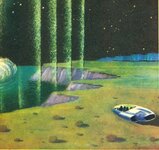
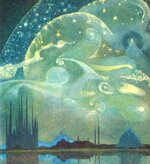
Картина с выставки «Космос завтрашнего дня». Художник В. БОСЕНКО (Москва). «Загадка Титана». A painting from the exhibition "Space of Tomorrow." Artist V. BOSENKO (Moscow). "The Riddle of Titan." Un cuadro de la exposición "El espacio del mañana". Artista: V. BOSENKO (Moscú). "El enigma de Titán".
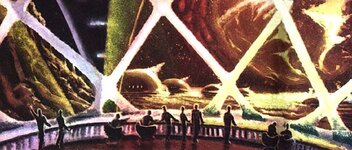
Картина с выставки «Космос завтрашнего дня». Художник П. ФАТЕЕВ (Москва). «Звездный город». A painting from the exhibition "Space of Tomorrow." Artist P. FATEEV (Moscow). "Star City." Un cuadro de la exposición "Espacio del Mañana". Artista: P. FATEEV (Moscú). "Ciudad de las Estrellas".
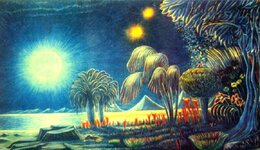
Картина с выставки «Космос завтрашнего дня». ХудожникГ. КУРНИН (г. Сочи). «Внеземная флора». A painting from the exhibition "Space of Tomorrow." Artist G. KURNIN (Sochi). "Extraterrestrial Flora.". Un cuadro de la exposición "Espacio del Mañana". Artista: G. KURNIN (Sochi). "Flora extraterrestre".
Картина с выставки «Космос завтрашнего дня». ХудожникГ. ТИЩЕНКО (Баку). «Обсерватория в космосе». A painting from the exhibition "Space of Tomorrow." Artist G. TISHCHENKO (Baku). "Observatory in Space." Una pintura de la exposición "Espacio del Mañana". Artista: G. TISHCHENKO (Bakú). "Observatorio en el espacio".
This site uses cookies to help personalise content, tailor your experience and to keep you logged in if you register.
By continuing to use this site, you are consenting to our use of cookies.