Updates ExoMars News & Updates

Title ExoMars PanCam filters
Released 27/05/2019 9:00 am
Copyright M. de la Nougerede, UCL/MSSL
Description
This may look like a collection of colourful contact lenses and in some respects there are some similarities: these are the filters through which the ExoMars rover – Rosalind Franklin – will view Mars in visible and near infrared wavelengths

http://www.esa.int/spaceinimages/Images/2019/05/ExoMars_PanCam_filters

https://www.liebertpub.com/doi/10.1089/ast.2016.1548
 
Last edited:
30 May 2019
On 15 June, the ESA-Roscosmos ExoMars Trace Gas Orbiter (TGO) will follow a different path. An ‘Inclination Change Manoeuvre’ will put the spacecraft in an altered orbit, enabling it to pick up crucial status signals from the ExoMars rover, Rosalind Franklin, due to land on the Red Planet in 2021.
After completing a complex series of manoeuvres during 2017, ExoMars TGO is now orbiting the Red Planet every two hours, collecting scientific data from NASA’s surface-bound rover and lander, and relaying it back to Earth. At the same time, the orbiter is gathering its own data on the planet’s atmosphere, water abundance and alien surface.

http://www.esa.int/Our_Activities/Operations/ExoMars_orbiter_prepares_for_Rosalind_Franklin
 
Title Fly over the ExoMars 2020 landing site
Released: 16/09/2019
Length 00:01:09
Language English
Footage Type Animation
Copyright TU Dortmund/NASA JPL-Caltech
Description
Scientists at TU Dortmund University are generating high-accuracy 3D models of the terrain in Oxia Planum on Mars, ahead of the arrival of the ESA/Roscosmos ExoMars rover, Rosalind Franklin, in 2021. The Digital Terrain Models (DTMs) have a resolution of about 25 cm per pixel and will help scientists to understand the geography and geological characteristics of the region and to plan the path of the rover around the site.

www.esa.int/spaceinvideos/Videos/2019/09/Fly_over_the_ExoMars_2020_landing_site
 
15 October 2019
Positive steps towards solving the problems discovered with the ExoMars mission parachutes have been taken in the last month to keep on track for the July-August 2020 launch window.
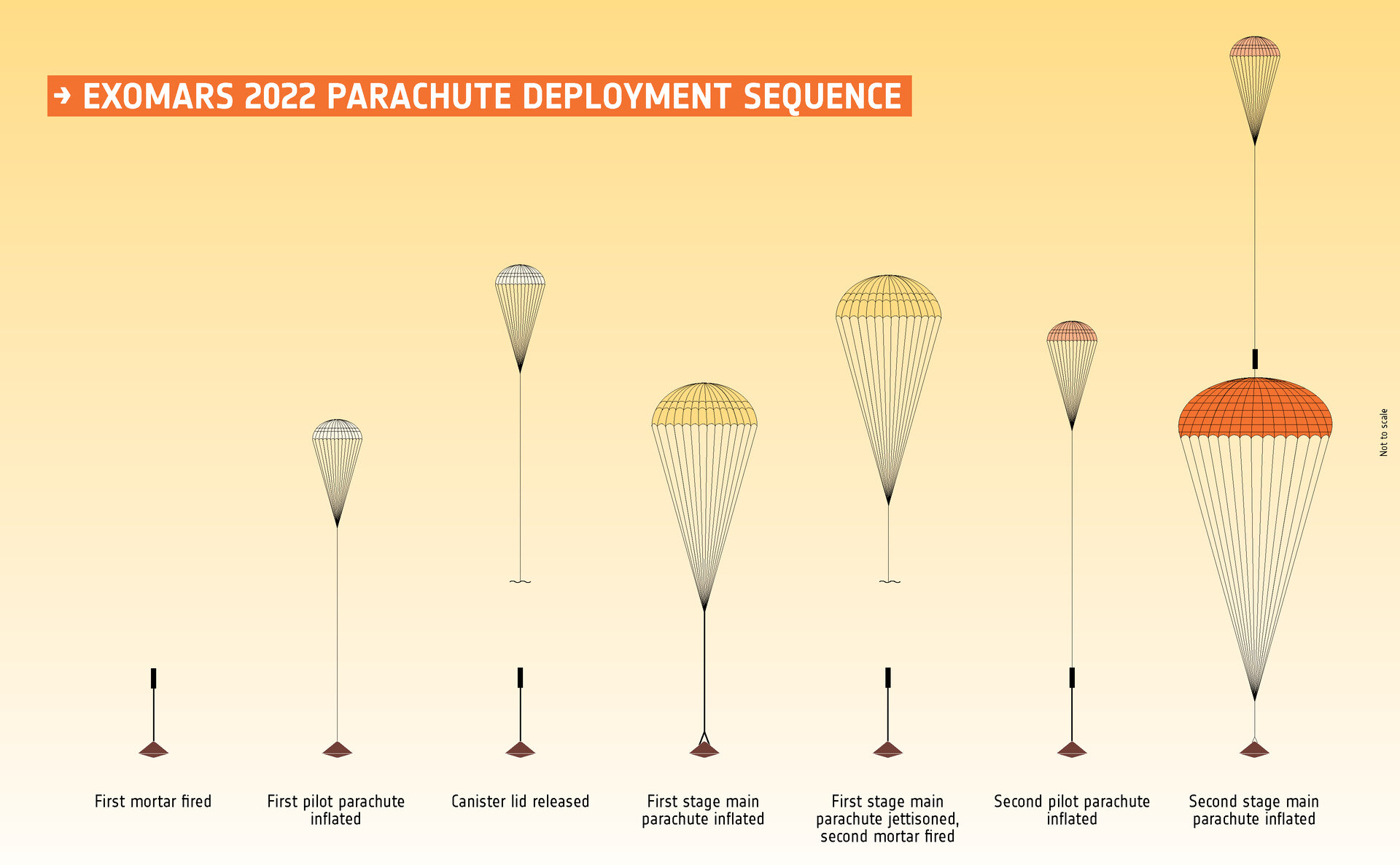
The mission needs two parachutes – each with its own pilot chute for extraction – to help slow the descent module prior to landing on Mars. Once the atmospheric drag has slowed the descent module from around 21 000 km/h to 1700 km/h, the first parachute will be deployed. Some 20 seconds later, at about 400 km/h, the second parachute will open. Following separation of the parachutes about 1 km above ground the braking engines will kick in to safely deliver a landing platform – with a rover encapsulated inside – onto the surface of Mars for its scientific mission. The entire sequence from atmospheric entry to landing takes just six minutes.

http://www.esa.int/Science_Explorat...xploration/ExoMars/ExoMars_parachute_progress
 
Ozone is a pretty big surprise since its existence is generally considered a marker for possible oxygen producing chemical reactions - especially plant life.

But before we get too excited there: Did somebody start the reactor?
 
 
ESA announced the readiness of the rover for the Russian-European mission
 
Well, the official ESA statement can maybe better summarized as:

We'll fight the powers that be just, don't pick our destiny 'cause you don't know us, you don't belong. We're not gonna take it. Oh no, we ain't gonna take it. We're not gonna take it anymore. Oh, you're so condescending, your gall is never ending. We don't want nothin', not a thing from you. Your life is trite and jaded, boring and confiscated. If that's your best, your best won't do.

 
Zhurong's landing strategy is almost identical to the planned landing of Rosalind Franklin, so they might collaborate on either of the two space agencies since currently CNSA are OK with both ESA and Roscosmos
 
frame from a boring video about scientific work
45454.jpg
 
Back
Top