Updates ESA LISA Pathfinder mission updates

http://www.esa.int/Our_Activities/Space_Science/LISA_Pathfinder_exceeds_expectations

June 2016
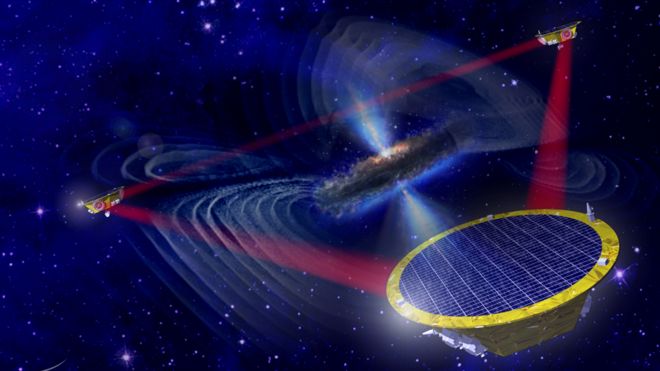
ESA’s LISA Pathfinder mission has demonstrated the technology needed to build a space-based gravitational wave observatory.

Results from only two months of science operations show that the two cubes at the heart of the spacecraft are falling freely through space under the influence of gravity alone, unperturbed by other external forces, to a precision more than five times better than originally required.
Briefing should have started by now, ut nothing:
http://www.esa.int/Our_Activities/Space_Science/Watch_LISA_Pathfinder_briefing

Been and gone...missed it!
 
Last edited:
BBC Article on the recent news:

http://www.bbc.co.uk/news/science-environment-36472434

A cutaway impression of the laser interferometer system inside Lisa Pathfinder

Nice pic. I always thought they were in a common chamber.

Building Pathfinder was a painstaking process. Its own gravity could have disturbed the experimental blocks and so the layout had to be very carefully designed so that the tugging force exerted by the onboard equipment was evenly balanced in all directions.

"Our mass log in Stevenage where we wrote down what everything weighs has 10,000 entries," said Airbus programme manager Christian Trenkel. "We are very proud of what we have achieved."

Bit of an understatement.

N.
 
Last edited:
Is this technology still necessary, given that we can now apparently detect gravitational waves with earth-based observatories?
 
Is this technology still necessary, given that we can now apparently detect gravitational waves with earth-based observatories?

No. While LIGO and LISA test for the same thing, they do so at different frequencies.
 
http://sci.esa.int/lisa-pathfinder/58006-lisa-pathfinder-completes-first-operations-phase/

LISA Pathfinder completes first operations phase

24 June 2016
On Saturday 25 June, the LISA Technology Package (LTP) – a European payload on ESA's LISA Pathfinder – completes its nominal operations phase, passing the baton to the Disturbance Reduction System, an additional experiment provided by NASA. This won't be the last time the European experiment is run – the recently approved mission extension will see the LTP back in action for seven months starting in November this year.

From 26 June, the mission will start running the Disturbance Reduction System (DRS) payload, a separate experiment contributed by the US. This experiment receives measurement input from the test masses and interferometer that are part of the LTP, but will then use its own drag-free control software and two clusters of micronewton thrusters, mounted on two opposite panels of the science module, to control the position and attitude of the spacecraft.

Based on colloidal micronewton thrusters, which generate propulsion by charging small drops of liquid and accelerating them through an electric field, the DRS experiment contributes to the mission by validating additional technology for future drag-free spacecraft.

After two weeks of commissioning, the operations phase of the DRS will last until the end of October. The LTP team will return for one week in early August to continue the long-term monitoring of their experiment and to facilitate some cross-calibration with the DRS experiment.

An extended mission, approved by ESA's Science Programme Committee at their 21-22 June meeting, will begin on 1 November, for seven months. During this period the team will further investigate the performance of the LTP at low frequencies – of particular interest in the context of a future space-based gravitational-wave observatory – as well as testing some experimental operational modes.

"Although we won't be working with our LISA Technology Package for most of the next few months while the Disturbance Reduction System experiment is running, we do have plenty of excellent data that we'll be examining in great detail," says Paul. "But there's no doubt that we'll be looking forward to seeing how far we can go with LISA Pathfinder when we start the extended mission later this year."

 
Last edited:
http://sci.esa.int/lisa-pathfinder/58633-lisa-pathfinder-s-pioneering-mission-continues/

13 December 2016
On 7 December, LISA Pathfinder started the extended phase of its mission, an additional six months during which scientists and engineers will push the experiment to its limits in preparation for ESA's future space observatory of gravitational waves.

LISA Pathfinder, a demonstration mission to validate important technologies to observe gravitational waves – fluctuations in the fabric of spacetime – from space, was launched just over a year ago, on 3 December 2015.

http://sci.esa.int/lisa-pathfinder/57869-lisa-pathfinder-performance/

At higher frequencies, between 60 mHz and 1 Hz (on the right), LISA Pathfinder's precision is limited only by the sensing noise of the optical metrology system used to monitor the position and orientation of the test masses. Nevertheless, the performance of this system has already surpassed the level of precision required by a future gravitational-wave observatory by a factor of more than 100. The cause of the spike around 70 mHz is still under investigation.

Cracking performance, looks good for the next one.
The 70mHz spike is just the alien secret-base carrier frequency.

N.
 
Last edited:
http://www.bbc.co.uk/news/science-environment-38897697

The long-planned LISA space mission to detect gravitational waves looks as though it will be green lit shortly.
Scientists working on a demonstration of its key measurement technologies say they have just beaten the sensitivity performance that will be required.  
The European Space Agency (Esa), which will operate the billion-euro mission, is now expected to "select" the project, perhaps as early as June.
The LISA venture intends to emulate the success of ground-based detectors.
 
Confirmed! Go for gravitational wave detection!

ESA:Gravitational Wave Mission Selected Planet-Hunting Mission Moves Forward

BBC News: Europe selects grand gravity mission

_85366976_lisa.jpg


20 June 2017
The LISA trio of satellites to detect gravitational waves from space has been selected as the third large-class mission in ESA’s Science programme, while the Plato exoplanet hunter moves into development.
 
Sad to see it go:

http://www.esa.int/spaceinimages/Images/2017/07/Last_command
That must be some command, presumably it was expecting it?

http://www.bbc.co.uk/news/science-environment-40644104


The commands, despatched from Esa's mission control centre in Darmstadt, Germany, tricked Pathfinder to reboot itself on to software that had already been corrupted.
It meant the gravity probe was locked down, unable to run its subsystems including its transmitter.
"The only way you could recover the spacecraft would be to go up there and attach an umbilical and restart from another computer," explained Pathfinder's spacecraft operations manager, Ian Harrison.
The kill procedure, more properly known as "passivating" the satellite, ensures there is no hazard to future missions through a collision or interference of radio communications.
 
Last edited:
http://www.esa.int/Our_Activities/Space_Science/ESA_creates_quietest_place_in_space

5 February 2018
Imagine a packed party: music is blaring and you can feel the bass vibrate in your chest, lights are flashing, balloons are falling from the ceiling and the air is filled with hundreds of separate conversations. At the same time your cell phone is vibrating in your pocket and your drink is fizzing in the glass. Now imagine you can block out this assault on your senses to create a perfectly quiet bubble around you, only letting in the unmistakable voice of your best friend who’s trying to get your attention from the other side of the room
 
Back
Top