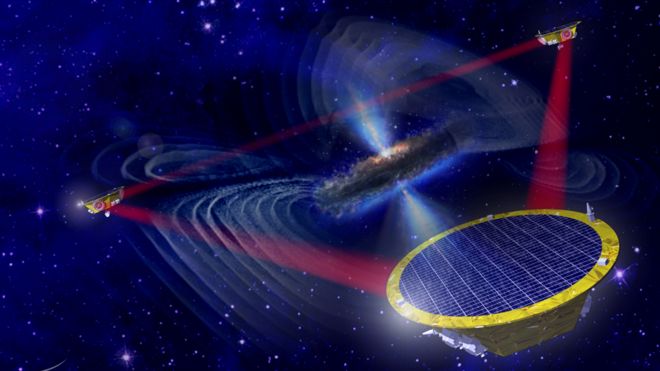
From 26 June, the mission will start running the Disturbance Reduction System (DRS) payload, a separate experiment contributed by the US. This experiment receives measurement input from the test masses and interferometer that are part of the LTP, but will then use its own drag-free control software and two clusters of micronewton thrusters, mounted on two opposite panels of the science module, to control the position and attitude of the spacecraft.
Based on colloidal micronewton thrusters, which generate propulsion by charging small drops of liquid and accelerating them through an electric field, the DRS experiment contributes to the mission by validating additional technology for future drag-free spacecraft.
After two weeks of commissioning, the operations phase of the DRS will last until the end of October. The LTP team will return for one week in early August to continue the long-term monitoring of their experiment and to facilitate some cross-calibration with the DRS experiment.
An extended mission, approved by ESA's Science Programme Committee at their 21-22 June meeting, will begin on 1 November, for seven months. During this period the team will further investigate the performance of the LTP at low frequencies – of particular interest in the context of a future space-based gravitational-wave observatory – as well as testing some experimental operational modes.
"Although we won't be working with our LISA Technology Package for most of the next few months while the Disturbance Reduction System experiment is running, we do have plenty of excellent data that we'll be examining in great detail," says Paul. "But there's no doubt that we'll be looking forward to seeing how far we can go with LISA Pathfinder when we start the extended mission later this year."