Launch phase report
Yet another long awaited universal mission left on paper for decades is about to fly!
The general relativity theory, of which its basis was published by Albert Einstein exactly one century ago, has one major prediction left untested till now - the ripples of gravitational waves caused by acceleration of objects.
Such changes in time-space is extremely minuscule - we are talking about scales of about 10^-24 meters - and so there's no way it can be detected on Earth. This must be done with multiple spacecraft that can measure the distance between them with lasers in extreme precision.
This concept, under the name of LISA (Laser Interferometry Satellite Antenna), has been floating around for years without actually reaching hardware manufacturing. No wonder, the challenges of extreme precise force measurements with every force you can imagine needed to be shielded is mountainous.
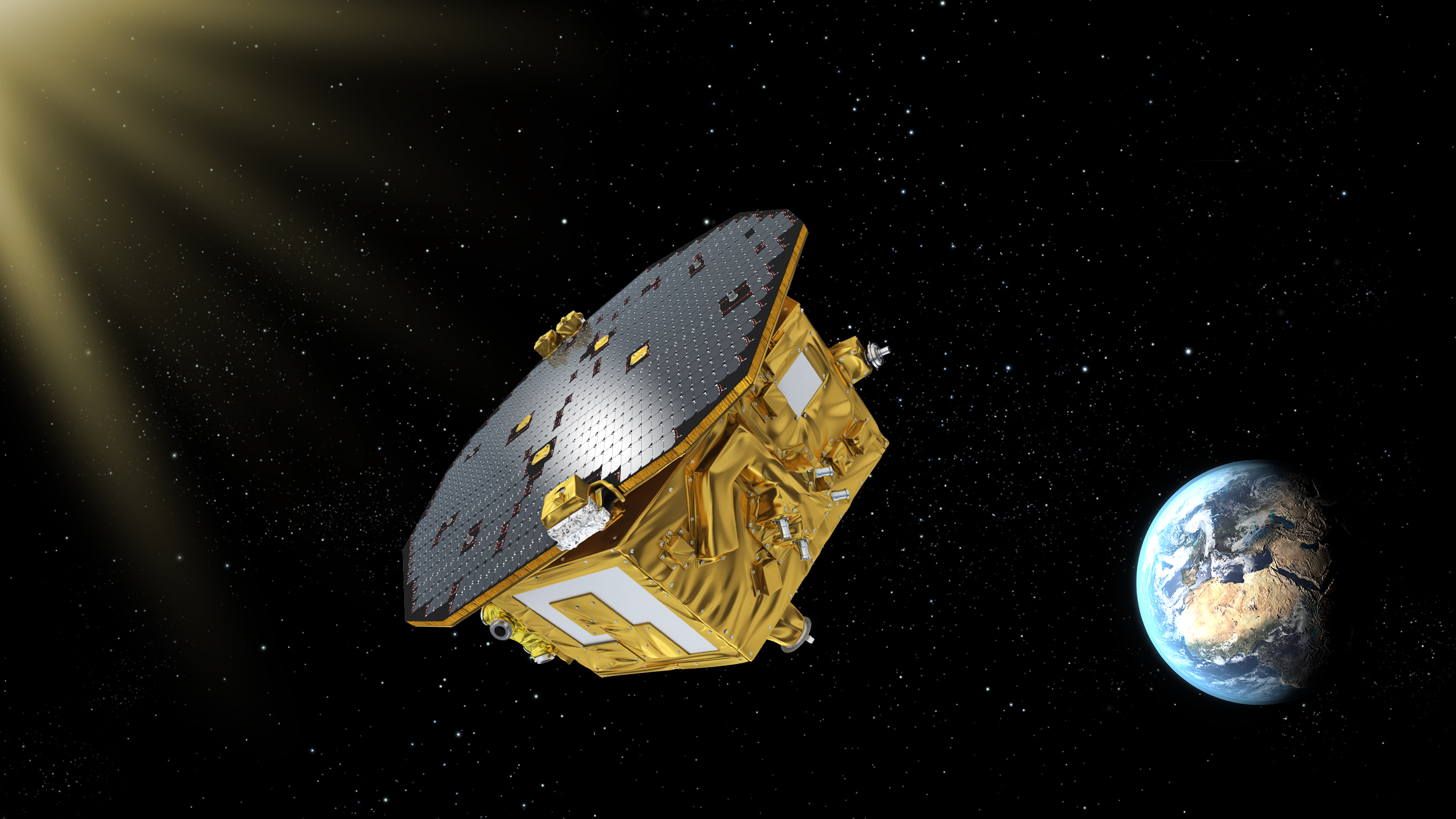
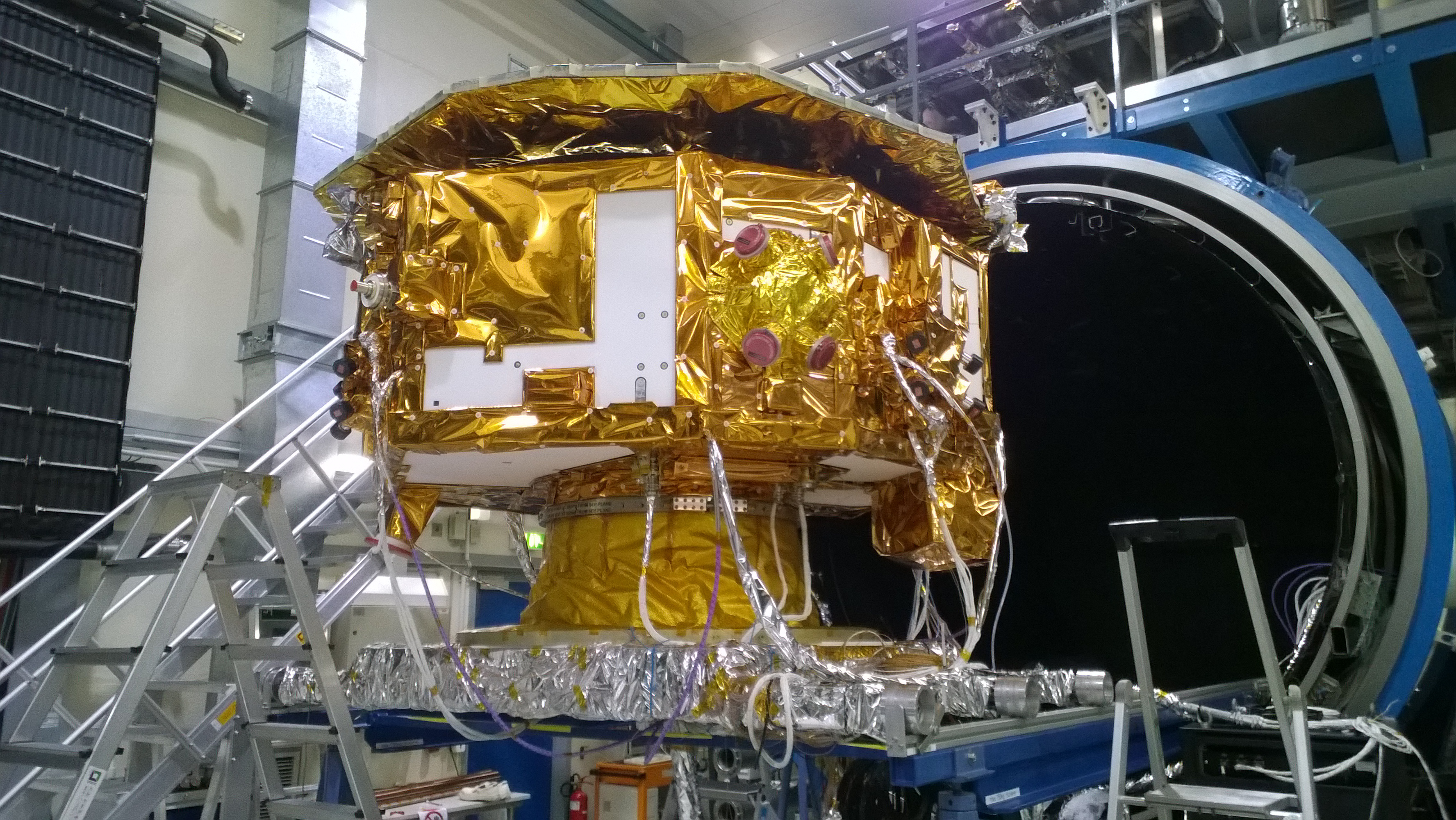
But ESA managed to fund something that can test out the concepts first. LISA Pathfinder is specially designed such that it can maintain 2 freely floating gold blocks inside it 30 cm apart with extreme precision using EM fields. To do so, everything on the spacecraft needs to be designed with shielding all forces in mind - the thrusters, the control software, the position sensors etc. needs to be designed such that it can control the spacecraft at the exact spot to within 1 nanometer, and for the blocks they need to be as precise as 1 picometer!
To do so, it will free float at the Sun-Earth L1 point - well in fact the 6th Vega rocket will only put it into a low Earth orbit; the remaining part will be covered by a separate propulsion module that will be throw away later.
Good luck!
 Launch location:
Kourou
Launch location:
Kourou ELV 5°14'9"N 52°46'30"W
Launch dates and times:
[table="head"]{colsp=7}Launch times
Time Zone|Australia - Sydney/AEDT|CEST UTC+1|Universal / UTC|French Guiana / UTC-3
|
Washington / EST|
Los Angeles / PST
Launch time:|15:04:00|05:04:00|04:04:00|01:04:00|23:04:00|20:04:00
on:|Dec. 3, 2015|Dec. 3, 2015|Dec. 3, 2015|Dec. 3, 2015|Dec. 2, 2015|Dec. 2, 2015
{colsp=7}[highlight]
[eventTimer]2015-12-03 04:04:00?before|after;%dd% Days %hh% Hours %mm% Minutes %ss% Seconds %c%[/eventTimer] LISA Pathfinder Launch[/highlight]
[/table]
Live Coverage
PAYLOAD
LISA Pathfinder technology demonstrator
LISA Pathfinder is a mission to demonstrate in orbit the technologies for LISA, the ESA/NASA Laser Interferometry Satellite Antenna gravitational wave observatory.
LISA Pathfinder, originally named SMART 2 (one of ESA's Small Missions for Application Research and Technology), is a new ESA space science mission. To be launched in 2015, LISA Pathfinder will be packed with radical instrumentation and technology to prepare the way for LISA, the world's first space-based gravitational wave detector.
The LISA Pathfinder mission will test a series of ultra-high precision technologies that will be used on a later and much larger international project called LISA
The basic principle of LISA is to measure the changes in distance between freely floating ‘test masses', literally, small gold blocks held in place by carefully controlled electrostatic fields. The six test masses will be contained in 3 separate spacecraft (two each) arranged in an equilateral triangle with sides of 5 million km! Each of the three arms of the constellation will be optically linked by a system of lasers (‘laser interferometer') and a software control system so as to form a ‘rigid' structure.
LISA Pathfinder is an in-orbit demonstrator of the key technologies for LISA: a kind of physics lab in space. It will test the gravitational reference sensors, the laser interferometry and the micro-Newton thrusters. But instead of a separation of 5 million km, LISA Pathfinder will use test masses only 30 cm apart and placed on a single spacecraft. In fact, because the technology is so challenging, LISA Pathfinder will carry two alternative packages of sensors, lasers and micro-thrusters. One (provided by European institutes and ESA) is called the LISA Test Package (LTP), while the other, the Disturbance Reduction System (DRS), will be provided by NASA under the New Millennium program as ST 7.
After the inertial sensor systems, the micro-propulsion is the most innovative technology to be tested on LISA Pathfinder. Two types of micro-Newton thrusters are under development in Europe. Field Emission Electric Thrusters are a type of electric propulsion which use very large electric fields to almost instantly accelerate tiny droplets of electrically conducting-metal up to high velocity. In contrast, micro-cold gas thrusters are tiny proportional valves; in essence, a controlled leak of inert high pressure gas (typically nitrogen).
LISA Pathfinder will be launched on a Vega launch vehicle into a 207 km × 1540 km, 5.96° Low Earth Orbit. To transfer the spacecraft into its operational orbit a conventional chemical propulsion system is needed, but this must be ejected after use, because even a few kilogrammes of left-over fuel sloshing around within the emptied tanks could disturb the experiments.
The operational orbit is a stable and eclipse-free orbit around the L1 Lagrange point, 1.5 million km from Earth towards the Sun. This location helps minimise disturbances from the Earth's gravity, magnetic field and atmosphere. The nominal mission life is just over 1 year, allowing the DRS and the LTP to be separately tested and also allowing special experiments where one system will monitor the performance of the other. This in-orbit feedback will then help the detailed design of LISA.
LISA Pathfinder involves an Industrial Core Team of EADS Astrium Ltd (system prime and platform); EADS Astrium GmbH (LTP industrial lead and drag-free control system) and SciSys Ltd (software architecture). The full industrial team comprising companies across Europe will be assembled over the next year via competitive selection.
The launch was originally planned for 2008, but has slipped to 2015.
[table="head"]{colsp=2}Characteristics
|[table="head"]{colsp=2}
LISA Pathfinder
Prime contractor:
|Airbus Defence and Space
Mass at Separation:
|
Stabilization:
|
Dimensions:
|
Power:
|
Life time:
|
Instruments:
|
- LISA Technology Package (LTP)
- Disturbance Reduction System (DRS)
Orbit:
|
- Earth-Sun L1 Lagrange Point (initial parking orbit 207 x 1540 km x 5.96 deg.)
[/table]
|
|
[/table]
Launch Vehicle:
[table="head"]{colsp=2}Characteristics
|[table="head"]{colsp=2}
Vega
Prime contractor:
|
Height:
| 29.9 m with upper stage and payload fairing
Diameter:
| max 3.025 m
Liftoff mass:
| 137 metric tonnes
Payload mass:
| ~1.5 tonnes at SSO (700 km, 90° inc.)
First stage:
|
- 1 X P80FW Solid Rocket Motor (SRM)
- Empty 7.43 tonnes
- Propellants 88.36 tonnes (HTPB)
- Thrust at sea level 2261 kN
- Vacuum specific impulse 280 s
Second stage:
|
- 1 X ZEFIRO 23 Solid Rocket Motor
- Empty 1.84 tonnes
- Propellants 23.91 tonnes (HTPB)
- Thrust at sea level 1196 kN
- Vacuum specific impulse 289 s
Third stage:
|
- 1 X ZEFIRO 9 Solid Rocket Motor
- Empty 0.83 tonnes
- Propellants 10.12 tonnes (HTPB)
- Thrust at vacuum 225 kN
- Vacuum specific impulse 295 s
Fourth stage (AVUM):
|
- 1 X RD-869 engine
- Empty 0.42 tonnes
- Propellants 0.55 tonnes (UDMH/N2O4)
- Thrust at vacuum 2.45 kN
- Vacuum specific impulse 315.5 s
Payload Fairing:
|
- Diameter 2.6 m
- Length 7.88 m
- Mass 490 kg
[/table]
[/table]
The launch vehicle's reliability standings (according to
http://www.spacelaunchreport.com/log2015.html#rate):
Code:
================================================================
Vehicle     Successes/Tries Realzd Pred  Consc. Last     Dates
                             Rate  Rate* Succes Fail
================================================================
Vega               4     4xx 1.00  .83      4    None     2012-

xx Does not include successful 2-11-15 suborbital flight with
    IXV reentry demonstrator.
Ascent profile
Weather Forecast for Kourou, French Guiana on December 3, 2015 (1 a.m.)
Scattered thunderstorms this evening becoming more widespread overnight. Low 23C. Winds light and variable. Chance of rain 80%.
Time|Temps|Dew Point|Relative Humidity|Precip|Snow|Cloud cover|Pressure|Wind|Weather
1 AM|24°C|24°C|96%|50%|0%|59%|1012 hPa|6 km/h E|
Chance of a Thunderstorm
References
http://www.arianespace.com
http://sci.esa.int/lisa-pathfinder/
http://space.skyrocket.de/doc_sdat/lisa-pathfinder.htm
http://www.csgpreparationlancement.com/
http://forum.nasaspaceflight.com
http://www.novosti-kosmonavtiki.ru
http://astronautique.actifforum.com
http://www.spacelaunchreport.com
http://www.esa.int/Our_Activities/Launchers/Launch_vehicles/Vega2
http://english.wunderground.com/cgi-bin/findweather/getForecast?query=zmw:00000.1.81403