Em drives

Nope. You are lumping together two issues:

(1) Whether the device generates thrust at all

(2) Whether thrust generation can be explained in the realm of known physics

Question (1) is a purely experimental matter, (2) is the job for theorists.

The crackpot argument is: (drive works) => (physics wrong), which is jumping to conclusions.

The pseudo-skeptical argument is: NOT (physics wrong) => NOT (drive works), which is viewing physics (or rather one's limited understanding thereof) as dogma.

The interferometer anomaly suggests that the drive's operation (if it works at all, that is -- I'm not entirely sure) can be explained by the warping of space. In such case, Newton's laws do not apply, because they require flat spacetime. Thus (drive works) <=> NOT (physics wrong).
 
Last edited:
If it works, it works. Period.

But thrust is not any kind of force, so it should better be made sure that any measured force is really a thrust force and not some other kind of force, that only exists in the experiment setup.
 
Well -- I'd wager that thrust is one thing NASA definitely knows how to measure :rofl:

Also -- another reason that I don't really concern myself with claims of apparent violation of law of physics, it that most of the time the violation only appears there because of someone's deficient understanding. Here's a funny story:

A PhD-level course in electronics, and the lecturer is explaining fundamental limits to circuit density etc. and proceeds to prove that the maximum capacity of a 5x5mm Flash chip is about 4GB, and that's why there are no USB drives larger than that.

Someone pulls out 16GB drive out his pocket.

The awkward silence is ended by your truly who has recently attended a conference presentation on the topic of vertical stacking of integrated circuits...

The fun part is that the lecturer was right. Under his assumptions (not sure if they still hold today), indeed the max limit per die was 4GB. But some crafty people have realized that you can stack 4 4GB dies in vertical, and put that stack in a single IC package, thus achieving the impossible 16GB chip...
 
Last edited:
Well -- I'd wager that thrust is one thing NASA definitely knows how to measure :rofl:

I would not be too sure there - NASA is a lot more than just Von Brauns. If NASAs theoretical sciences department would be free of errors, I would agree to you. But in the past, the future propulsion systems department had been really a science fiction playground with great news and little lasting science.
 
Last edited:
How is unicorns related to EM drives?

It is a great metaphor for what we, experimental scientists, do. We hunt unicorns.

Don't let anyone tell you that there are no unicorns. If there is one out there, we will catch it and deliver to you -- measured and weighted to eight decimal places. If the unicorn is not there, and all you get from us is a zero -- it's gonna be the best zero you could wish for.
 
How is unicorns related to EM drives?

Because the essentially are one. Conservation of energy/momentum appears to be hard coded into the universe at a very fundamental level and the EM drive claims to violate it.

So we have two options A: 99% of what we think we know about science is just flat out wrong. or B: There is something squirrely going on in the experiment. (IE the em drive is not actually producing thrust, but instead pushing against an ambient magnetic field.)

Option B seems way more likely than A.

---------- Post added at 10:20 ---------- Previous post was at 10:11 ----------

Also -- another reason that I don't really concern myself with claims of apparent violation of law of physics, it that most of the time the violation only appears there because of someone's deficient understanding.

You should in this case though as the ability to "Push" against quantum vacuum or would invalidate most of quantum physics, along with relativity.

Basically you will have proven the existence of Aether.
 
So we have two options

You're forgetting the third option: The device might work, but for completely different reasons than originally assumed. Reasons that might not violate known physics quite as much.
 
You're forgetting the third option: The device might work, but for completely different reasons than originally assumed. Reasons that might not violate known physics quite as much.

Covered under option B.

IE Some oddball example of magnetic levitation.
 
Problem is, at this point none of the alternate theories can explain why the Michelson interferometer is seeing length expansion inside the RF cavity. That effect is literally in the "should never happen" category. And it's on a different bench with a different test article.

Of course it's possible that this is another measurement error, but, from experience, there are too many "errors" here. Think about it this way: when building a test setup, either something moves when it shouldn't (causing a false positive) or does not move when it should (causing a false negative). (*) Let's say that probabilities of each type of mechanical error are equal, i.e. 50%. So if you have two unrelated test setups, testing for two different things, then probability of two false positives is 25%.

And that 25% is contingent on the assumption that both setups are faulty in the first place. These are lab professionals, not grad students, but let's conservatively assume that they get things right 50% of the time (**). So probability that the lab builds two faulty setups in the first place is 25%. (Again, note that these are completely different devices, so it's extremely unlikely that a bad assumption would be carried over from one experiment to another).

So the probability that these guys have measured both the force and the interference pattern due to their own errors is a whooping 6.25%. It's definitely still possible, of course, but it's the point where you should seriously start considering that the gizmo may be working after all.

The next logical step (outside of redoing interferometry in vacuum, but preparing that will take a few months) would be to build several different gizmos and test them comparatively. If some gizmos move faster, and some gizmos move slower, depending e.g. on the aspect ratio of the cavity, then the effect is definitely legit. If all gizmos move the same, then it's probably not legit.

These guys look like they know what they are doing, so they will probably deliver. Even if they ultimately deliver a null, it should at least be a very well supported null.

(*) And that is, of course, why ductape and WD40 are a must at every lab!

(**) That's very conservative, because a professional will make an effort to prove that the testbench itself is working correctly before running the actual test.

 
Last edited:
Problem is, at this point none of the alternate theories can explain why the Michelson interferometer is seeing length expansion inside the RF cavity. That effect is literally in the "should never happen" category. And it's on a different bench with a different test article.

Wrong. Try again. Maybe you are not knowing a known theory, that applies, but thats just you. (and its the point, where I would like to summon Fizyk into the thread)
 
Last edited:
You're forgetting the third option: The device might work, but for completely different reasons than originally assumed. Reasons that might not violate known physics quite as much.

But we're there already. The original inventor's theory of operation was equivalent to pulling yourself up by your shoelaces. The current conjectures about quantum vacuum, space warping and (my favorite) Casimir effect, may sound sci-fi, but at least do not seems to be expressly forbidden. And they are falsifiable, so experiments can be performed to verify them.

---------- Post added at 09:03 PM ---------- Previous post was at 08:50 PM ----------

Wrong. Try again. Maybe you are not knowing a known theory, that applies, but thats just you. (and its the point, where I would like to summon Fizyk into the thread)

Enlighten me :)

---------- Post added at 09:26 PM ---------- Previous post was at 09:03 PM ----------

Review paper: http://www.slideshare.net/KurtZelle...tromagnetic-propulsion-devices-41315-46946953 ...from which we learn that Northwestern Polytechnic University is also seeing thrust. Well, well, well. The plot thickens.

And this is just gorgeous:

index.php
 
Enlighten me :)

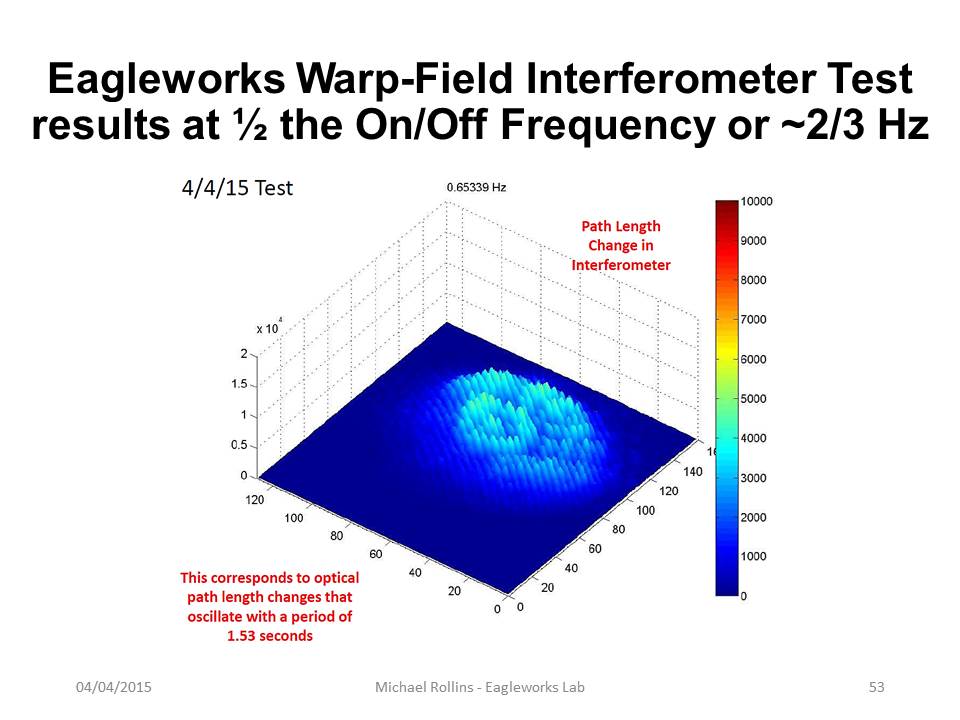
BTW... do I read their plot correctly that they actually measured a change of 2.4 mm over 5 cm distance? (4000 wavelengths of the laser)

Also, despite the claims of the scientists, the existence of air in the test path does not go away by them claiming that the effect by just heating the air is 40 times smaller than the measurement - because their justification also contains: The smallest we can measure at all, as theoretical limit, is 40 times bigger than possible by heating the air by 30 W.
 
No, you don't. This is an FFT plot of CCD pixel data. I usually rescale FFTs so the maximum is 1. Less confusing this way. You are looking for relative values anyway.

Measuring 2.4mm displacement does not require interferometers :lol:

The displacement value can be back-calculated from his error analysis: he's saying that he has ~1/100th wavelength precision, He-Ne wavelength is 633nm, thus ~6.3nm noise... times 40 gives ~252nm displacement.
 
Last edited:
I don't know... the paper you posted isn't all that convincing.

Including the data that says more thrust was produced from a 2.6 W input than at 15+W.

This seems like another case of FTL neutrinos to me.

I wish it would work. I really do. We'd finally get somewhere in space...
 
No, you don't. This is an FFT plot of CCD pixel data. I usually rescale FFTs so the maximum is 1. Less confusing this way. You are looking for relative values anyway.

Measuring 2.4mm displacement does not require interferometers :lol:

The displacement value can be back-calculated from his error analysis: he's saying that he has ~1/100th wavelength precision, He-Ne wavelength is 633nm, thus ~6.3nm noise... times 40 gives ~252nm displacement.

No, I mean the other plot, that was using some physical dimension from 0 to 10000 without any units and called it displacement.
 
No, I mean the other plot, that was using some physical dimension from 0 to 10000 without any units and called it displacement.

Ah, that one:

Eagleworks_Warp-Field_Interferometer_CCD_Camera_Test_Results_04-04-2015.jpg


Yes, that gave me pause as well.

On a second thought, makes sense. An interferometer will only measure displacement up to one wavelength so the maximum is 633nm. (If path length is x wavelengths, it reads out x-floor(x)). From the color, the graph peaks are around 40% full scale, which corresponds to 250nm, which is the same value as he uses in his noise analysis (noise = 1% full scale, signal = 40*noise = 40% full scale).

Also: graph apparently done in Matlab using default settings :lol:
 
Last edited:
2 years is optimistic IMO, I say 5 at the least 15 if we are being realistic, and no outside party intervenes.
 
Politics. The management distances themselves from the project so they are not dragged down in case it fails.

It makes no sense to launch this into space at this point. If the effect is confirmed, people everywhere will start copying this and optimizing the design, which, logically, should result in increased thrust. (Remember, at this point nobody really knows how the gizmo works, so it's extremely unlikely that the current design has no room for improvement.)

---------- Post added at 03:26 PM ---------- Previous post was at 03:20 PM ----------

2 years is optimistic IMO, I say 5 at the least 15 if we are being realistic, and no outside party intervenes.

Hard to say. It can be everywhere from 1 year to infinity depending on how hard it is to make the gizmo work reliably.
 
6 months and a day, if they just launch it as experiment on a sounding rocket - those are very flexible in terms of mission design, cheap enough to launch experiments even as private company and offer enough payload capacity and minutes of microgravity for a short test.

The biggest challenge would just be a precise enough experiment setup to measure such a low thrust in a few minutes of microgravity.
 
Last edited:
Back
Top