Also, you sure know the basic relation between wire diameter, voltage and current?
OOooo! I know this one! But then again, it's kind of what I do.


Also, you sure know the basic relation between wire diameter, voltage and current?

OOooo! I know this one! But then again, it's kind of what I do.

...
Your conclusions are based on three equations on your favorite source:
f_geo is more or less voodoo there, the author provides some approximations without experimental confirmation.
if you paid as much attention to math as I did, you would notice the following relation:
This term really increases slowly with decreasing wire radius r:
[math]Y = d \cdot \ln \left( \frac{f_{geo}}{r} \right)[/math]
But the effect of the term is inverse proportional on the thrust force, the larger term Y, the lower the thrust force:
[math]F=\frac{2 \pi e_0 L V(V-V0)}{Y}[/math]
As predicted by other less esoteric sources and peer reviewed papers: The smaller the wire diameter, the lower the thrust.
Lifter theory.
Force/Power optimization
by Evgenij Barsoukov
Courtesy of Evgenij Barsoukov
Created on April 30, 2002 - JLN Labs - Updated on April 30, 2002
...
3. Corona wire radius optimization
Radius was changed from gauge 50 (0.015 mm) to gauge 20 (1.5mm). Resulting thrust/power relation is given below :
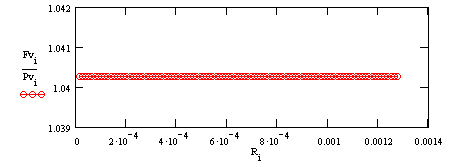
It is great to see, that efficiency does not change, but thrust does! See below absolute thrust/radius dependence :
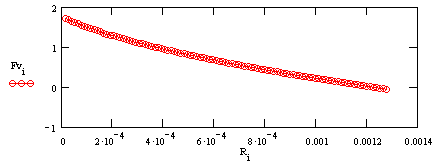
With decreasing radius thrust increases a lot, without losing efficiency!
Conclusion
Increasing the wire/collector distance by simultaneous increase of wire/collector lenght can allow to achieve thrust/power ratios up to 40g/W.
Decreasing wire radius increases thrust without degrading thrust/power ratio.http://jnaudin.free.fr/html/liftfpwr.htm
Corona wire
The corona wire is usually, but not necessarily, connected to the positive terminal of the high voltage power supply. In general, it is made from a small gauge bare conductive wire. While copper wire can be used, it does not work quite as well as stainless steel. Similarly, thinner wire such as 50 gauge tends to work well compared to more common, larger sizes such as 30 gauge, as the stronger electric field around the smaller diameter wire results in better ionisation and a larger corona. current.https://en.wikipedia.org/wiki/Ionocraft#Corona_wire
Ja.. you can put a 'zillion' volts on any 'wire'.. it's just the current (or discharge) that will turn it into fuse-wire..so he is assuming that he can always put 40 kV through 200 mm of wire there, regardless how thin the wire gets. He does not say the material of the wire or even the assumed current for the thrust, which is conveniently hidden.

Ja.. you can put a 'zillion' volts on any 'wire'.. it's just the current (or discharge) that will turn it into fuse-wire
That is a purely mathematical simulation with the following warning:
Note that spark discharge might occur before 100kV.
By the lack of any other information, I have to assume he used the constants stated on top, so he is assuming that he can always put 40 kV through 200 mm of wire there, regardless how thin the wire gets. He does not say the material of the wire or even the assumed current for the thrust, which is conveniently hidden.
As the resistance of a wire of a given length increases by decreasing radius, you have to assume that keeping voltage constant requires less current. But he does not say if he did so, his assumed formula is stated, but not plot for checking the data.
And then, remember the old reality of a fuse. A thin wire with too much current melts. Even Nanotubes do so. Nanotubes are estimated to decompose in contact with air at a temperature of 750°C already (not 2600°C as in vacuum).
It is not experimentally. It is just a stupid mathematical simulation of punching numbers into something that looks like Mathematica and let it plot the results by the formulas. Anything not stated in the equation is ignored - as shown above.
And it was not done by you. And not peer reviewed, it is still just fan boy work. And what can you actually do there? What is your competence?
PS: The formula on Wikipedia is using basic physical dimensions and not AWG or SI system.
About the formula for the thrust, other research teams have derived similar formulas, including ones published in peer-reviewed research journals. See for example eq. 41 here:
An analysis of the Brown–Biefeld effect.
Reuven Ianconescu, Daniela Sohar, Moshe Mudrik
Journal of Electrostatics
Volume 69, Issue 6, December 2011, Pages 512–521
http://arxiv.org/pdf/1011.1393v3.pdf
They all show the thrust increases with decreasing wire radius.
Are you kidding me?
The paper only shows again, that lifting force increases with current. No conclusion with decreasing wire radius increasing Lift force and no calculation claiming so - the increase in Ei by smaller wire radius is smaller than other factors. The only advantage mentioned is that smaller wires produce a simpler electric field for the calculations.
Don't try to cheat me that easily - if you cite it, I might read it.
The resistivity of SWNTs is measured on the order of 10E-4 Ohm/cm, which is only ten times better than a 1mm copper wire.
I'm referring to the term subtracted off at the end of the formula. It gets smaller as the radius gets smaller. There is the effect of the radius in the denominator, but because it is in a log its effect is less than the linear term subtracted off at the end, as can be confirmed by plugging in numbers. And all reports state the thrust increases with decreasing wire radius.

Sorry - what are you talking about? Which equation number?
In your cited paper, you can find the following equation for the thrust force (41):
[math]F = 4.792{\pi}{\epsilon_{0}}{l}\frac{V_0}{b}\left ( \frac{V_0}{1.011 \ln{ \left ( b / a \right )} + 1.3035} - 3 \times 10^6 \left (a + 0.03\sqrt{a} \right ) \right )[/math]
a is anode wire radius
b is air gap
[math]V_0 [/math] is Voltage.
l is perimeter, or length of the anode wire.
Which term does show a positive effect of decreasing wire radius a on lift force F?
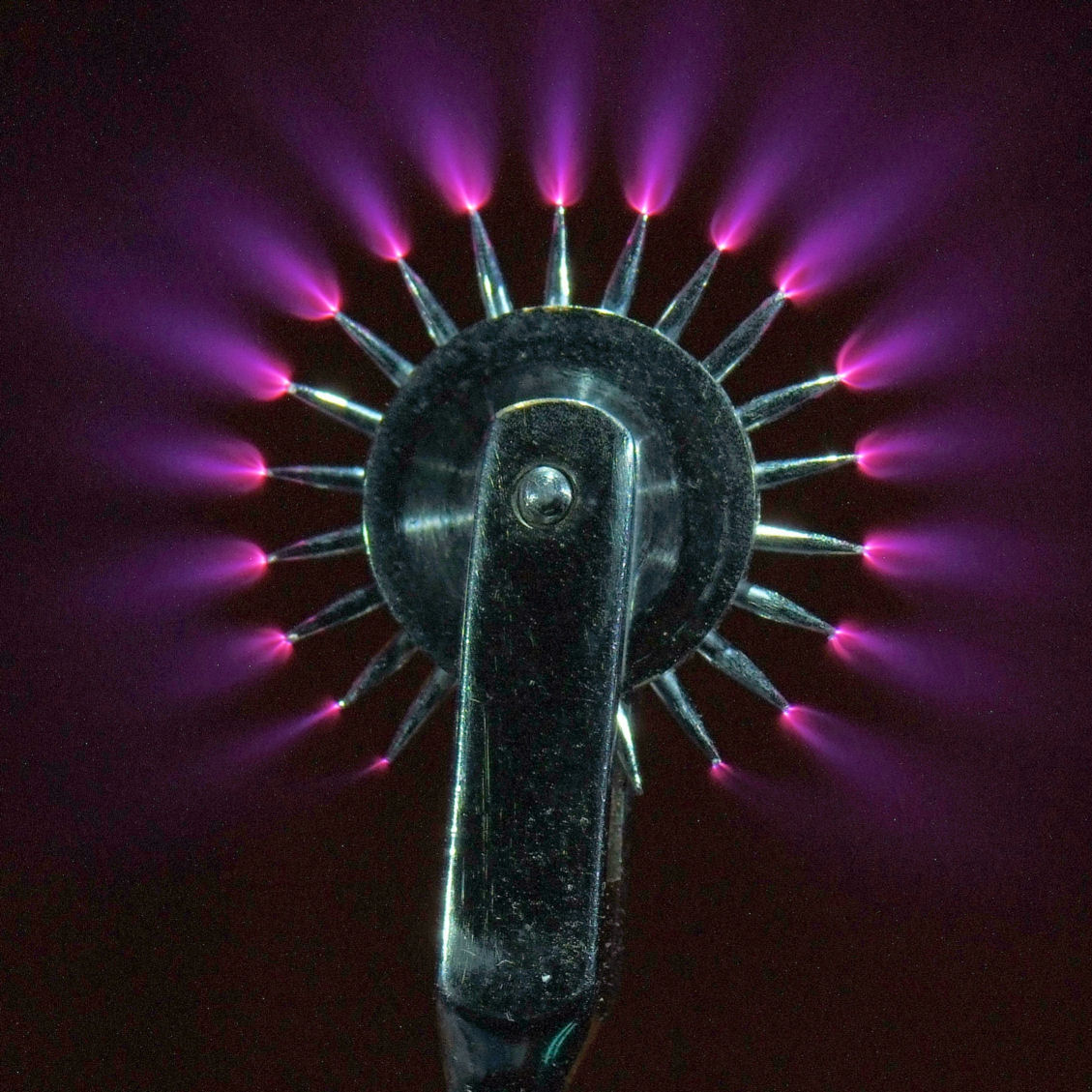
When the potential gradient (electric field) is large enough at a point in the fluid, the fluid at that point ionizes and it becomes conductive. If a charged object has a sharp point, the electric field strength around that point will be much higher than elsewhere. Air near the electrode can become ionized (partially conductive), while regions more distant do not. When the air near the point becomes conductive, it has the effect of increasing the apparent size of the conductor. Since the new conductive region is less sharp, the ionization may not extend past this local region. Outside this region of ionization and conductivity, the charged particles slowly find their way to an oppositely charged object and are neutralized.