Discussion ChatGPT Can help writing Code for Orbiter

To quote Monty Python: "Well that esculated quickly!" I'm (apparently) way behind on this matter and it's very interesting to hear how and why people use it (particularly coding). It's certainly having a bigger impact and is more contentious/devisive than I anticipated. I personally do not like the commercial guinea pig aspect and hope that non-commercial open-source will also be prevelant. For the forseeable future it's here to stay and society will have to find a consensus (in some form), here's good luck to all of us.:)
 
It’s my code, I hold the license. Also software dev is built on abstractions, no one person usually understands everything.
Do you fully understand how the TCP/IP stack works? We use code we don’t fully understand all the time.

I missed that bonmot, but I have to chime in there: Actually I had to learn it in detail to get just pass the very basic first step in my professional career and end my apprenticeship (in the German vocational training system). Down to the bits and bytes of the IP header. And at work discovered that this exam knowledge was not even good enough for understanding Apache Tomcat and its configuration good enough for doing what the customer expects of us. I also had to learn how the various mobile communication standards work later in university, at a level I never again needed at work (since we don't work at that complex)... but other things at U proved to be more valueable than even our professors told us.

You are right, nobody can ever know every line of code in a 750,000 SLOC project. If we would know, we would have no bugs. But we need to understand the components of the software. We also need to know the major technical debts of the sofware. A 900 line of code function is OK for AI, but actually, its a symptom of a developing meltdown. Even worse if this function is called multiple times per job and contains a few goto statements to bring more joy. Even more, we are expected to write code for the compiler, not just for us. A simple straight forward solution works, but properly engineered code operates on a completely different level. Even in a hated language like Java. I once had Java EE code written by a C++ developer.... it was cruel to see. He even ignored most exception handling since the Java VM behaves different to the C++ runtime and he didn't understand it. Some how even managed to program a memory leak into the Java VM. But thats also the level of code you get from AI. Maybe the superficially right code. But it buggy as hell under load. Bad to compile and worse to maintain.

Also, I strongly doubt AI can really understand distributed systems or the run-time behaviour of multiple processes running in parallel. Thats already a challenge for many experienced humans.
 
Last edited:
Linux kernel and AS (artificial stupidity)...


Yeah, for obvious reason, especially the unclear copyright situation, which can be fatal in FOSS.

Did y’all watch the same video I did? This isn’t about not using AI in kernel dev, it’s about standardizing the use of AI tools by building standard context files to guide the tools into writing idiomatic code.

We do this at work too. The models can’t read millions of lines on the fly so to write idiomatic code you have to have guidelines and documentation.

Literally the proposals whole point is to standardize things in a world where AI is being used for kernel development.

Maybe I missed something but did y’all watch that video :p ?
 
"And now for something completely different!"

These "professionals" must be kept far far away from critical industries!

Once again, I find it hilarious that someone who can’t even code is giving me shit, someone who’s been coding professionally long before LLMs.
 
Maybe I missed something but did y’all watch that video :p ?

Maybe you just didn't get the reality. First of all, and what really matters:


Tell me, can Claude AI tell you if its using copyrighted material? How was which training material licenced? Its not a human, its a digital algorithm and as such, really capable of remembering a large segment of code with photographic accuracy.

And much more important: Can you trust Claude AI? Or any other AI?
 
I missed that bonmot, but I have to chime in there: Actually I had to learn it in detail to get just pass the very basic first step in my professional career and end my apprenticeship (in the German vocational training system). Down to the bits and bytes of the IP header. And at work discovered that this exam knowledge was not even good enough for understanding Apache Tomcat and its configuration good enough for doing what the customer expects of us. I also had to learn how the various mobile communication standards work later in university, at a level I never again needed at work (since we don't work at that complex)... but other things at U proved to be more valueable than even our professors told us.

You are right, nobody can ever know every line of code in a 750,000 SLOC project. If we would know, we would have no bugs. But we need to understand the components of the software. We also need to know the major technical debts of the sofware. A 900 line of code function is OK for AI, but actually, its a symptom of a developing meltdown. Even worse if this function is called multiple times per job and contains a few goto statements to bring more joy. Even more, we are expected to write code for the compiler, not just for us. A simple straight forward solution works, but properly engineered code operates on a completely different level. Even in a hated language like Java. I once had Java EE code written by a C++ developer.... it was cruel to see. He even ignored most exception handling since the Java VM behaves different to the C++ runtime and he didn't understand it. Some how even even managed to program a memory leak into the Java VM. But thats also the level of code you get from AI. Maybe the superficially right code. But it buggy as hell under load. Bad to compile and worse to maintain.

Also, I strongly doubt AI can really understand distributed systems or the run-time behaviour of multiple processes running in parallel. Thats already a challenge for many experienced humans.

It’s all about grounding. If you look at benchmarks like humanity’s last exam you’ll find that the sheer knowledge of these models is insane.

But the English language experiences combinatorial explosion, and LLMs being causal autoregressive models in practice means their output is exponentially divergent because one wrong token output can cause whole trace to be wrong.

LLMs can be seen as a lossy general purpose intelligence engine. You have to do a lot of engineering/scaffolding around them to make them valuable right now for non trivial enterprise dev.

Cursor/Claude Code are general purpose code editors but you can create your own code editing pipelines to optimize for specific use cases.

In my day job my company runs the store locator pages for multinational brands like AT&T/maybelline. Had to do a migration and render the pages off a new engine. All the pages were “developed” by overseas developers, the code was non standardized and in horrible shape. Developed a custom code editors pipeline to use AI to migrate the code for millions of pages. These AI generated pages are live and chances are some of you have utilized some of them :p
 
Maybe you just didn't get the reality. First of all, and what really matters:


Tell me, can Claude AI tell you if its using copyrighted material? How was which training material licenced? Its not a human, its a digital algorithm and as such, really capable of remembering a large segment of code with photographic accuracy.

And much more important: Can you trust Claude AI? Or any other AI?

That feature is built into vs copilot and I believe there are third part apps that let you scan code and check if it’s public.

It’s a grey area for sure. Like you pointed out FOSS presents unique challenges. But none of this is a critique over the quality of the output.
 
It’s a grey area for sure. Like you pointed out FOSS presents unique challenges. But none of this is a critique over the quality of the output.

If you don't see it yourself, its really better that you use AI. A paper wall is still better than no wall at all.
 
Once again, I find it hilarious that someone who can’t even code is giving me shit, someone who’s been coding professionally long before LLMs.
Someone, who can coding, use AI instead of coding himself.

And someone, who can't understand what benefits and what problems make AI code generation, can be programmer. And someone, who tries to tell that AI generated code is his own, can't be allowed to use Open source software.

I am coding for myself no for money, and I am coding in my own time schedule with my own quality requirements. That's the difference between "professionals" monkeys like you and me. I am doing it for perfection instead of making money without quality and responsibility of result.
 
Don't make me explain the differences between:
  • Programming
  • Software development
  • Software engineering
  • Software architecture
  • And, last but not least, user experience (UX)
Its all related, its all operating together, sometimes unconsciously and ad-hoc, but its not the same. Yes, AI can work on the programming level. I'd estimate it can cover 80% there. On software development, things get controversial. I'd estimate it to cover 10% of what a full software developer (roughly three years of professional experience) can do, maybe 15%. Anything else: Hell no.

And please:

If you need to clarify, who of you has the bigger tonker, do that in a place where consenting adults go for investigating such matters.
 
If you need to clarify, who of you has the bigger tonker, do that in a place where consenting adults go for investigating such matters.
Nice one! I'll definietly do it! I already suggested him to go into private/direct messages... But... There are people, who like to wear coat and show what is under coat... by using his "experience"...
 
At any rate going back to the original topic:

ChatGPT isn’t too useful for orbiter coding, but Cursor and Claude Code can easily use the orbiter API. Especially with the amount of code that’s available.

I was trying to find Imfd sources but couldn’t. Launch mfd and transx sources seem amazing.
 
When the absolute heck is going on in this thread...


I don't really understand the motivation in using something like ChatGPT et al. to do anything, but in particular hobby stuff like Orbiter addons, art, etc.

There is no arguing that AI ( the field of study, not the corporate driven LLMs) has a lot of uses. But specifically in the context of these LLMs, it really does bare asking the question of what you're really getting out of using it. Especially the "vibe coder" trend, and the equivalent in art.

First of all, LLM's get their training data from a lot of copyrighted sources, which, at least in the context of copyright law is a kind of theft. These companies are, at least practically speaking, legally protected from any persecution for this, in ways that you and I aren't. (I get a fine if I download a song ilegally, but the AI companies can download all the songs, and remix them and make billions and that's okay). Are you being part of that? I'm not.

For programming, it's a pretty explicit violation of many of the Free software licenses to scrape code off of Github/Gitlab/etc. A lot of code comes form Stackoverflow too, and based on some of the code I've seen (and posted) there, I'm not sure I want to base any code.

Programming is hard, but it's hard because it requires you to think in a very structural way. You have to organize your thoughts, you have to plan, you have to understand your program on a macro level, because on a micro-level most programs are simply too big to hold all in your brain at one time. The same is true of writing or one of the visual arts. For most people, the biggest thing you have is your creative/productive efforts. Use them to make what you want, not something that a glorified search engine spits out.

If programming is an art, than I will borrow a [probably] Bertolt Brecht quote: "Art is not a mirror held up to reality, but a hammer with which to shape it". Are you the hammer or the nail when you use LLM's to write code, write a paper, paint a painting?

AI[LLMs] will not bring about a revolution in making Orbiter addons. What will:
  • Release addons under a Free Software license
  • Work collaboratively
  • Make tutorials on making addons
  • The excelent work on LUA functionality that has been done already
  • Tell people about Orbiter
 
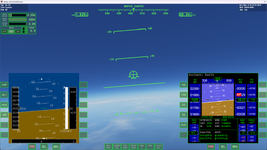
1754270587401.png
Just made a beautiful dv monitor MFD in Cursor.

Last prompt to it was:
better but not sexy enough! I need a full MFD screen futuristic display that's big and robust takes the entire MFD screen and visually shows DV left prominently in big flashy way

Edit:
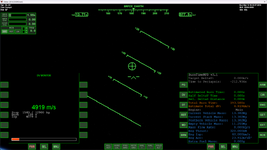
Here's an MFD that shows a 2D layout of the base you are flying over with your position being shown in real-time.

1754274139632.png

Three MFD's effortlessly created within the span of 24 hours. I hope this at least convinces some of you that Cursor/Claude Code type agentic coders can make short use of the Orbiter API to create addons.
 
Last edited:
Three MFD's effortlessly created within the span of 24 hours. I hope this at least convinces some of you that Cursor/Claude Code type agentic coders can make short use of the Orbiter API to create addons.

Not really. But feel proud of Claudes work. Not your work. And maybe the work of add-on developers that had been used for teaching Claude to do tiny tricks in its name. Hey, wow, a speaking horse!

In classic human tinkering, each MFD would be a 1-3 hour project. The first line of code is naturally the hardest. But if you use AI for that, fine. I would just take example code (Did I need to be experienced for doing it that way). And then change it, view the results, repeat. They are also absolutely uncomplex.

The discussion sounds more like selling a piece of modern art: You wiped your brushes for 5 minutes on a canvas, and now tell your potential buyer for 4 hours, what feeling this painting evokes and how it reminds you of your mother.
 
What model are you using? What code editor are you using? Try Claude Code Pro plan ($20/month) or Cursor with claude sonnet 4.
You have to properly ground the model with context/conventions about the project. Having the model scan the code base and having it generate a .cursorrule/CLAUDE.md files is the way to go. For new projects, you can design them from grounds up to be optimized for code generation by using small modular file structure and convention over configuration.

This is basically what I'm doing already. We've got a small budget for that and use mostly Claude Sonnet. And there is that I found it usable for boiler-plating. The others usually create complete garbage, anyway. YMMV.
 
Idk what you are trying to get it to do Steph. That’s triggering image generation through dalle. What is your goal?
I was just trying to show that it doesn't really 'grasp' the idea of even what the DeltaGlider is. When talking to it about complex topics, you realize it's a bit like talking to someone who's read everything there is to read about a subject, but never actually experienced it or worked in the domain.
I'm not against AI, I actually use it almost daily (not for work) but that's also how I know that , while it will get some stuff right, 10-20% of output will be bs.
Perhaps it's also a paid vs free thing, but even on the GPT Plus subscription, it screwed up quite a lot
 
Not really. But feel proud of Claudes work. Not your work. And maybe the work of add-on developers that had been used for teaching Claude to do tiny tricks in its name. Hey, wow, a speaking horse!

In classic human tinkering, each MFD would be a 1-3 hour project. The first line of code is naturally the hardest. But if you use AI for that, fine. I would just take example code (Did I need to be experienced for doing it that way). And then change it, view the results, repeat. They are also absolutely uncomplex.

The discussion sounds more like selling a piece of modern art: You wiped your brushes for 5 minutes on a canvas, and now tell your potential buyer for 4 hours, what feeling this painting evokes and how it reminds you of your mother.

If it’s so easy for humans to tinker, why don’t you recreate one of the mfds I made? 😏

I bet you won’t. Challenge is open to anyone who thinks agentic code editors are merely toys.

Talk is very cheap.

Id flip the challenge as well. Open challenge to anyone to create any orbiter mfd in a time horizon of < 1 week of human work. The bet is I’d be able to reproduce your work.
 
I was just trying to show that it doesn't really 'grasp' the idea of even what the DeltaGlider is. When talking to it about complex topics, you realize it's a bit like talking to someone who's read everything there is to read about a subject, but never actually experienced it or worked in the domain.
I'm not against AI, I actually use it almost daily (not for work) but that's also how I know that , while it will get some stuff right, 10-20% of output will be bs.
Perhaps it's also a paid vs free thing, but even on the GPT Plus subscription, it screwed up quite a lot

It doesn’t know what a delta glider is. Only concepts that were repeatedly seen in the training corpus are then encoded and learnt by the model. Not enough training material on delta gliders.

But that’s fine…. Although the LLM latent knowledge is vast, they experience an emergent phenomenon called in context learning. So you can feed it information about a delta glider and it’ll know more. Tell it to find images for delta glider on the web, you can feed it images of your own.

When working with Orbiter API it doesn’t know the API at all. You have to ground it by having it read the orbiter api header files for example.

You can view llm models as “cognitive cores”.
 
Back
Top