

-
ORBITER-FORUM will be temporarily closed at 2026-07-23 18:00 UTC while we complete some OF maintenance tasks. The amount of downtime is expected to take up to one hour, but probably less.
You are using an out of date browser. It may not display this or other websites correctly.
You should upgrade or use an alternative browser.
You should upgrade or use an alternative browser.
News Changes to the SpaceX BFR rocket.
- Thread starter RGClark
- Start date

The 2 photos at the top of the page are not from this flight, they are just showing the pool. In the photos in the previous page, it is visible that the aft part of the flap root is eaten up.The aft flap looks surprisingly good.

Hmmm... The front fell off...
Ah! That makes more sense!The 2 photos at the top of the page are not from this flight, they are just showing the pool.

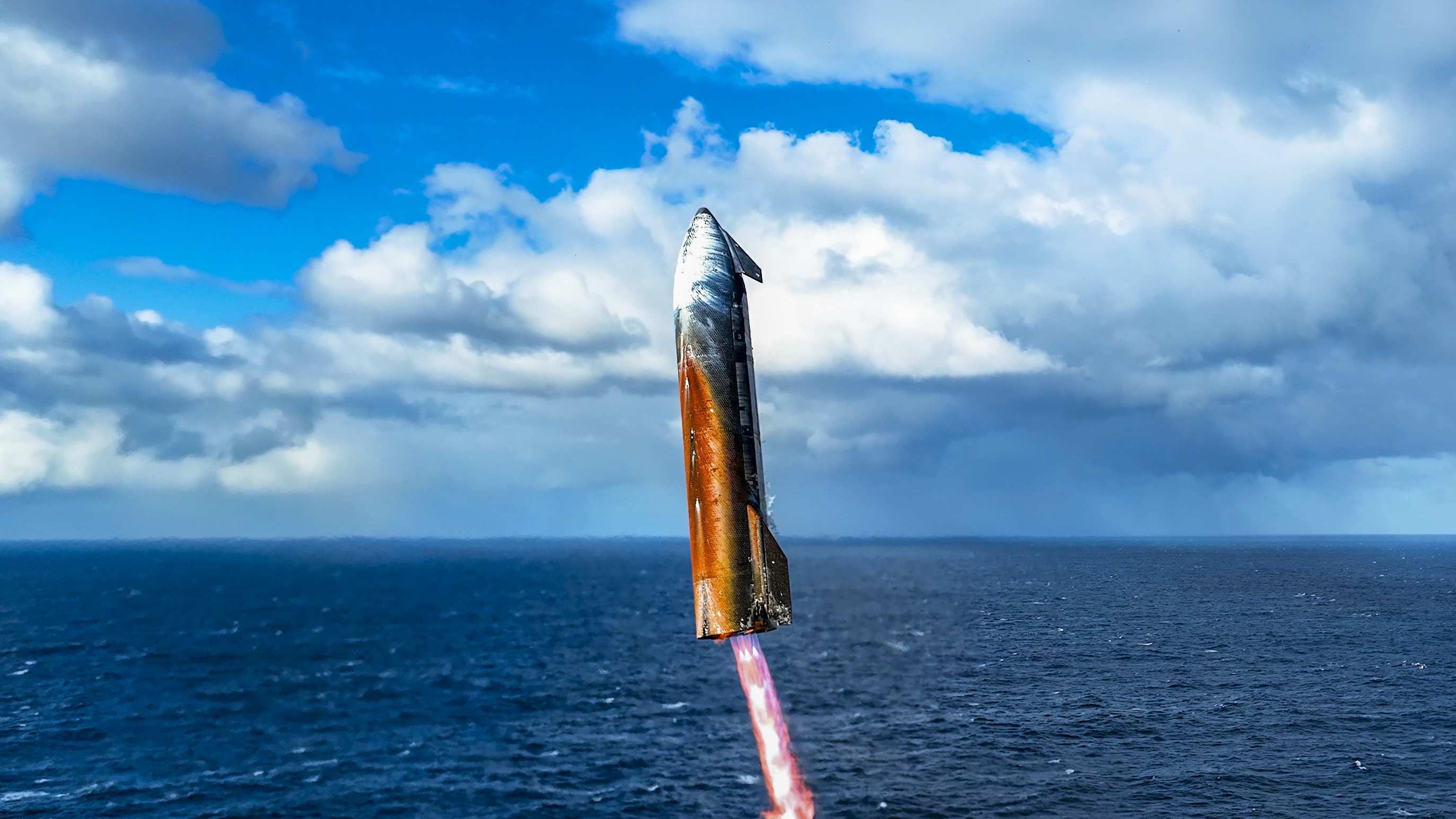
It's interesting that there appears to be ice on the leeward aft portion of the stage over the tank. It was in reentry plasma just 5 minutes before this touchdown.
diogom
Well-known member
- Joined
- Aug 2, 2010
- Messages
- 1,564
- Reaction score
- 927
- Points
- 128
- Website
- github.com
- Preferred Pronouns
- he/him
That should be venting from the QD, methane I think? Similar to the booster.It's interesting that there appears to be ice on the leeward aft portion of the stage over the tank. It was in reentry plasma just 5 minutes before this touchdown.


richfororbit
Active member
The vehicle has been successful. Will there be a much taller one built. If this vehicle could carry dozens of people?
The company is pushing chemical engine performance.
The company is pushing chemical engine performance.

The vehicle has been successful. Will there be a much taller one built. If this vehicle could carry dozens of people?
The company is pushing chemical engine performance.
Flying people to orbit on this is likely never going to happen due to a lack of launch abort system. This thing is nothing but a shell and it'll take many more iterations before it's ready for anything useful.
Landing this on the Moon is just asking for trouble, given that it's tall and narrow and requires the same engines to get home - the engines that are exposed to possible damage on landing.
They're late for that anyway...

- Joined
- Feb 6, 2008
- Messages
- 38,938
- Reaction score
- 3,937
- Points
- 203
- Location
- Wolfsburg
- Preferred Pronouns
- Sire
The company is pushing chemical engine performance.
So, they do necrohippoflagallation. Which seems to be the goal of the whole project. And for launching humans, the damn thing should have a payload capacity in first place. Which it currently doesn't have at all. The performance was just enough for 8 satellite dummies of unknown mass (but likely equal to a current Starlink satellite with about 300 kg, not one of the planned satellites with much higher mass). even if each satellite has the mass of a planned Starship Starlink satellite of 1250 kg (Which means the flat mass dummies where about 4 times thicker than they appeared to be), they had merely 10 tons of payload and required lots of performance optimizations to carry it. Not even the 35 tons to orbit that SpaceX planned to achieve with this time.

What worries me more is that, in my opinion, there should be no burn-throughs on any aerodynamic control surfaces and their hinges on a spacecraft approved for human use, even if this reduces the entertainment value.
To be fair, it is a challenge to predict the empty mass of a vessel when the structural design is continuously evolving. Their initial concepts were much lighter than what they were able to actually build. The Starship and Superheavy version 1s gave them a starting data point, and they realized that they need to go bigger to get a specified amount of payload to orbit.
From my experience as a mechanical engineer, yes, it is generally preferred that the behavior of the vehicle design does not instill terror with the passengers.What worries me more is that, in my opinion, there should be no burn-throughs on any aerodynamic control surfaces and their hinges on a spacecraft approved for human use, even if this reduces the entertainment value.
Perhaps they could do a collaboration with Red Bull?

richfororbit
Active member
When the US NASA was planning the moon, one option was a rocket landing on the moon.
But that aside, the fact that the vehicle is tall, and could carry twelve Astronauts or even more, twenty four passengers into orbit? With a proper setup. A massive shuttle like rocket.
This vehicle is suppose to do Mars in a shorter time, that is why it is as tall as it is, and the chemical engine enhancement is a must to get there within a timeframe that isn't forty or fifty years from now, yeah there are alternatives like Nuclear or this other waffle which would take forty or fifty years, and another forty or fifty years. Other ideas. What ever. Just saying.
I don't know where this project will go. Reminds me of the old Cernan and Aldrin discussion one, was supportive of government only with contractors, and the other was open to companies, and Space Exploration technologies has been convincing in ambition and some results.
But that aside, the fact that the vehicle is tall, and could carry twelve Astronauts or even more, twenty four passengers into orbit? With a proper setup. A massive shuttle like rocket.
This vehicle is suppose to do Mars in a shorter time, that is why it is as tall as it is, and the chemical engine enhancement is a must to get there within a timeframe that isn't forty or fifty years from now, yeah there are alternatives like Nuclear or this other waffle which would take forty or fifty years, and another forty or fifty years. Other ideas. What ever. Just saying.
I don't know where this project will go. Reminds me of the old Cernan and Aldrin discussion one, was supportive of government only with contractors, and the other was open to companies, and Space Exploration technologies has been convincing in ambition and some results.
We need something like Red Bull's Flugtag with rockets.
- Joined
- Feb 6, 2008
- Messages
- 38,938
- Reaction score
- 3,937
- Points
- 203
- Location
- Wolfsburg
- Preferred Pronouns
- Sire
We need something like Red Bull's Flugtag with rockets.
Well, we should impose some sane limits on the maximum impulse of the rockets then, otherwise we could motivate people to commit suicide by high-velocity impact.
A JATO bottle is too strong, isn't it?
Oh, I suppose. We'll restrict them to single stage. Everyone must wear goggles and a helmet and will be launched over water.Well, we should impose some sane limits on the maximum impulse of the rockets then, otherwise we could motivate people to commit suicide by high-velocity impact.
Well, with all the pennants, bed curtains, capes, and other drag-inducing papier mache art work, perhaps not?A JATO bottle is too strong, isn't it?
Maybe compressed air/water bottle rockets could be used? This guy has the right spirit, if not the engineering prowess:
- Joined
- Feb 6, 2008
- Messages
- 38,938
- Reaction score
- 3,937
- Points
- 203
- Location
- Wolfsburg
- Preferred Pronouns
- Sire
Well, a classic JATO bottle from Aerojet has 1000 lb(f) of thrust for 15 seconds, that might be a bit of powergaming, especially because of the long burn-time (how to control a makeshift manned rocket that long). But there once was a JATO Junior version for civilian aircraft with just 250 lb(f) of thrust for 2 seconds, that seems just perfect.
EDIT: Does somebody know, where to find the dimensions of JATO and JATO junior bottles? Lets do a little experiment...
EDIT: Does somebody know, where to find the dimensions of JATO and JATO junior bottles? Lets do a little experiment...
Last edited:
EDIT: Does somebody know, where to find the dimensions of JATO and JATO junior bottles? Lets do a little experiment...
3-D (Length x Diameter): 64.8 × 15.9cm (2 ft. 1 1/2 in. × 6 1/4 in.)
If I read the boilerplate correctly the rocket itself weighed 43.5 lbs full. Strap this to an adult with a crash helmet and the acceleration would be less than 2 G for 12 seconds. One would be able to see the crash site from the launch site anyway.
Similar threads
- Replies
- 14
- Views
- 5K


- Replies
- 11
- Views
- 6K


- Replies
- 7
- Views
- 4K