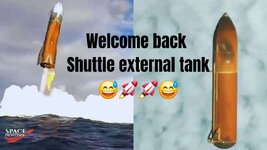
News Changes to the SpaceX BFR rocket.

Aft skirt was interesting, seems early and too explosive to be plasma burn-through, though it was at the aft flap joint. No pressure vessels there specifically, there's an engine chill line through the aero cover, but they weren't in engine chill yet and they got through that later. I think though that heating effect on the aft flap by SECO had been seen in previous flights, could be heating from hot staging maybe?
 
I heard the flaps screaming during the whole reentry lol... 🤒
 
So they made it down! "In one piece" might be overstating it a bit, but mostly. Kind of impressive, but the big question is, can they do it again, or was it just lucky? Even if they can do this reliably, we're still a very, very very, very long way away from doing it reliably with the same rocket...
 
I'd be curious to see video of the payload bay during re-entry. External views showed a pretty significant heat affected zone on the steel leeward of the TPS tiles. That payload bay area probably gets pretty hot just from radiation heat transfer.

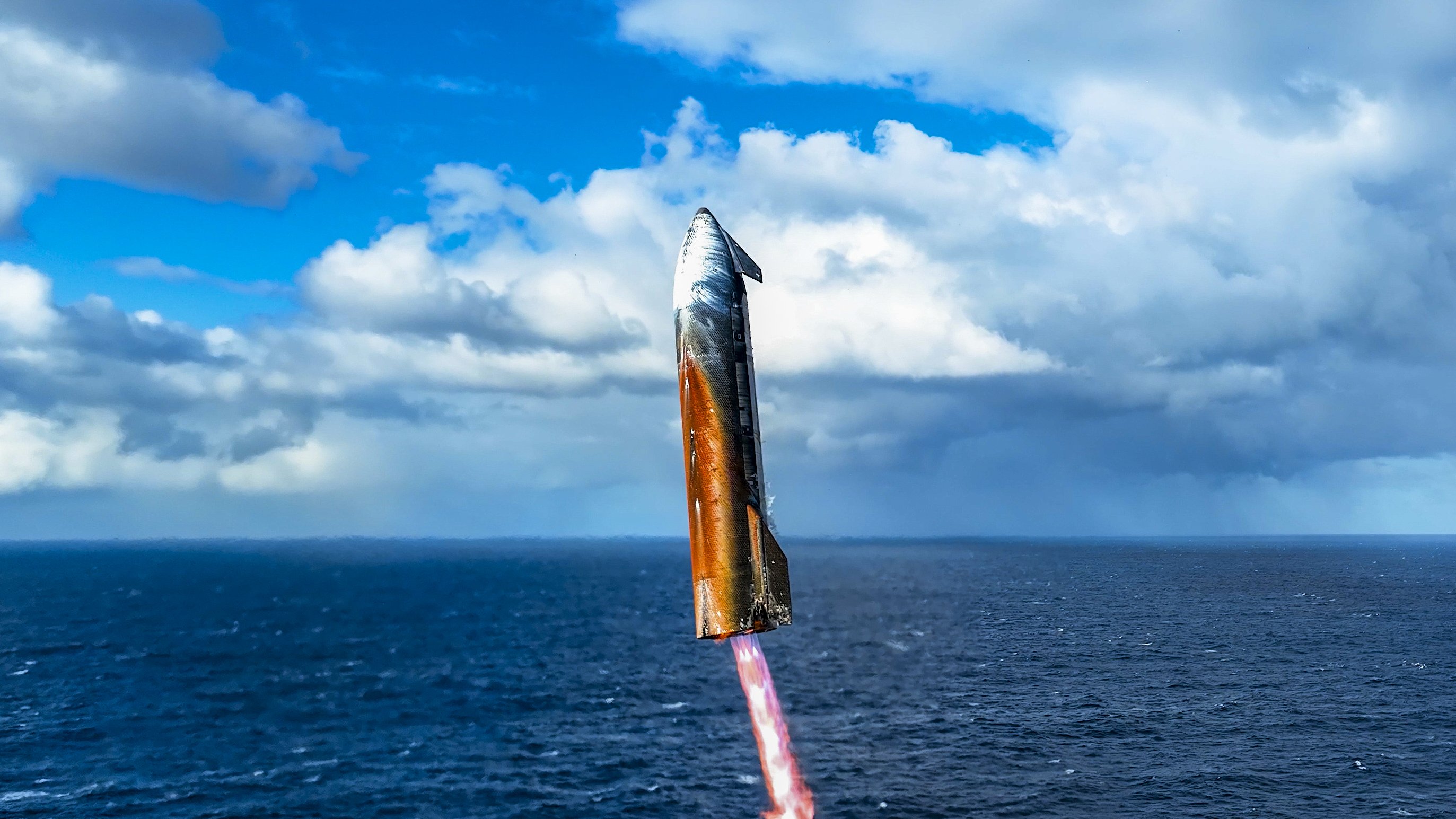
It will be interesting when they finally are able to recover Starship intact and inspect it. It leaves the pad all nice and shiny, but it looks like a well-used barbecue grill on touchdown.
 
GzYcJm1bIAAu8OZ

GzYcJmva4AUkxX0
 
what's with the orange hue, though? Never seen that before. And ice on the top? Hard to believe it stayed cold through all that on the windward side
 
I wonder if the TPS could still be incandescent at touchdown? The shuttle had an extended glide where the TPS was exposed to convective cooling with relatively high convection coefficients. The Starship is entering as a blunt body and the convective coefficients would be much lower as there is a stagnation point on the leeward side of the ship. The time between where we see visible reentry plasma and touchdown is only about 5 minutes for Starship. Silica tiles have very low thermal conductivity to limit heat ingress, but that also means it limits conduction of absorbed heat to the convective surface. It might also be a color change due to some weird oxidation reaction with ions in the upper atmosphere, but I have never seen such color change on the shuttle TPS.

It is going to be very interesting when we get a good look at a recovered Starship.
 
Is it bad, that I don't trust the prognosed payload masses for V3 and V4? Its just a small amount of more fuel in V3, but is supposed to almost triple the payload to orbit.
 
Is it bad, that I don't trust the prognosed payload masses for V3 and V4? Its just a small amount of more fuel in V3, but is supposed to almost triple the payload to orbit.
Based on the rocket equation, the natural log of the mass ratio should be a constant, and so the mass ratio should remain constant. Making the rocket bigger would tend to increase the mass ratio, so payload capacity can increase to keep the ratio constant, and it's not a linear relationship.
 
Based on the rocket equation, the natural log of the mass ratio should be a constant, and so the mass ratio should remain constant. Making the rocket bigger would tend to increase the mass ratio, so payload capacity can increase to keep the ratio constant, and it's not a linear relationship.

Exactly. Its just a two stage rocket, so the payload mass fraction of the whole rocket is just the results of multiplying the payload mass fractions of both stages. And same thus applies to relative increases of it.

But still, 3 is for example the product of 2=6/3 and 5/3. So the booster would need to multiply its payload mass fraction by 5/3 and the Starship by 2 to have a three times higher payload mass in the end.

And I don't see it in these numbers. The booster just gets 10% more propellant, the Starship ~12.5% more.
 
Is it bad, that I don't trust the prognosed payload masses for V3 and V4? Its just a small amount of more fuel in V3, but is supposed to almost triple the payload to orbit.
Well, I'm sure there are some "cow cookies" in those numbers, but V3 also has more prop and higher thrust, and the engines won't need thermal shielding, so maybe less structure? Conveniently, there is no dry mass in the table, so it is not easy to tell how many cow cookies there are...
 
Well, I'm sure there are some "cow cookies" in those numbers, but V3 also has more prop and higher thrust, and the engines won't need thermal shielding, so maybe less structure? Conveniently, there is no dry mass in the table, so it is not easy to tell how many cow cookies there are...

The shielding might also be more a factor for the Booster, less for the Starship. The V3 Starship is supposed to finally! test the refueling in orbit and gets more hardware for that. Also, the Raptor 3 engines have not been tested in flight and might be a surprise of their own. Reportingly, production and servicing of those engines is a PITA, thanks to moving sensors and electronics behind welds, instead of surrounding the mounted engines with thermal and acoustic protection.
 
Back
Top