News Changes to the SpaceX BFR rocket.

I think that may just be an outdated or incomplete render. Might be more like this:

Both headers seen on that recent flyover seem to have an inlet, not sure how many others have been spotted. And since it'll be a reverse showerhead of sorts, the water inevitably gets dumped through the top, possibly doubling as some sound suppression.

Supposedly, from what's on site, they'll use high pressure nitrogen to make sure that water comes out of the top with higher pressure than the engines do in the opposite direction.
 
I think that may just be an outdated or incomplete render. Might be more like this:

Both headers seen on that recent flyover seem to have an inlet, not sure how many others have been spotted. And since it'll be a reverse showerhead of sorts, the water inevitably gets dumped through the top, possibly doubling as some sound suppression.

Supposedly, from what's on site, they'll use high pressure nitrogen to make sure that water comes out of the top with higher pressure than the engines do in the opposite direction.
That plate is going to have some interesting pressure loads on it, from both sides, which are not uniform. If the resistance of the water jets is too low, the plate won't act like a manifold with a uniform pressure and the rocket exhaust could locally push into the plate chamber through one or more of them. I could easily see this happening on a single jet and the entire plate overpressurizing and failing.
 
That plate is going to have some interesting pressure loads on it, from both sides, which are not uniform. If the resistance of the water jets is too low, the plate won't act like a manifold with a uniform pressure and the rocket exhaust could locally push into the plate chamber through one or more of them. I could easily see this happening on a single jet and the entire plate overpressurizing and failing.

The static overpressure on the plate will be roughly 800 kPa. If it should also get enough flow to cool the plate, this will become "Interesting".
 
The static overpressure on the plate will be roughly 800 kPa. If it should also get enough flow to cool the plate, this will become "Interesting".
I wonder how much flex that plate will have. Even nominally it will have about 175C boiling water on one side of the plate at that pressure and the stagnation temperature of the rocket exhaust on the other. That plate is going to be under extreme, spatially non-uniform, and transient thermal stress and it doesn't have much apparent way to flex or bend to relieve that stress. In boilers you DO NOT ever rigidly mount anything without the ability to flex and bend to allow for stress relief.

At best that flat plate will not remain flat. At worst it will buckle and fail and fly apart.
 
Last edited:
Maybe it should just buckle and fail AFTER the rocket departed ;)
 
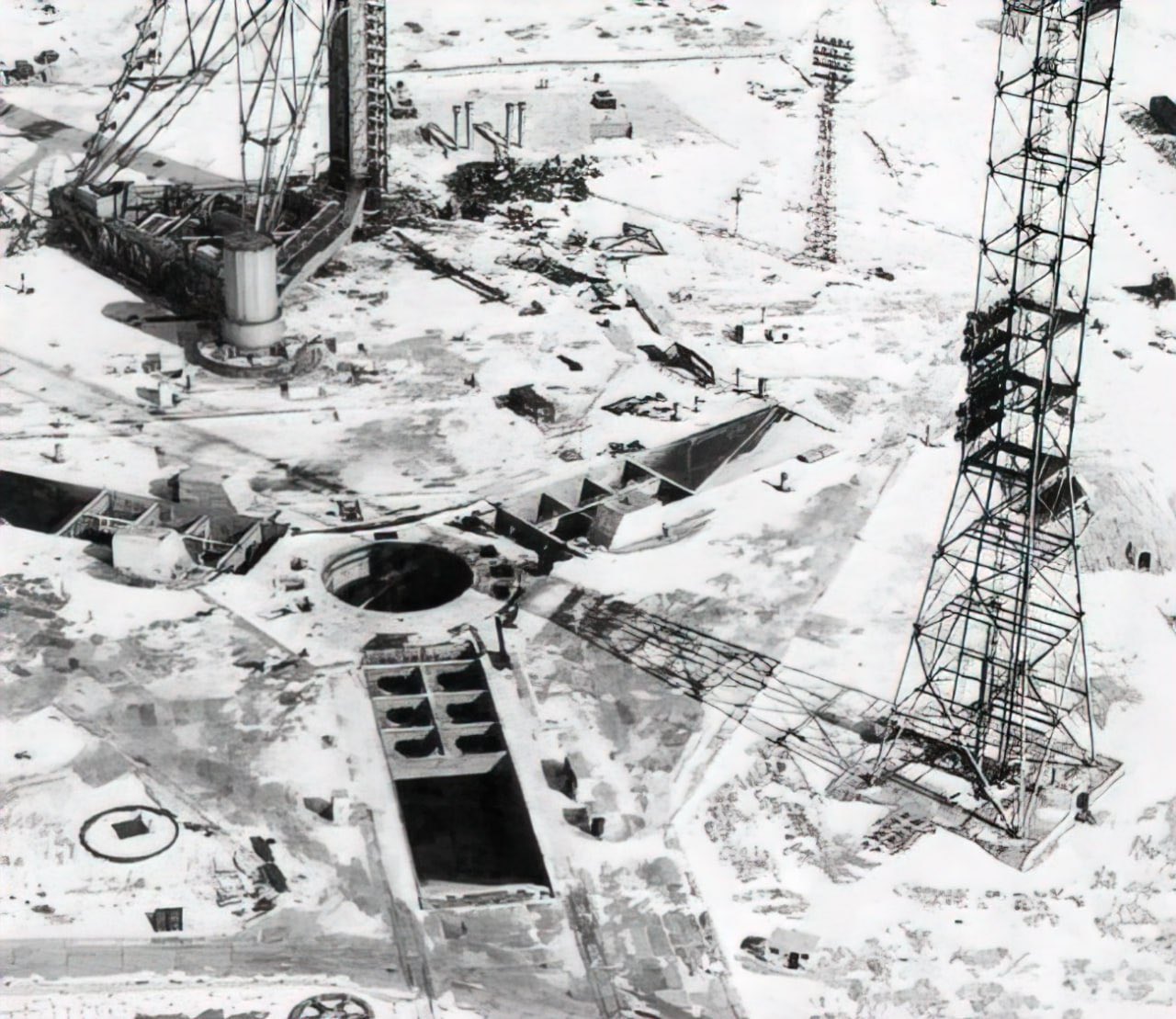
Someone needs to say this: the N1 pads had a much superior "exhaust management".
FuVHPzrXsAEU2BZ.jpg:large
 

Someone needs to say this: the N1 pads had a much superior "exhaust management".
Has there been some kind of spike in the center?
For Saturn V a 2-sided ramp was used to deflect the exhaust without building up too much static pressure. But maybe Elon knows it better than these old engineers :unsure:
 
Someone needs to say this: the N1 pads had a much superior "exhaust management".
FuVHPzrXsAEU2BZ.jpg:large
True, but Boca Chica is pretty much right at the water table and so they really can't dig a trench below grade (not on purpose, anyway). If they were to do a flame trench they'd have to build up a hill something like the 39A/B pads at KSC, and I don't think they can make such a large ramp on the existing site footprint.

I really wonder if LC-39A and B could be built today with existing environmental regulations.
 
Why not mount the launch platform over a basin? Maybe less good for accessibility, but the problem would be solved.
 
Other possible solutions to the flame deflector conundrum:
  • hang the rocket high on the tower
  • put the launch mount on top of the tower
  • launch the rocket with the engines off
 
Other possible solutions to the flame deflector conundrum:
  • hang the rocket high on the tower
  • put the launch mount on top of the tower
  • launch the rocket with the engines off

Everyone has it backwards. We should push the Earth farther away from the rocket, not push the rocket away from Earth!

Seriously, there is the precedent of the Saturn IB milkstool launch, but that wasn't for flame trench issues, but to align tower umbilicals for a smaller Saturn stack.

Other very valid potential solutions

*Lift the rocket with balloons and air launch it.
*Call SpinLaunch and ask for a quote for a new Stage 0. Just have to sling the stack a couple of stack heights above the ground before firing.
*Fire it out of a tube with compressed air first. What could go wrong?
 
Why not push Earth away by about 20 km and than start the engines?
 
Why not push Earth away by about 20 km and than start the engines?
If the moon and Mars weren't so far away in the first place this wouldn't be a problem at all.

We choose to go to the moon not because it is easy, but because bringing the moon to Earth would be harder.
 
Back
Top