

Looks like I would need to join their forums too, as she has misquoted me about a possible future plan of a Chinese asteroid orbiter in the 2020s. :lol:



2013-07-14
China's space probe Chang'e-2 has flew to an outer space about 50 million km from the Earth, marking a new height in the nation's deep space exploration, Chinese scientists said on Sunday.
The probe, which is now "in good conditions", reached the height at around 1 a.m. Sunday Beijing Time, the State Administration of Science, Technology and Industry for National Defence(SASTIND) said in a statement.
Chang'e-2 will be able to travel to a distance as far as 300 million km away from Earth, according to calculations done by scientists from the Beijing Aerospace Control Center.
Chang'e-2 was launched on Oct. 1, 2010 from Xichang Satellite Launch Center in southwest China and later orbited the moon to finish a more extensive probe than its predecessor Chang'e-1.
On June 9, 2011, after finishing its lunar objectives, Chang'e-2 left its lunar orbit for an extended mission to the Earth-Sun L2 Lagrangian point.
Since its blast-off, Chang'e-2 has made multi-faceted achievements: being the first to capture full coverage map of the moon with a resolution of seven meters; being the first object ever to reach the L2 point directly from lunar orbit.
On December 13, 2012, the probe flew by Toutatis, an asteroid about seven million km away from the Earth, making China the fourth after the United States, the European Union and Japan to be able to examine an asteroid by spacecraft.
Chang'e-2's extended missions, which were conducted millions of km away from Earth, have tested China's spacecraft tracking and control network, including two newly built measuring and control stations in the northwest Xinjiang Uygur Autonomous Region and northeast Heilongjiang province, sources with the SASTIND said in an interview in December 2012.
http://news.xinhuanet.com/english/china/2013-07/14/c_125005864.htm
2013-11-26
Lunar probe Chang'e-2 is more than 60 million kilometers away from Earth and has become China's first man-made asteroid, a spokesperson said Tuesday.
Still in good condition, Chang'e-2 is heading for deep space and is expected to travel as far as 300 million km from Earth, the longest voyage of any Chinese spacecraft, Wu Zhijian of the State Administration for Science, Technology and Industry for National Defence (SASTIND) told reporters at a press conference.
In comparison, the shortest distance between Earth and the Mars is about 55 million km, and the longest 400 million km. NASA confirmed in September that Voyager-1, launched in 1977, had left the solar system and was over 18.7 billion km away from Earth.
Launched on Oct. 1, 2010, Chang'e-2 was designed for half a year of service but has kept working for over three years. The probe verified some crucial technologies for Chang'e-3 and reconnoitered the landing area. It also made the world's first lunar holographic image with a resolution of 7 meters, Wu said.
Chang'e-2 and Chang'e-3 are part of the second stage of China's three-stage lunar mission: orbiting, landing, and return.
http://news.xinhuanet.com/english/china/2013-11/26/c_132918832.htm
2014-02-14
China's second lunar probe, Chang'e-2, has traveled more than 70 million km into deep space in good condition, so far the longest voyage of a Chinese spacecraft, a senior engineer said Friday.
Chang'e-2 was launched on Oct. 1, 2010 to verify crucial technologies for Chang'e-3. It set off from its moon orbit for outer space in June 2011 after finishing all of its tasks.
Chang'e-2 is expected to travel as far as 300 million km from the earth, after which it will return to perigee of about 7 million km from the earth around 2029, said Zhou Jianliang, chief engineer of the Beijing Aerospace Control Center.
The probe will reach 100 million km from Earth in July of this year.
The control center has made many breakthroughs in fuel use and orbital decay technologies, which will boost China's future deep space exploration, Zhou said.
http://news.xinhuanet.com/english/china/2014-02/14/c_133116427.htm
2014-10-30
China's second lunar probe, Chang'e-2, was 100 million km into deep space in July, the longest journey of ant Chinese spacecraft, a senior engineer said Thursday.
The lunar probe, launched on Oct. 1, 2010, has extended its service by several years and remains in good condition, Zhou Jianliang, chief engineer of the Beijing Aerospace Control Center told Xinhua.
Chang'e-2 tested technology for Chang'e-3, the landing mission. It left lunar orbit for outer space in June 2011 after completing all of its tasks.
Chang'e-2 is expected to travel as far as 300 million km from the earth, after which it will return to about 7 million km from the earth around 2029.
Chinese space scientists are currently awaiting for the return of an experimental lunar orbiter, set for Nov. 1. The orbiter, launched Friday last week atop a Long March-3C rocket, has escaped lunar gravity and is approaching the Earth after 114 hours of space flight.
There are a few challenges on the way home, Zhou said. "The window for landing is very small and requires a highly sophisticated TT&C (telemetry, tracking and command) system," he said.
The test orbiter will maneuver on the edge of the Earth's atmosphere to slow from a speed of 11.2 kilometers per second before re-entry, a process that generates extremely high temperatures.
It is a test run for Chang'e-5, China's fourth lunar probe intended to fetch samples from the lunar surface.
http://news.xinhuanet.com/english/china/2014-10/30/c_133754585.htm
May 08, 2015

WJ297AD = Chang'e 2 r/b. Images (c) Peter Starr, Australia
On 7 May 2015 near 7:35 UT, the Catalina Sky Survey (MPC 703) in Arizona detected a bright mag. +17 fast moving object moving at about 12"/minute through Virgo. The object was reported as a potential Near Earth Asteroid and entered the NEO Confirmation Page (NEOCP) of the IAU's Minor Planet Center with temporary NEOCP designation WJ297AD.
Some 6 hours later, Peter Starr at Warrumbungle Observatory (MPC Q65) in Australia targetted the object with his 0.51-m Dall-Kirkham telescope, in order to confirm it and obtain more positions.
As he often does with NEOCP objects he images, Peter sent the imagery to me for astrometric processing.

image (c) Peter Starr. Click image to enlarge
After I measured the images (a part of one is shown above, showing the object as a short trail amidst the stars) and tried to fit an orbit to the astrometry obtained from Peter's images and the Catalina Sky Survey observations, the result was odd.
FindOrb suggested that this object was in orbit around the Earth, in a trans-lunar orbit with perigeum at 352 666 +/- 426 km, apogeum at 552 356 +/- 934 km, an orbital inclination of 41 degrees and an orbital period around the Earth of 35 days! The MPC itself, fitting several preliminary orbits, also presented solutions pointing to an object in an odd, very earth-like orbit with semi-major axis about 1.05 AU and a heliocentric orbital period of ~1.0 year.
At that time, after an initial "Huh? That's odd..." I already developed some feeling that this might perhaps be an artificial object, if this fit was not spurious. I was not sure though (preliminary orbit fits to small observational arcs can come out weird on occasion), so I sent Peter an e-mail mentioning that it was a "weird object that seems to be in a very Earth-like orbit".
Meanwhile, another asteroid observer, Jacques Cristovao, also thought that this NEOCP object was odd. Around the time Peter was doing his observations from Warrumbungle, Cristovao suggested in a message on the Minor Planet Mailing List that the object was artificial, and specifically was 2010-050B, the upper stage of the Chinese Chang'e 2 Lunar probe.
That turned out to be correct: WJ297AD indeed is the rocket stage from this launch.
This rocket stage moves in a very wide translunar orbit with perigeum close to one lunar distance, and apogeum at almost twice the Earth-Moon distance. At the time of the observations it was near apogee at a distance of about 535 500 km, well beyond the moon at almost twice the Earth-Moon distance.
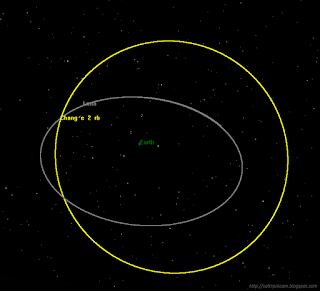
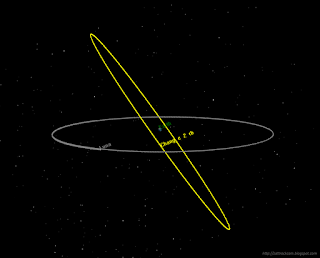
Chang'e 2 orbit in the Earth-Moon system (based on May 7 observations)
The rocket stage was used to bring the second Chinese Lunar mission, Chang'e 2, into a temporary orbit around the moon. Chang'e 2 itself later left the Earth-Moon system for a journey to asteroid Toutatis, but the rocket stage it left behind is still in orbit around the Earth-Moon barycenter.
It was not the first time that the Chang'e 2 rocket was initially confused with a Near Earth Asteroid. The same happened in 2013 when the rocket was briefly known as 'asteroid' 2013 QW1.
These days, even the asteroids are Made in China....
http://sattrackcam.blogspot.nl/2015/05/an-asteroid-that-wasnt-chinese-change-2.html
Mon, 15 Jun 2015
Observations of the Chang'e 2 r/b in translunar orbit, made 'remote' with the
0.61-m telescope of Sierra Stars Observatory (MPC G68) in California.
Imaged at a distance of 430000-410000 km. As to the why: simply because it is
cool to do! And this is an extremely distant object not in the Space-Track
catalogue (it is in the MPC ART SAT database though).
Using Bill Gray's FindOrb and combining the above obs with the obs early May:
http://www.satobs.org/seesat/May-2015/0081.html
http://www.satobs.org/seesat/May-2015/0090.html
...I get this approximate orbit:
from 31 observations 2015 May 7-June 15; mean residual 0".690Code:Chang'e 2 rb 1 00000U 15166.00000000 .00000000 00000-0 00000-0 0 02 2 00000 40.5742 226.2289 2290925 168.2062 269.1615 0.03405342 00
Same observations in MPC format:Code:Perigee 2015 Jun 22.432600 +/- 0.000207 TT = 10:22:56 (JD 2457195.932600) Epoch 2015 Jun 15.0 TT = JDT 2457188.5 Find_Orb M 268.12214 +/- 0.0028 n 12.36146832 +/- 3.39e-5 Peri. 169.21724 +/- 0.0022 a 399843.583 +/- 0.732 Node 226.01125 +/- 0.00008 e 0.2300816 +/- 3.85e-6 Incl. 40.57546 +/- 0.00008 q 307846.914 +/- 1.44 Q 491840.253 +/- 2.04 km P 29.12d H 27.7
Code:NET UCAC-4 2010-050B C2015 06 14.28490 17 32 20.87 +26 59 34.9 15.1 R G68 2010-050B C2015 06 14.28536 17 32 21.48 +26 59 45.0 15.2 R G68 2010-050B C2015 06 14.28582 17 32 22.13 +26 59 55.3 15.3 R G68 2010-050B C2015 06 14.28628 17 32 22.72 +27 00 05.2 15.4 R G68 2010-050B C2015 06 15.28906 18 15 44.65 +32 09 31.9 15.9 R G68 2010-050B C2015 06 15.29091 18 15 47.84 +32 10 11.3 15.7 R G68 2010-050B C2015 06 15.29253 18 15 50.72 +32 10 45.6 15.8 R G68 2010-050B C2015 06 15.29439 18 15 53.91 +32 11 24.0 15.6 R G68
http://satobs.org/seesat/Jun-2015/0164.html
Monday, July 20, 2015

Recently, I have posted several times about my tracking of two extremely remote pieces of space junk: 2010-050B and 2013-070B, the CZ-3C upper stages of the Chinese Chang'e 2 and 3 Lunar missions. These orbit in orbits with (currently) perigee just within, and apogee beyond one Lunar distance, i.e. a trans-Lunar orbit.
In a recent post I discussed the tumbling behaviour of 2013-070B, the Chang'e 3 booster. At that time, I stated that by contrast the Chang'e 2 booster, 2010-050B, appears steady.
I can now say that is not true: 2010-050B is tumbling too. And very rapidly, which is why I didn't notice it earlier.
My earlier imaging sessions were done while 2010-050B was at well over one Lunar distance (beyond 400 000 km), towards its apogee. On July 18th I imaged it from MPC Q65 Warrumbungle while it was only a few hours from its perigee, at a distance of 280 000 km (about three quarter of a Lunar Distance), moving at 47" per minute. The result is a much longer trail on the image than in earlier imaging sessions.
Rather than being a trail, suddenly the trail is resolved in a series of dots: typically three (and in one image two) per 30 second exposure. See the image in the top of this post. The reason this was not visible during earlier imaging sessions, was that the trail was so short (a few arcsecs) when imaging the object at larger distance, that the dots merge into one trail.
The 3 dots per image, and once two dots, indicate a flash period of ~15 seconds, testifying to a rapid tumble. This is close to the period determined by Peter Birthwhistle (MPC J95 Great Shefford) in 2010 shortly after the launch.
I also imaged 2013-070B that night, at a distance of about 479 000 km (1.25 Lunar Distances). This object is tumbling much slower than 2010-050B: the brightness variation in the animated GIF below fits nicely with the 7m 05s flash period determined from June 26 and July 5.

The orbits of 2010-050B and 2013-070B are changing extremely fast, in a chaotic way, notably as a result of Lunar perturbations. As you can see in the table that is part of my SeeSat-List post here, the apogee of the 2010-050B orbit for example changed from about 550 000 km to about 446 000 km between May 7 and July 18. The perigee changed from about 350 000 km to about 280 000 km, i.e. from about 1 Lunar Distance to about 0.73 Lunar Distance, during that same period. The orbital period was shortened by almost 10 days.
While the apogee and perigee distances are currently decreasing for this object, a new Lunar perturbation might make them increase again in the future. The orbital inclination also widely varies over time. Such changes are very sudden, especially in connection to close Lunar encounters. These objects are on a true Rollercoaster ride through the Earth-Moon system.
As it turns out, this kind of chaotic orbit is very difficult to model, even over relatively short time scales. Attempts using GMAT show that very small variations in the determined orbit yield very different outcomes within only a few years. Variations in the order of a few hundred meters (!) in apogee and perigee will already do it, i.e. variations well within the uncertainties in the determined orbital parameters.
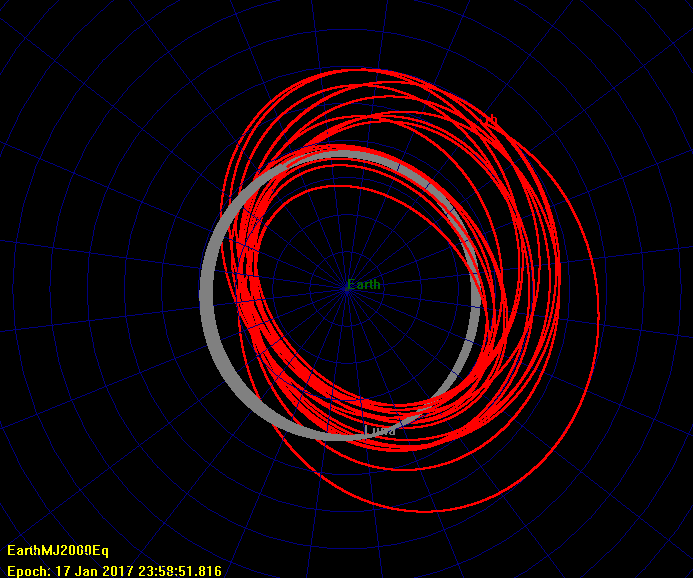

GMAT-simulated chaotic orbital evolution of 2010-050B over a 1.5 year period. Grey is the Moon orbit, red is 2010-050B orbit, blue grid is earth equatorial plane. In reality, the orbital evolution might be different as small variations in initial conditions (see text) yield large differences after 1.5 years.
So we have to observe these objects to see how their orbits evolve in the future. And this is what I will do: keep following them, over the coming years.
Basically, three eventual future fates are possible for these objects: one is eventual ejection into a Heliocentric orbit (so it will leave the Earth-Moon system); two is an eventual Earth impact (i.e. a decay in the Earth atmosphere); and three is an impact on the moon.
Labels: 2010-050B, 2013-070B, Chang'e, Chang'e 2, Chang'e 2 rb, Chang'e 3, Chang'e 3 rb, flashing
http://sattrackcam.blogspot.nl/2015/07/rapid-tumbling-of-change-2-rb-2010-050b.html
http://moon.bao.ac.cn/WEBDATA/CLEPWebMaps/CEAtlas/CE2/atlas/XXX-large.jpg


